
Original text
ॐ जय श्री श्याम हरे, बाबा जय श्री श्याम हरे । खाटू धाम विराजत, अनुपम रूप धरे ॥ ॐ जय श्री श्याम हरे, बाबा जय श्री श्याम हरे । रतन जड़ित सिंहासन, सिर पर चंवर ढुरे । तन केसरिया बागो, कुण्डल श्रवण पड़े ॥ ॐ जय श्री श्याम हरे, बाबा जय श्री श्याम हरे । गल पुष्पों की माला, सिर पार मुकुट धरे । खेवत धूप अग्नि पर, दीपक ज्योति जले ॥ ॐ जय श्री श्याम हरे, बाबा जय श्री श्याम हरे । मोदक खीर चूरमा, सुवरण थाल भरे । सेवक भोग लगावत, सेवा नित्य करे ॥ ॐ जय श्री श्याम हरे, बाबा जय श्री श्याम हरे । झांझ कटोरा और घडियावल, शंख मृदंग घुरे । भक्त आरती गावे, जय-जयकार करे ॥ ॐ जय श्री श्याम हरे, बाबा जय श्री श्याम हरे । जो ध्यावे फल पावे, सब दुःख से उबरे । सेवक जन निज मुख से, श्री श्याम-श्याम उचरे ॥ ॐ जय श्री श्याम हरे, बाबा जय श्री श्याम हरे । श्री श्याम बिहारी जी की आरती, जो कोई नर गावे । कहत भक्त-जन, मनवांछित फल पावे ॥ ॐ जय श्री श्याम हरे, बाबा जय श्री श्याम हरे । जय श्री श्याम हरे, बाबा जी श्री श्याम हरे । निज भक्तों के तुमने, पूरण काज करे ॥ ॐ जय श्री श्याम हरे, बाबा जय श्री श्याम हरे । ॐ जय श्री श्याम हरे, बाबा जय श्री श्याम हरे। खाटू धाम विराजत, अनुपम रूप धरे ॥ ॐ जय श्री श्याम हरे, बाबा जय श्री श्याम हरे ।
Transliteration
Om Jai Shri Shyam Hare, Baba Jai Shri Shyam Hare. Khatu Dham Virajat, Anupam Roop Dhare. (Refrain) Ratan Jadit Singhasan, Sir Par Chanvar Dhure. Tan Kesariya Bago, Kundal Shravan Pade. (Refrain) Gal Pushpon Ki Mala, Sir Par Mukut Dhare. Khevat Dhoop Agni Par, Deepak Jyoti Jale. (Refrain) Modak Kheer Churma, Suvaran Thaal Bhare. Sevak Bhog Lagavat, Seva Nitya Kare. (Refrain) Jhanjh Katora Aur Ghadiyaval, Shankh Mridang Ghure. Bhakt Aarti Gave, Jai-Jaikar Kare. (Refrain) Jo Dhyave Phal Pave, Sab Dukh Se Ubare. Sevak Jan Nij Mukh Se, Shri Shyam-Shyam Uchare. (Refrain) Shri Shyam Bihari Ji Ki Aarti, Jo Koi Nar Gave. Kahat Bhakt-Jan, Manvanchhit Phal Pave. (Refrain) Jai Shri Shyam Hare, Baba Ji Shri Shyam Hare. Nij Bhakton Ke Tumne, Puran Kaaj Kare. (Refrain) Om Jai Shri Shyam Hare, Baba Jai Shri Shyam Hare. Khatu Dham Virajat, Anupam Roop Dhare.
An aarti that shows you the darbar
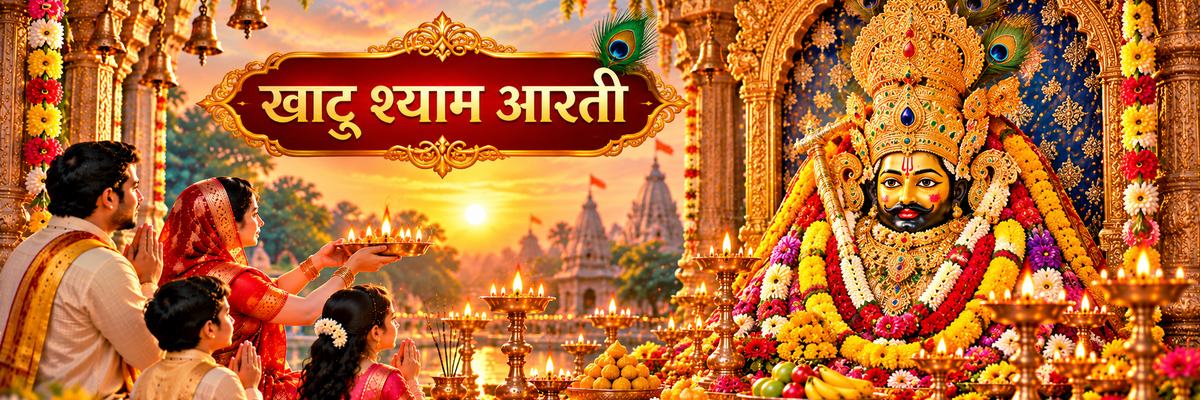
Many aartis are about a deity's deeds. This one is about his court. Sung to the tune and pattern of Om Jai Jagdish Hare, nearly every stanza describes what you would see standing before Baba Shyam's image at Khatu, the town in Sikar district, Rajasthan, where Barbarik's head is worshipped as Krishna's own form:
- He sits on a throne set with jewels, and a chanvar (whisk) waves over his head.
- He wears the kesariya bago, the saffron robe, with earrings and a garland of flowers. On his head is a crown, at Khatu the peacock-feather crown.
- Incense smokes on the coals and lamps burn.
- A golden platter (suvaran thaal) is filled with modak, kheer and churma, the Rajasthani crumbled wheat sweet that is Khatu's signature offering.
- Cymbals, a bell-bowl, the temple gong (ghadiyaval), conches and drums all sound together while the devotees sing and shout his victory.
The refrain names the place directly: Khatu Dham virajat, anupam roop dhare, "enthroned at Khatu Dham, in a form beyond compare".
Shyam, Hare, Bihari
The names in the aarti show how completely Khatu's deity is identified with Krishna. He is Shri Shyam Hare (Hare is a name of Vishnu-Krishna), and in the closing stanza he is Shri Shyam Bihari, the dark one who plays in Braj. The story behind this, told in the Khatu Shyam Chalisa, is that Krishna gave Barbarik his own name, Shyam, after Barbarik gave his head before the Mahabharata war. The aarti doesn't retell that story. It simply worships Shyam as present at Khatu. It also calls him Baba, the affectionate, familiar title his devotees use.
Its promises
The last stanzas are brief and confident. Whoever meditates on him gets the fruit and is lifted out of every sorrow, his servants keep "Shyam, Shyam" on their lips, whoever sings this aarti gets the fruit of their heart's desire, and he has always fulfilled the tasks of his own devotees. That last line matters to the many people who come to Khatu when something in their life has gone wrong. Shyam is known as haare ka sahara, the support of the defeated.
When it is sung
At the Khatu temple the deity receives a fixed round of aartis through the day, from the early-morning Mangla aarti to the Shayan aarti at night, and this aarti is sung at them. It is sung especially on Ekadashi and Dwadashi, during the great Phalgun mela (around Phalgun Shukla Ekadashi–Dwadashi), and at the night-long Shyam jagrans held in homes and community halls all over north India. At home, light a ghee lamp before his picture, offer whatever sweet you can (traditionally churma or kheer), and sing it at the end of the puja. Devotees often follow it with a vinati, a sung personal prayer to Shyam.
Spotted a mistake?
If you find any grammatical, Hindi, English, mantra-text or other mistake on this page, tell us — we will correct it within 24 hours.