
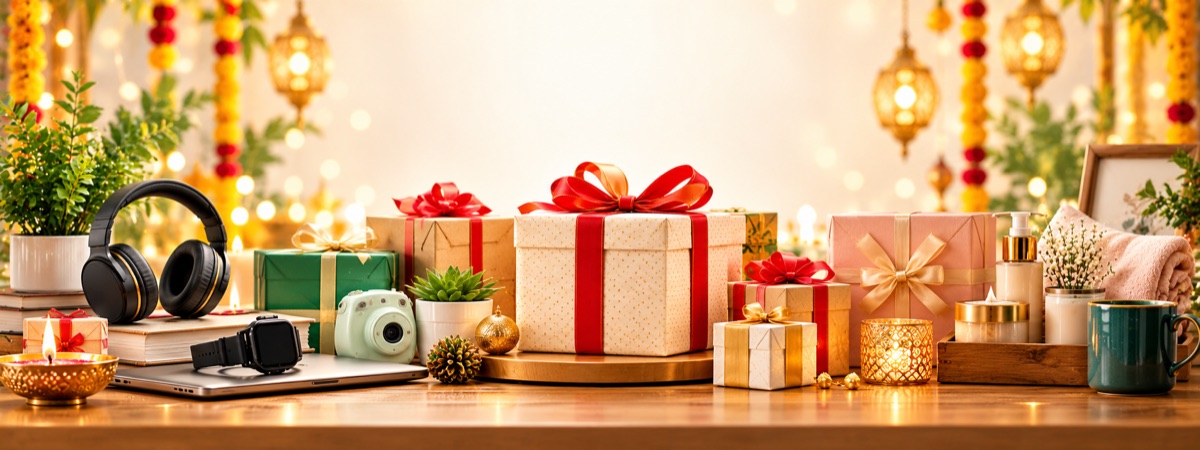
Why Diwali gifting is different
A Diwali gift is not a birthday present. It travels along a web of relationships: the box of sweets that goes to the neighbour, the dry fruits that go to a boss, the new clothes for the people who work in your home, the silver coin a grandmother keeps for the youngest grandchild. The gift says "we are still connected, and we wish you prosperity in the year ahead". That is why a modest but well-chosen gift almost always lands better than an expensive one picked in a hurry.
In 2026 the main dates are close together: Dhanteras on Friday, 6 November, Lakshmi Puja on Sunday, 8 November, Govardhan Puja on Tuesday, 10 November, and Bhai Dooj on Wednesday, 11 November. Most families exchange gifts in the week before Lakshmi Puja, and Bhai Dooj brings a second round between brothers and sisters. If anything has to be ordered, personalised or shipped to another city, the last week of October is the sensible time to do it.
Before you buy: three questions that make a list easier
- Who is it really for? A "family" gift for a household (a dry-fruit box, a brass diya set) is different from a personal gift for one person. Decide which you are giving, so you don't end up buying ten personal gifts where one shared one would do.
- Will they use it after Diwali? Decorative items peak for a week. Things that are used every day (a good water bottle, a shawl, a cookbook, a plant) remind people of you for months.
- Is it allowed in their home? Some families avoid leather in the puja season, some are strictly vegetarian, some don't keep anything with alcohol. When unsure, sweets, dry fruits, diyas and plants are safe almost everywhere.
For parents, grandparents and elders
Elders usually say they need nothing, and mean it. What they enjoy is comfort, health and something that connects them to the festival.
- A soft woollen shawl or stole (roughly ₹800–₹3,000). Diwali comes as the evenings turn cool in North India, so it is used immediately.
- A brass or copper puja set: a thali, a diya, a small kalash or an aarti stand. Choose solid, plain brass that will polish up for years, not lacquered pieces.
- A large-print book of the Hanuman Chalisa, Sundarkand or Bhagavad Gita, or a gutka they can carry. Check the font size in person if you can; it matters more than the binding.
- Health that doesn't feel clinical: a foot massager, a good pair of slippers with grip, a pill organiser in brass rather than plastic.
- Time: book a day to take them to a temple or to visit an old friend. For many parents this is the gift they talk about afterwards.
For tech lovers
Gadgets make easy gifts but are easy to get wrong, because tech-minded people usually already own the obvious thing. Aim for accessories that improve what they already use.
- A fast charger or a compact power bank (₹1,000–₹3,000) that matches their phone's charging standard. Check whether they use USB-C before you buy.
- A smart plug to run Diwali lights on a schedule. It's useful on the festival night and every evening afterwards.
- Wireless earbuds or a small Bluetooth speaker for the person who plays bhajans while cooking.
- An e-reader or a subscription to an audiobook or music app. For an older relative, set it up with a few bhajans or a recorded katha before you hand it over.
- A digital photo frame loaded with family photographs. This one bridges the generations, and grandparents love it.
Avoid buying the main device (a phone, a laptop) as a surprise. People have strong preferences; a gift card or simply offering to pay part of it is kinder.
Budget-friendly finds (under ₹500)
A tight budget is not a problem at Diwali. Many of the most traditional gifts are also the least expensive.
- Hand-painted clay diyas in a set of six or twelve, bought from a local potter.
- A small box of homemade sweets or namkeen: besan laddoo, shakkarpara, mathri. Packed in a steel dabba, it doubles as a gift that gets used again.
- A tulsi or money plant in a clay pot with a handwritten tag.
- Rangoli colours and stencils for a family with children.
- Scented candles or a sandalwood incense set for colleagues.
Eco-conscious picks
For people who wince at plastic wrapping and single-use decorations:
- Cow-dung or clay diyas that dissolve or can be reused.
- Seed paper cards that can be planted after reading.
- Jute or cloth bags instead of gift bags, which become the shopping bag of the next six months.
- Handloom textiles: a cotton saree, a khadi kurta, a block-printed table runner. Buying directly from weavers' cooperatives or Khadi outlets keeps more of the money with the people who made it.
- Beeswax or soy candles in place of paraffin ones.
For children
- Illustrated story books of the Ramayana, Krishna's childhood or the Panchatantra. Children who know why Diwali is celebrated enjoy it more.
- A rangoli or diya-painting kit: plain clay diyas, non-toxic paints and brushes. It keeps them busy on the afternoon of Lakshmi Puja.
- Board games the whole family can play during the holidays.
- A small piggy bank with the first coin inside. It's an old Dhanteras tradition, and a gentle first lesson in saving.
Instead of firecrackers, which many cities restrict, consider sparkler-free activity kits. Always check your local rules before buying any crackers for children.
For colleagues, clients and the people who help at home
Office gifts should be useful and neutral: a dry-fruit box, a plant, a good notebook and pen, a set of tea. Avoid anything too personal (perfume, clothes) for people you don't know well.
For the people who help in your home (house help, drivers, security staff, the newspaper delivery person), the tradition of Diwali bonus or bakshish runs deep. Cash or a month's extra wage is usually the most helpful gift, given with sweets and, if you can, new clothes for their family. Give it a few days before Diwali, not on the day, so they can use it for their own celebration.
For a new home or a newly married couple
Diwali is often the first big festival in a new home or after a wedding. Good choices are a brass Lakshmi–Ganesha pair for the home mandir (see our guide to placing murtis in the home mandir), a set of brass or copper diyas, a toran for the main door, or a silver coin with Lakshmi on it. Everything here gets used on Lakshmi Puja night itself.
Gifts many families avoid
Customs vary by region and community, and none of these is a scriptural rule, but you will find many families uncomfortable with:
- Sharp objects (knives, scissors): an old belief says they "cut" relationships.
- Black clothes in a festive season associated with light.
- Empty wallets or purses: put a coin or a note inside before giving one.
- Handkerchiefs are associated with tears in some regions.
- Clocks: some see them as marking time running out.
If you know the person well and they don't hold such beliefs, there's no harm. When in doubt, choose something else.
Wrapping and giving it well
- Use cloth, newspaper decorated by children, or plain kraft paper with a marigold tucked under the string.
- Write a card by hand. Two lines in your own handwriting do more than an expensive box.
- Give with the right hand, or both hands, to elders, and touch their feet if that is your family's custom.
- When you visit, carry sweets even if you have a separate gift. It's the expected greeting.
Frequently asked questions
When should Diwali gifts be given in 2026?
Most gifting happens in the days before Lakshmi Puja on Sunday, 8 November 2026. Gifts for staff and service people are best given a few days earlier, so they can use them for their own Diwali. Bhai Dooj gifts are exchanged on Wednesday, 11 November.
Is it auspicious to gift gold or silver on Dhanteras?
Buying gold, silver or new metal utensils on Dhanteras (6 November 2026) is a widespread custom, and a silver coin is a classic gift for that day. You don't have to buy precious metal; brass and steel utensils are also traditional. Our Dhanteras guide explains what is bought and why.
What is a good Diwali gift under ₹500?
Hand-painted clay diyas, homemade sweets in a reusable steel box, a tulsi or money plant, rangoli kits and sandalwood incense sets are all good choices under ₹500.
Can I give cash as a Diwali gift?
Yes. Cash in an envelope (shagun) is completely traditional, especially from elders to children and to people who work in your home. Many families add one rupee to make the amount uneven (₹101, ₹501), symbolising growth.
What should I gift colleagues for Diwali?
Neutral, shareable gifts are best: dry fruits, a plant, a tea or coffee set, a good notebook, or scented candles. Avoid clothing, perfume, and anything with alcohol unless you know the person well.
Are there gifts that should not be given at Diwali?
Many families avoid knives and scissors, black clothes, empty wallets, handkerchiefs and clocks. These are regional beliefs, not scriptural rules, so follow what the receiving family is comfortable with.
How can I make a Diwali gift eco-friendly?
Choose clay or cow-dung diyas, handloom textiles, plants and seed paper cards, and wrap with cloth or kraft paper instead of plastic and glitter.
Was this article helpful?
Spotted a mistake?
If you find any grammatical, Hindi, English, mantra-text or other mistake on this page, tell us — we will correct it within 24 hours.
Related content
- What to Buy and Avoid on Dhanteras 2026? Zodiac-wise Shopping, 3 Coriander Remedies and Yama DeepamPublished10 min read
- Diwali 2026 Laxmi Puja Vidhi: A Step-by-Step Guide to Welcoming Mahalakshmi at Home and at Your Shop or OfficePublished10 min read
- Bhai Dooj 2026: Auspicious Tilak Timing, Direction, and the Story of Yama and YamunaPublished8 min read
- Vastu Rules for Idols and Pictures in the Home Mandir: What Not to Keep Together, and What to Do With a Broken IdolPublished9 min read