
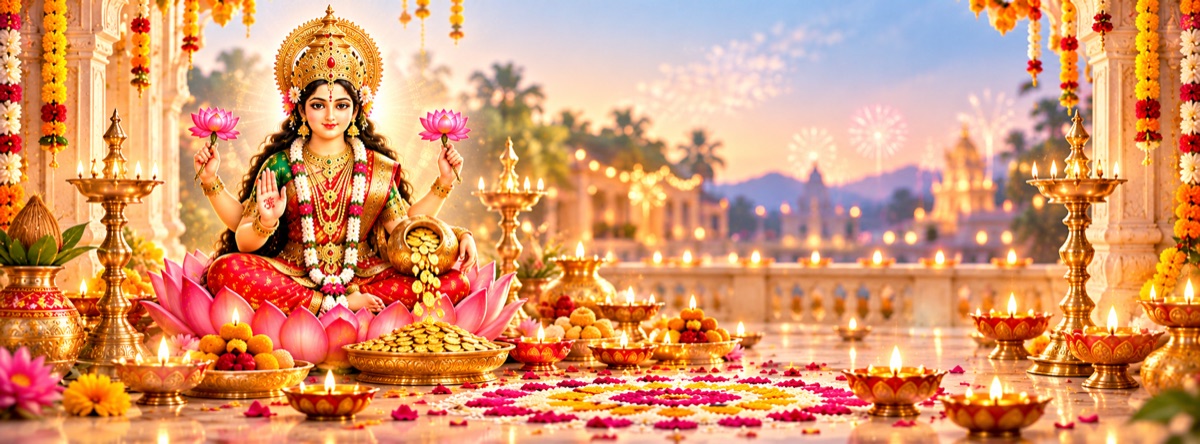
Diwali 2026: date and muhurat
Diwali's Lakshmi Puja is done on Kartik Amavasya, the new-moon night, in the evening when Amavasya is current. In 2026 that is Sunday, 8 November.
- Lakshmi Puja muhurat: 5:54 pm to 7:50 pm (1 hour 56 minutes)
- Pradosh kaal: 5:31 pm to 8:09 pm
- Vrishabha kaal (sthir lagna): 5:54 pm to 7:50 pm
- Nishita kaal (Mahanishita): 11:39 pm to 12:31 am (night of 8–9 November)
- Simha kaal (sthir lagna): 12:25 am to 2:42 am (night of 8–9 November)
- Amavasya tithi: 11:27 am on 8 November to 12:31 pm on 9 November
These timings are for New Delhi.
Pradosh kaal or Nishita kaal: which should you choose?
Households do the main puja in Pradosh kaal, the period after sunset, and the best part of it is the Vrishabha lagna, a sthir (fixed) lagna. The idea is simple and old: Lakshmi is called chanchala, restless, and a fixed lagna is believed to make her stay. In 2026 the Vrishabha lagna falls entirely inside Pradosh kaal in Delhi, which gives a clean, easy window of almost two hours.
Nishita kaal, around midnight, is for those who do tantric or Kali worship, or a second, quieter Lakshmi sadhana with japa. Most families don't need it. Some do a short puja and keep the main lamp burning through Nishita kaal, so the house is lit when Lakshmi is believed to walk the earth.
Lakshmi Puja muhurat in other cities, 8 November 2026
| City | Lakshmi Puja muhurat |
|---|---|
| New Delhi | 5:54 – 7:50 pm |
| Noida | 5:54 – 7:49 pm |
| Gurgaon | 5:55 – 7:51 pm |
| Chandigarh | 5:52 – 7:46 pm |
| Jaipur | 6:03 – 7:59 pm |
| Kolkata | 5:20 – 7:18 pm |
| Ahmedabad | 6:22 – 8:20 pm |
| Mumbai | 6:27 – 8:27 pm |
| Pune | 6:24 – 8:24 pm |
| Hyderabad | 6:07 – 8:08 pm |
| Bengaluru | 6:17 – 8:20 pm |
| Chennai | 6:07 – 8:09 pm |
Choghadiya muhurats for shops and offices (Delhi)
Businesses that open their new books during the day or late at night often use the choghadiya instead. On 8 November 2026 in Delhi:
- Morning (Char, Labh, Amrit): 11:27 am to 12:05 pm
- Afternoon (Shubh): 1:26 pm to 2:48 pm
- Evening (Shubh, Amrit, Char): 5:31 pm to 10:27 pm
- Night (Labh): 1:43 am to 3:22 am, 9 November
- Early morning (Shubh): 5:00 am to 6:39 am, 9 November
The morning window begins only at 11:27 am because Amavasya starts then. Our choghadiya guide explains how these periods are worked out.
Placing Lakshmi, Ganesh and Saraswati
This is the question families argue over every year, so here is what the tradition actually agrees on, and where it differs.
What everyone agrees on:
- Ganesh is worshipped first and sits beside Lakshmi, never behind her or below her.
- The deities sit on a chowki (low wooden stool) covered with red or yellow cloth, raised above the floor.
- The chowki is placed so that you face east or north while you worship. The north-east corner of the home or shop is the preferred place.
- Seated idols are used for Lakshmi, not standing ones, for the same reason as the fixed lagna: a seated Lakshmi stays.
The most common arrangement, and the one printed on the Diwali puja pictures sold in every market, is, from left to right as you face the altar: Ganesh, then Lakshmi in the centre, then Saraswati. Ganesh is then on Lakshmi's right hand, the place of honour, and Saraswati on her left.
Many families keep only Ganesh and Lakshmi. In that case the most widely followed custom is that Lakshmi sits on Ganesh's right side, which means, as you face them, Lakshmi on your left and Ganesh on your right. Some families and some regions reverse this. If your family has a set arrangement, keep it; the puja is complete either way. Kuber, or a symbol of him such as a coin box, is placed near Lakshmi, and the kalash on the right side of the chowki as you face it.
Puja samagri checklist
For the altar
- Wooden chowki, red or yellow cloth
- Seated idols or a picture of Lakshmi and Ganesh (and Saraswati if you keep her); a Kuber yantra or coin box if you use one
- Kalash of copper or brass, with water, mango leaves, a coconut wrapped in red cloth and tied with kalava
- A small heap of rice or wheat for the kalash to sit on
For the worship
- Roli or kumkum, haldi, chandan, akshat (unbroken rice), kalava
- Ganga jal, panchamrit (milk, curd, ghee, honey, sugar)
- Lotus or red flowers, marigold garlands, durva grass for Ganesh
- Paan leaves, supari, cloves, cardamom, coins
- Kheel and batasha, sweets, seasonal fruit (singhara, sugarcane, ber in many regions), dry fruit
- Silver coin or jewellery bought on Dhanteras, gomti chakra, cowrie shells, whole coriander
- Incense, camphor, cotton wicks, ghee
For the lamps
- One large ghee lamp to burn through the night (the akhand or main lamp)
- Earthen diyas with mustard oil for the house, the doors and the courtyard; 11, 21 or more
For a shop or office
- New bahi-khata (account books), a new pen or inkpot, the cash box or safe (tijori)
- Your scales, cash register, laptop or tools of trade
Lakshmi Puja vidhi at home, step by step
- During the day. Finish cleaning the house, draw a rangoli at the door, and hang a toran of mango leaves and marigold. Draw small footprints of Lakshmi entering the house, from the door towards the puja place, with rice paste or kumkum. Bathe and wear clean, preferably new, clothes before the muhurat.
- Set up the altar as described above, with all the samagri within reach.
- Purify and take the sankalp. Sprinkle Ganga jal on yourself, the place and the samagri. With water, akshat and a flower in your right hand, state your name, gotra, the place and the date, and your resolve to worship Mahalakshmi for the family's well-being. Release the water at the chowki.
- Kalash puja. Worship the kalash with roli, akshat and a flower, inviting the sacred rivers and the deities into it.
- Ganesh puja. Offer Ganesh water, roli, akshat, durva, flowers, a modak or laddoo, and light incense and a lamp. Our Ganesh puja vidhi has the full method.
- Lakshmi puja. Bathe the idol or a silver coin of Lakshmi with panchamrit and then clean water (or sprinkle them if it is a picture). Offer red cloth or a chunri, kumkum, akshat, lotus or red flowers, the Dhanteras jewellery or coin, kheel-batasha, sweets and fruit. Offer paan, supari and dakshina. Chant Om Shreem Mahalakshmyai Namah 108 times, or read the Mahalakshmi Ashtakam or Lakshmi Chalisa. The detailed sixteen-step form is in our Lakshmi puja vidhi.
- Saraswati and Kuber. Offer flowers and akshat to Saraswati and to your books or pens, and to Kuber or the cash box.
- Deep puja. Worship the thali of diyas with roli and akshat, light the main ghee lamp, then light the diyas and place them through the house: the main door first, then the kitchen, the water source, the tulsi, the rooftop and every room. Leave one at the threshold for Lakshmi to find her way.
- Aarti. Do the aarti of Ganesh first with the Ganesh aarti, then of Lakshmi with Om Jai Lakshmi Mata. Take the aarti to every member of the family.
- Kshama prarthana and prasad. Ask forgiveness for any mistake in the puja, then share the prasad. Touch the feet of elders.
- Through the night. Keep the main lamp burning, and in many homes, a door or window open for Lakshmi. Don't sweep the house after the puja that night.
The extra steps for a shop or office
- Clean and decorate the premises during the day: wash the floor, put up a toran, and draw a swastik in kumkum on the entrance and the cash box.
- Set up the altar near the cash counter or in the north-east, with the new bahi-khata, a pen and the tijori in front of the deities.
- Worship Ganesh and Lakshmi as at home.
- Chopda pujan (sharda puja). On the first page of the new account book, draw a swastik in kumkum and write Shri (often as a pyramid of five or more Shris) and Shubh-Labh. Worship the book with roli, akshat and flowers as a form of Saraswati, and the pen with it. Write the first entry, or simply the date, during the muhurat.
- Tijori and Kuber puja. Draw a swastik on the safe, worship it with roli and akshat, and place the Dhanteras coin, a few gomti chakras and a pouch of the worshipped coriander inside.
- Tools of trade. Do a short puja of the scales, the cash register, the computer or the machines, with roli and a flower.
- Aarti and sweets. Do the aarti with your staff, and share sweets with them and with your customers the next day.
Many businesses do this puja in the evening Pradosh kaal along with home; others use a daytime choghadiya and then go home for the family puja.
Common mistakes to avoid
- Placing Lakshmi without Ganesh, or worshipping her before him.
- Using a standing idol of Lakshmi, or a cracked or damaged idol.
- Starting the puja before Amavasya begins or after the evening muhurat has passed, unless you are following Nishita kaal on purpose.
- Letting the main lamp go out early, or leaving the puja place dark.
- Quarrelling, harsh words or heavy drinking in the house on Diwali night.
- Bursting crackers near the puja place or the idols while the puja is on.
Frequently asked questions
When is Diwali Lakshmi Puja in 2026?
Sunday, 8 November 2026. Amavasya begins at 11:27 am that day and ends at 12:31 pm on 9 November, so the evening puja is on 8 November.
What is the best Lakshmi Puja muhurat in 2026?
In Delhi, 5:54 pm to 7:50 pm, when the fixed Vrishabha lagna falls inside Pradosh kaal. For other cities, see the table above.
Which side should Ganesh be on, left or right of Lakshmi?
The most common custom places Lakshmi on Ganesh's right side, which puts Lakshmi on your left as you face the altar. On printed Diwali pictures with Saraswati, the order as you face them is Ganesh, Lakshmi, Saraswati. If your family has its own custom, keep it.
Can the old Lakshmi-Ganesh idols be used again?
Many families bring new clay idols every Diwali and immerse or respectfully keep the old ones. Metal idols or pictures that are worshipped daily are simply used again. A cracked or broken idol should not be used.
Can I do Lakshmi Puja without a pandit?
Yes. Most households do it themselves, and the vidhi above is written for that. A pandit is helpful for a large or formal puja, but sincerity matters more than the number of steps.
What should a shop owner write in the new bahi-khata?
A swastik in kumkum, Shri (often repeated in a pyramid), and Shubh-Labh on the first page, followed by the date. Some families also write Shri Ganeshaya Namah at the top.
Should the house be kept open all night on Diwali?
Many families keep the main lamp burning and a door or window open, as a welcome to Lakshmi. Keep the house safe, though: a closed door with a lit lamp at the threshold is just as traditional.
Can I do Lakshmi Puja in Nishita kaal instead of the evening?
Yes, if that is your family's practice, or if you are doing japa or a sadhana. In 2026 Nishita kaal in Delhi is 11:39 pm to 12:31 am. For most households the evening Pradosh muhurat is the main puja.
Was this article helpful?
Spotted a mistake?
If you find any grammatical, Hindi, English, mantra-text or other mistake on this page, tell us — we will correct it within 24 hours.
Related content
- Maa Lakshmi
- Maa Lakshmi Puja Vidhi: Friday Worship and Diwali Night
- Ganesh Puja Vidhi: Wednesday, Chaturthi and Everyday Worship
- Om Jai Lakshmi Mata
- Ganesh Aarti
- Mahalakshmi Ashtakam – Namaste'stu Mahamaye
- Lakshmi Chalisa
- Om Shreem Mahalakshmyai Namah (Lakshmi Beej Mantra)
- Choghadiya: Reading the Day's Good and Bad Hours
- Diwali