
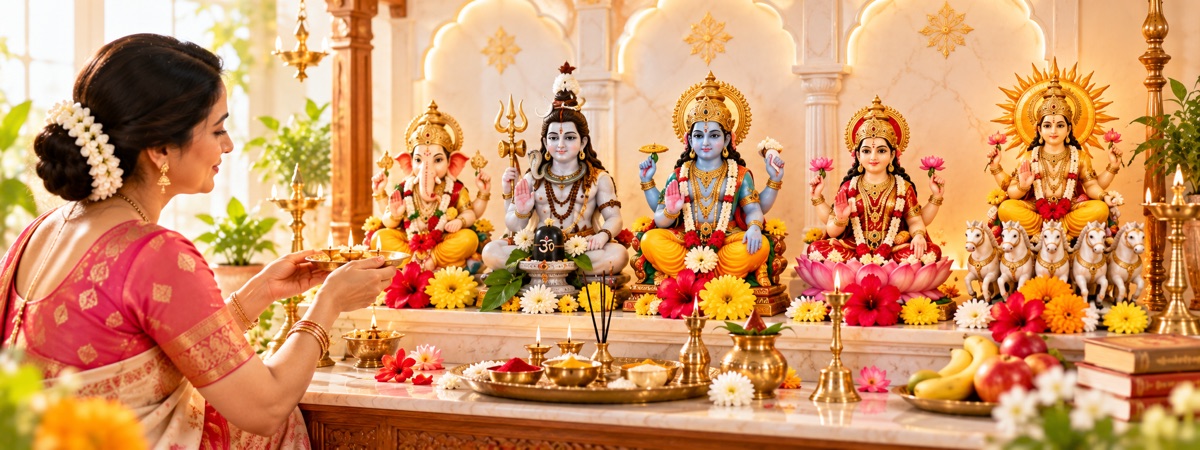
Who the panchdev are
The panchdev (five deities) are Surya, Ganesha, Devi (Durga), Shiva and Vishnu. Worshipping all five together is called panchayatan puja, and it is the daily worship of the Smarta tradition, the stream of Hinduism that follows the smritis and puranas and does not restrict worship to a single sect. Adi Shankaracharya is traditionally credited with establishing it as the household norm, and it remains the default puja in very many North Indian homes, even where families don't know the name.
The idea behind it is that these five are the major forms in which the one Divine is worshipped: Vishnu by Vaishnavas, Shiva by Shaivas, Devi by Shaktas, Ganesha by Ganapatyas and Surya by Sauras. A household that worships all five honours every path at once, while still choosing one as its own.
A note on "compulsory": many Hindi sources say that panchdev worship is mandatory for every householder. That is true within the Smarta tradition. A Vaishnav family devoted to Krishna or Ram, a Shaiva family devoted to Shiva, or a family following a guru's sampradaya, will follow their own rule, and that is not a lapse. If your family has no specific sampradaya, panchdev puja is the traditional default and an excellent daily practice.
Why these five: what each one stands for
- Surya, the visible god, source of light, health and the day itself. He is the one deity everyone can see, which is why the morning begins with his arghya.
- Ganesha, the remover of obstacles and the pratham pujya, the one worshipped first in every ritual.
- Durga (Devi), the Mother, Shakti, the power that protects and sustains.
- Shiva, the auspicious one, who dissolves and renews, and stands for detachment and grace.
- Vishnu, the preserver, who upholds dharma and descends as Ram and Krishna.
The five are also often linked with the five elements (fire, water, earth, air and space), so that together they stand for the whole of creation. Sources pair deity and element differently, so treat this as an explanation, not a rule.
The panchayatan: your ishta devata at the centre
In panchayatan worship, the family's ishta devata, its chosen deity, sits in the centre, and the other four are placed around it. The commonly published arrangement for a Ganesha panchayatan, with Ganesha as ishta, is:
- Centre: Ganesha (the ishta)
- North-east corner: Vishnu
- South-east corner: Shiva
- South-west corner: Surya
- North-west corner: Devi
For a Shiva, Vishnu, Devi or Surya panchayatan, the ishta moves to the centre and the others take the corners according to your family's or priest's tradition; the arrangements differ between sources, so ask your family priest if you are setting one up formally. In practice most homes don't use a formal panchayatan set. A small picture or idol of each of the five on one shelf, with the ishta in the middle, serves the same purpose.
Many families use natural stones in place of idols: a Shaligram for Vishnu, a bana lingam for Shiva, a red shona bhadra stone for Ganesha, a sphatik (crystal) for Surya, and a swarnamukhi stone for Devi. This is the classical panchayatan, but it is entirely optional.
Who comes first: water, tilak and flowers
The order most families follow is simple:
- Ganesha first, always. He is the pratham pujya, worshipped before any other deity in any ritual. Water, tilak, flower and bhog go to him first.
- Surya next, with arghya. If you offer Surya arghya outside at sunrise, that usually comes even before you sit down at the mandir, which is fine; Ganesha is then remembered at the start of the indoor puja.
- Then your ishta devata, in the centre.
- Then the remaining deities, commonly in the order Shiva, Vishnu, Devi, or as your family does it.
Tilak: chandan (sandalwood) for Shiva and Vishnu, roli or kumkum for Ganesha and Devi, and red chandan or roli for Surya are the usual choices. Akshat (unbroken rice) is offered to all except Vishnu in many traditions, where tulsi takes its place.
What not to offer each deity
Some prohibitions are widely repeated and observed in temples as well as homes:
- Ganesha: no tulsi. The usual story says Tulsi cursed Ganesha when he refused to marry her. Offer durva (green grass) instead, which he loves.
- Shiva: no ketaki (screwpine) flower, cursed for its part in the story of the endless lingam, and no turmeric or kumkum on the Shivling itself. Offer bilva leaves, white flowers and water.
- Vishnu: no akshat in many traditions, and no aak or dhatura, which belong to Shiva. Tulsi is the essential offering.
- Durga: durva is commonly said not to be offered to the Devi. Red flowers, especially hibiscus, are hers.
- Surya: offer water from a copper vessel with roli, red flowers and a few grains of rice; many traditions avoid bilva for him.
A five-minute daily panchdev puja
This is for weekday mornings, when time is short. It keeps the full structure of the worship in a form anyone can do every day.
- Bathe and sit facing east or north on a clean asan before the mandir.
- Achaman: sip a little water three times from your right palm, and sprinkle a few drops on yourself and the puja place.
- Light a ghee or oil lamp and an incense stick.
- Ganesha: offer a drop of water, a tilak of roli, a flower or durva, and say Om Gam Ganapataye Namah.
- Surya: if you have not offered arghya outside, offer water to his image, or simply turn to the east and offer water from a copper lota into a plant, saying Om Suryaya Namah.
- Durga: roli and a red flower, saying Om Dum Durgayai Namah.
- Shiva: water and chandan, a bilva leaf if you have one, saying Om Namah Shivaya.
- Vishnu: chandan and a tulsi leaf, saying Om Namo Narayanaya.
- Bhog: a little mishri, a sweet or fruit, offered to all five together.
- Aarti: wave the lamp before all five, or sing one short aarti.
- Kshama prarthana: fold your hands and ask forgiveness for anything left out. This is what makes a short puja complete.
On days when even this is not possible, folding your hands before the five, lighting a lamp and saying each name once is still panchdev worship.
Frequently asked questions
Is panchdev puja compulsory?
Within the Smarta tradition it is the prescribed daily worship of a householder. Families who follow a specific sampradaya, such as Vaishnav or Shaiva, follow their own rule instead.
Which deity should be worshipped first?
Ganesha, who is pratham pujya. Surya's arghya is usually offered at sunrise, then the indoor puja begins with Ganesha, then the ishta devata and the other three.
Can I keep pictures instead of idols for panchdev puja?
Yes. Pictures, small idols or the traditional five stones are all accepted. What matters is that all five are present and the worship is regular.
What is the ishta devata, and how do I know mine?
The ishta is the deity you feel closest to or that your family has traditionally worshipped. If you don't know, ask your elders or follow your kuldevata. If neither is clear, Ganesha is commonly placed in the centre.
Can women do panchdev puja?
Yes. The daily panchdev puja at home is done by women and men alike, and in many households it is the women of the family who keep it up.
Why is tulsi not offered to Ganesha?
According to a well-known story, Tulsi cursed Ganesha when he refused her proposal of marriage, and he in turn declared that she would not be offered to him. Durva is offered instead.
How long should daily panchdev puja take?
As long as you can give it. A full puja with abhishek can take an hour; the five-minute version above keeps the full structure and is enough for a daily practice.
Was this article helpful?
Spotted a mistake?
If you find any grammatical, Hindi, English, mantra-text or other mistake on this page, tell us — we will correct it within 24 hours.
Related content
- Ganesh Puja Vidhi: Wednesday, Chaturthi and Everyday Worship
- Surya Dev Puja Vidhi: Sunrise Arghya and Sunday Worship
- Maa Durga Puja Vidhi: Everyday and Friday Worship at Home
- Shiva Puja Vidhi: Shivling Worship at Home on Monday and Shivratri
- Vishnu Puja Vidhi: Thursday and Ekadashi Worship at Home
- Surya Arghya: How to Offer Water to Surya Dev
- Vastu Rules for Idols and Pictures in the Home Mandir: What Not to Keep Together, and What to Do With a Broken IdolPublished9 min read