
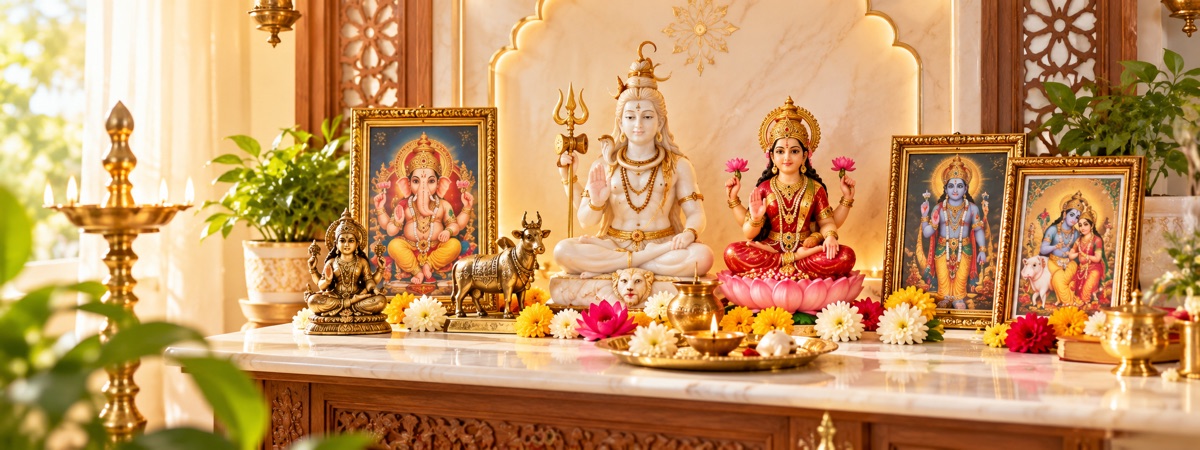
Why the mandir gets attention before Diwali
The Diwali clean-up reaches the home mandir last, and in many homes it is the one place where a year of small additions has piled up: a Ganesha idol from a wedding, a Lakshmi from last Dhanteras, calendar pictures, a gift from a pilgrimage, a cracked frame nobody wanted to throw away. Before Lakshmi Puja on 8 November it is the natural time to sort it out.
The rules below come from Vastu and from household custom. They are widely followed, but they are not one single shastra, and families and sampradayas differ. A Vaishnav home with a full Thakurji seva, for instance, has its own rules that override general advice. Where a custom is near universal we say so; where it varies, we say that too. The underlying idea is simple: the mandir is where the deities are treated as living guests, so it should be ordered, clean and uncluttered.
Where the mandir should be, and which way you face
- The north-east (ishan kon) is the preferred corner for the home mandir in Vastu. North and east are the next best.
- When you sit for puja, face east or north. That means the idols usually face west or south. If your shrine is on an east wall, the deities face west and you face east, which is the most common arrangement.
- Not in the bedroom, under a staircase, or sharing a wall with a toilet. If a flat leaves no choice, many families keep a small shrine in a cabinet with doors that are closed at night.
- Raise it off the floor. A low wooden chowki or a shelf, with the idols' feet roughly at the level of your chest when you sit, is common practice.
- Keep the idols small. Vastu guides commonly advise home idols no taller than about 9 to 12 inches. Large idols are traditionally for temples, where daily abhishek and full seva can be offered. This is guidance, not a fixed measure.
Why not two idols of the same deity?
This is the rule people ask about most. The common teaching is that a home shrine should not have two Shivlingas, or two or three idols of the same form of Ganesha, or several idols of the same Devi worshipped side by side. A widely repeated saying lists two Shivlingas, three Ganeshas, two conches, two Surya images, three Durga idols, two Gomati chakras and two Shaligrams as combinations to avoid. We could not trace this list to a text we can cite, but the custom is widespread and the reasoning behind it is consistent:
- A murti is worshipped as a presence, not a decoration. One deity, one seat. Two idols of the same form divide the worship and make it unclear which receives the daily offering.
- Each installed idol asks for daily seva. Several identical idols usually means some are neglected, and a neglected murti is the thing tradition really warns against.
- Conflicting energies is the Vastu explanation, especially for two idols placed facing each other. Whatever one makes of that, it is good advice not to place idols facing one another.
What this rule does not mean: a Lakshmi-Ganesha pair bought for Diwali next to an older Ganesha is not a problem if you treat the older one as the main idol and the Diwali pair as the festival set. Different deities together, such as Ganesha, Lakshmi, Saraswati, Shiva-Parvati, Ram Darbar and Radha-Krishna, are entirely normal. The rule is about duplicates of the same form.
If you already have duplicates, don't panic or throw any away. Keep one in the mandir as the idol you worship daily, and wrap the others in clean cloth and store them, give them to a temple, or gift them to a family who will worship them.
How the main deities should be placed
Ganesha
Ganesha is placed so that he faces into the room, never with his back to the living space: a well-known belief holds that Ganesha's back is where poverty sits, so his face should be towards the house. For homes, a seated Ganesha with the trunk curving to his left (vamamukhi) is the usual choice; the right-trunk form (dakshinamukhi) is traditionally associated with stricter worship and is more often seen in temples. Ganesha sits to the left of Lakshmi as you face them, which is the standard Diwali arrangement.
Radha-Krishna
Radha stands on Krishna's left, that is, on your right as you face them. Keep them together on one seat rather than as two separate idols. A Bal Gopal (Laddu Gopal) is a separate case: many families keep him in his own small singhasan, with his own seva of bathing, dressing and bhog, and that seva should be regular if you bring him home.
Shivling
A home Shivling should be small, traditionally no bigger than the thumb to a palm's length, and placed so that the spout of the yoni (jalahari) points north, the direction in which the abhishek water flows out. Don't keep a Shivling in a closed cupboard without daily water; if daily jal is not possible, a picture of Shiva-Parvati is the better choice.
Lakshmi
A seated Lakshmi is preferred over a standing one at home: the belief is that a standing Lakshmi is about to leave. Lakshmi with Ganesha, or with Vishnu, is ideal.
Pictures and images better kept out of the mandir
- Photographs of departed family members. Ancestors are honoured, but not in the deities' shrine. Place their photographs on a south wall of the house.
- Fierce forms for daily home worship: images of Kali in her ferocious form, Bhairava, Narasimha tearing Hiranyakashipu, or the Mahabharata battle. Many families do worship these forms, under the guidance of a guru; for an ordinary home shrine, the calmer forms are the usual advice.
- Shani Dev, Rahu and Ketu idols are customarily worshipped at temples or under a peepal, not installed at home.
- Torn, faded or water-damaged pictures, and calendar images that have become cluttered. A few well-kept images are better than many neglected ones.
- Idols facing each other, or images with their backs to the main idol.
When an idol breaks: what khandit murti means
An idol that is chipped, cracked or broken is called khandit, and the near-universal custom is that a khandit murti is no longer worshipped as the main idol. It is not a bad omen or a punishment. Idols break: they fall, they crack with age, clay idols crumble. What matters is how the idol is parted with.
Two traditional exceptions are often mentioned: a Shaligram and a natural Narmadeshwar (bana) Shivling are widely held not to become khandit even if chipped, since they are natural stones and not shaped idols. If one of these is damaged, ask your family priest before deciding.
Small damage to a metal idol
Brass, silver or panchdhatu idols with a bent ornament or a loose base can usually be repaired by a temple jeweller. Many families have the idol repaired and then perform a short re-installation: bathing it in Gangajal and panchamrit and offering a lamp before placing it back.
How to part with a broken idol
- Remove it from the shrine respectfully. Offer a final lamp and a flower, fold your hands, and ask forgiveness for any shortcoming in the worship. A simple prayer in your own words is enough.
- Wrap it in a clean red or yellow cloth.
- Choose a respectful place for visarjan:
- Clay or unpainted idols: dissolve in a bucket of clean water at home, then pour the water and earth into a garden bed or at the roots of a tree.
- Plaster or painted idols: don't put them in a river or pond, where the paint and plaster pollute the water. Many temples collect broken idols for proper immersion; this is the best option.
- Stone or marble idols: leave under a peepal or banyan tree in a temple compound, or hand over to the temple.
- Metal idols beyond repair: give them to a temple. Don't sell them as scrap.
- Never throw an idol or a picture of a deity in the dustbin, and don't leave it lying at a crossroads.
Old pictures and calendar images
Remove the glass and frame, which can be reused or recycled. The paper image can be immersed in clean water at home until it softens and then put in soil, or given to a temple. Burning old pictures is followed in some homes, but immersion or burial is the more common custom.
A simple pre-Diwali mandir clean-up
- Choose a morning, after your bath. Light a lamp and ask the deities' permission before moving them.
- Take the idols down onto a clean cloth. Wash metal idols with water and a little tamarind or lemon for brass; wipe marble with a damp cloth. Don't use harsh chemicals on painted idols.
- Clean the shelf or chowki, and lay fresh red or yellow cloth.
- Sort: one idol of each form stays; duplicates are stored or given away; broken idols and pictures are set aside for visarjan as above.
- Replace the idols facing the right way, light a lamp and offer flowers and a little sweet. In 2026, finishing by Dhanteras on 6 November leaves the mandir ready for Lakshmi Puja on Sunday, 8 November.
Frequently asked questions
Can I keep two Ganesha idols in my home mandir?
Custom says one Ganesha of a form should be worshipped as the main idol. A Diwali Lakshmi-Ganesha set beside an older Ganesha is commonly accepted. Avoid placing them facing each other, and keep any extras wrapped and stored or give them to a temple.
What should I do with a Lakshmi-Ganesha idol from last Diwali?
Many families buy a new pair each Diwali. The old clay pair is immersed in a bucket of water at home or given to a temple after the new one is installed. Metal or silver pairs are usually kept and worshipped year after year.
Is it a bad sign if an idol breaks?
No. Tradition treats it as something that happens, not an omen. What matters is that the khandit idol is no longer used as the main idol and is parted with respectfully.
Can I immerse a broken plaster idol in a river?
It is better not to. Plaster and paint pollute water. Give it to a temple that collects idols, or dissolve clay idols in a bucket at home and put the soil in a garden.
Can photographs of my late parents be kept in the mandir?
Customarily no. Ancestors' photographs are kept on a south-facing wall elsewhere in the house and honoured there, especially during Pitru Paksha.
Which direction should I face while doing puja?
East or north. Arrange the shrine so the idols face west or south.
Is a Shivling allowed at home?
Yes, a small one, with daily water offered and the jalahari spout facing north. If you can't offer jal daily, keep a picture of Shiva-Parvati instead.
Was this article helpful?
Spotted a mistake?
If you find any grammatical, Hindi, English, mantra-text or other mistake on this page, tell us — we will correct it within 24 hours.
Related content
- Deep Clean or Deep Wealth? The Vastu Rules of Pre-Diwali Sweeping, Mopping and the BroomPublished7 min read
- After the Lamps Go Out: How to Respectfully Dispose of Burnt Wicks, Broken Diyas and Leftover Diwali Puja SamagriPublished8 min read
- Diwali 2026 Laxmi Puja Vidhi: A Step-by-Step Guide to Welcoming Mahalakshmi at Home and at Your Shop or OfficePublished10 min read
- Ganesh Puja Vidhi: Wednesday, Chaturthi and Everyday Worship
- Maa Lakshmi Puja Vidhi: Friday Worship and Diwali Night