
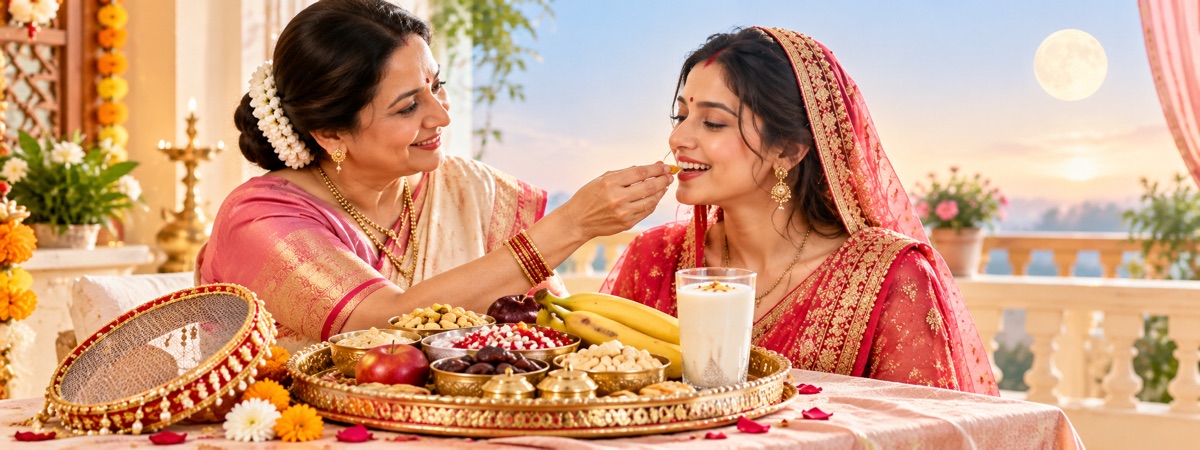
What sargi is, and why it comes from the mother-in-law
Sargi (also sargahi) is the meal a married woman eats before dawn on Karwa Chauth, before a fast that in most families lasts until the moon rises. It is also a gift. In the Punjabi custom, where the word comes from, the mother-in-law prepares or sends a thali for her daughter-in-law: food for the morning, and with it clothes, bangles and shringar items for the day. The bahu eats the food before sunrise and wears what was sent when she dresses for the evening puja.
The meaning is easy to read. Karwa Chauth is a fast for the husband's long life, and the sargi is the husband's mother blessing the woman who keeps it for her son. It turns a hard day into a shared one: the older woman feeds the younger one before the fast and receives her baya (a thali of sweets, dry fruits, a little money and often a saree) after the evening puja. In many families the mother-in-law is keeping the fast herself and eats her own sargi alongside.
Not every region has sargi. In parts of Uttar Pradesh, Madhya Pradesh and Rajasthan, the morning meal is simply eaten at home without a formal thali, and the emphasis falls on the evening baya. Where your family has no sargi custom, there is nothing missing from your vrat. Where it does, the details below are the ones most homes follow.
When to eat sargi on 29 October 2026
- Karwa Chauth: Thursday, 29 October 2026 (Kartik Krishna Chaturthi)
- Sunrise, when the fast begins: 6:31 am in New Delhi
- Usual sargi window: about 4:00 to 5:30 am, finishing before sunrise
- Moonrise, when the fast ends: 8:17 pm in New Delhi
The rule is simply that sargi is finished before sunrise, because the vrat begins with the sun. Many women aim for the Brahma muhurta, the hour and a half before sunrise, so that they have time to bathe and take the sankalp (the vow of the fast) as the day begins. Eating at 2 am to "get it over with" defeats the purpose: you will be hungry far sooner. Sunrise is a few minutes earlier in eastern India and later in the west, so check your own city's sunrise and finish ten to fifteen minutes before it.
The seven things a sargi thali usually holds
No scripture fixes a list for sargi, and "seven things" is a convenient way of describing what most Punjabi and North Indian families put on the thali, not a rule. Read it as a guide to a balanced pre-dawn meal plus the shringar gift.
- Pheni or sevaiyan. Fine vermicelli cooked in milk with sugar or eaten soaked in warm milk. It is the one dish almost every Punjabi sargi has: soft, filling and slow to digest.
- Fresh fruit. Banana, apple, pomegranate, papaya, pear. Fruit gives water and sugar without salt. Avoid very sour fruit on an empty stomach.
- Soaked dry fruits. Almonds, walnuts, raisins and dates, soaked overnight. A handful is enough; dry fruits are dense, and too many make you thirsty.
- Mathri or a light savoury. A mathri or two, or a paratha in some homes. Keep it to a small portion and go easy on salt.
- Sweets. Usually something homemade or a few pieces of barfi or ladoo. The sweet is also the auspicious part of the thali: the day begins sweet.
- Something to drink. Milk, lassi, coconut water or plain water. This matters most if you keep the fast nirjala, without water.
- Suhag and shringar items. Sindoor, bindi, bangles, mehendi, a red or bright saree or suit, sometimes jewellery. These are not eaten, of course; they are the mother-in-law's blessing to be worn for the evening puja.
Many families add a coconut or a little money (shagun) to the thali, and some include sweets or clothes for the husband too.
What to eat, and what to skip, before a nirjala day
The sargi has to carry you for around fourteen hours. Some practical points from women who keep the fast every year:
- Drink water through the evening before, not just at sargi. Your body cannot store a litre gulped at 5 am.
- Go light on salt, fried food and pickles. Salt makes the afternoon thirst much worse.
- Tea and coffee are a trap. Many women can't start a day without tea, but it dehydrates, and a caffeine headache in the afternoon is common. If you must, have one small cup, with a glass of water.
- Protein and fat last longer than sugar. Milk, curd, paneer, nuts and pheni-in-milk keep you full far longer than sweets alone.
- Don't overeat. A heavy meal at 4 am can leave you nauseous by mid-morning.
If you are pregnant, breastfeeding, diabetic, on regular medication or recovering from illness, speak to your doctor before keeping a nirjala fast. Families and priests widely accept a phalahari fast (with water, fruit and milk) in such cases; the vow is kept in spirit.
The saas-bahu customs around sargi
- The mother-in-law gives, the bahu receives. In joint families the saas often wakes her daughter-in-law and hands her the thali herself. In nuclear families the sargi is usually delivered the evening before.
- Touch her feet. Before eating, the bahu touches her mother-in-law's feet and takes her blessing. If the saas lives in another city, a phone call before sargi has become a perfectly ordinary version of this.
- Eat facing east or north, if your family keeps such a custom. Many homes don't.
- The baya goes back in the evening. After the katha and puja, the bahu gives her mother-in-law the baya: sweets, dry fruits, money and often a saree. It is offered with the karwa circled over it in many homes, and she touches her feet again.
- The first Karwa Chauth is special. For a new bride, the sargi often comes with more shringar, and her own mother's family sends the baya and gifts for the in-laws. Both families take part.
If there is no mother-in-law
This is one of the most common questions, and the answer is reassuring: the vrat does not depend on who hands you the thali. Families handle it in several accepted ways:
- An elder woman of the in-law family, such as the husband's elder brother's wife (jethani), his aunt (chachi or tai saas) or an elder sister-in-law, gives the sargi in her place.
- Your own mother sends the sargi. In many families this is already the custom when the saas is not living.
- You prepare it yourself. Arrange the thali, place it first before Gauri Mata, or before a photograph of your late mother-in-law, take her blessing in your mind, and then eat. The baya that would have gone to her can be given to an elder woman, a priest's wife, or a needy married woman.
- Your husband gives it. Some couples, especially those living away from family, have made this their own custom. It is modern, but no rule forbids it.
If your mother-in-law is alive but you are not in touch, or live far apart, the same choices apply. The blessing that sargi carries is the elders' goodwill for the marriage, and it can come from any elder who gives it with love.
Frequently asked questions
What time should I eat sargi on Karwa Chauth 2026?
Finish before sunrise, which is 6:31 am in Delhi on 29 October. Most women eat between about 4:00 and 5:30 am. Check your city's sunrise, which varies by up to half an hour across India.
Can I drink water after sargi?
Yes, until sunrise. Once the sun is up, a nirjala fast means no water until you have offered arghya to the moon. If your family keeps a sajala fast (with water), you can drink through the day.
Can I drink tea in the sargi?
No rule forbids it, but tea dehydrates. One small cup with plenty of water is the most you should have before a nirjala day.
Is sargi compulsory?
No. It is a strong custom in Punjabi and many North Indian families but not universal. If your family has no sargi tradition, simply eat before sunrise and keep the vrat as usual.
Who gives sargi if the mother-in-law is not alive?
An elder woman of the husband's family, your own mother, or you yourself, after offering the thali to Gauri Mata or before your mother-in-law's photograph. The baya can then go to another elder married woman.
I woke up after sunrise and missed the sargi. Is my fast broken?
No. Missing the meal is not breaking the vow. Take the sankalp and keep the fast; if your health makes a full nirjala day risky, keep it with water or fruit.
What does the bahu give back to the saas?
The baya, after the evening puja: a thali with sweets, dry fruits, some money and often a saree or suit, given while touching her feet.
Was this article helpful?
Spotted a mistake?
If you find any grammatical, Hindi, English, mantra-text or other mistake on this page, tell us — we will correct it within 24 hours.