
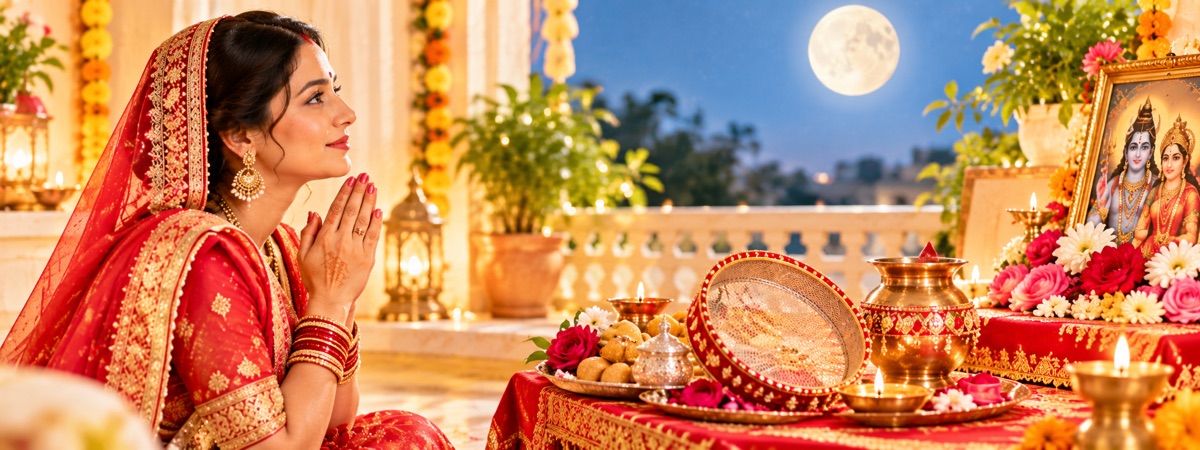
Karwa Chauth 2026: the day in brief
- Date: Thursday, 29 October 2026 (Kartik Krishna Chaturthi)
- Fast begins: at sunrise, 6:31 am in New Delhi, after the sargi
- Puja muhurat: 5:38 to 6:56 pm
- Moonrise and arghya: 8:17 pm, after which the fast is opened
Timings are for New Delhi; moonrise differs by city, by more than an hour across India. The vrat is traditionally nirjala (without water) from sunrise to moonrise, and the evening puja is of Gauri (Parvati), Shiva, Ganesha and Kartikeya, with the karwa, the katha and the moon's arghya.
A word before the rules: almost everything people search for as "Karwa Chauth rules" is household custom handed down by mothers-in-law, not a text you can open. That doesn't make it unimportant. It does mean that customs differ from family to family, and that where your family's way differs from a list on the internet, your family's way is the one to follow. We have separated the near-universal rules from the regional ones.
The five rules families are strictest about
1. Don't give away your suhag items on the day
Sindoor, bindi, bangles, mehendi, the mangalsutra and the bridal red are the signs of a married woman's saubhagya, the good fortune of her marriage, and Karwa Chauth is the day that good fortune is prayed for. The custom is that a woman does not give away, lend or throw out her own suhag items on this day, and does not take off the ones she is wearing.
This is often confused with the baya, which seems to contradict it: the baya given to the mother-in-law after the puja often includes new shringar items. The difference is that the baya is a gift of new things, offered as a blessing and received by an elder. The rule is about not parting with your own worn suhag. Many families also give new bangles and sindoor to other married women on the day as suhag ka daan, which is customary and auspicious.
2. Avoid donating white things
Many families avoid giving away white things on Karwa Chauth: milk, curd, rice, white sweets, white clothes, sugar. The usual explanation links white with the moon, who is worshipped and awaited all day, and it is believed that giving away the moon's things before he has been worshipped weakens the prayer. Some families extend this to not wearing white or black clothes for the puja, since white is associated with widowhood and black with inauspiciousness.
This is a widespread but regional custom. If your family has none of it, you have broken nothing.
3. Don't break the fast before the moon
The vrat ends with the moon's arghya, not with the clock. If the sky is cloudy, families wait; when moonrise has passed and the moon can't be seen, the common practice is to offer arghya in the direction of the moon at the calculated moonrise time, or to look at the moon's image through a sieve or on a screen and offer arghya towards the east. Opening the fast at sunset "because the moon is late" is the one thing every tradition agrees against.
4. No sharp work, no sleeping the day away
Two household customs almost every family repeats: avoid sewing, cutting and work with needles or scissors on the day, and don't spend the afternoon asleep. The day is meant to be given to the vrat: rest, prayer, getting ready, listening to the katha. Sleeping through it, or keeping busy with sharp work, is felt to take away from the fast. Many women also don't wake anyone sleeping on this day.
5. Keep the mind of the vrat: no quarrels, no harsh words
This is the rule the katha itself teaches. Veeravati's brothers broke her fast with a false moon out of love, and the loss that followed came from a broken vow. The fast is for a marriage: arguing with the husband or the in-laws on the day, or speaking harshly, is felt to undo it. Many women keep the day quiet, listen to bhajans, and spend it with the other women of the family.
Other customs you may hear
- Don't throw away the karwa after the puja. Keep it for Ahoi Ashtami, which in 2026 is on 1 November, when many women offer arghya from the same karwa.
- Don't eat or offer leftover food; the meal that opens the fast is freshly cooked.
- Don't sit in the sun without need, and keep water close for when the moon rises.
- Brown or tan clothes are avoided in some homes. Red, maroon, pink, yellow and green are the favoured colours.
If you have your period on Karwa Chauth
This is one of the most searched questions about the vrat, and many women worry that their fast is "lost". It isn't. The practice most families and priests follow distinguishes between two things:
- The vow (sankalp) and the fast continue. You can keep the fast as usual, nirjala or with water, as your family does.
- Touching the puja items and idols is what traditional households avoid during menstruation. That is the part that changes.
How to keep the puja
- Take the sankalp mentally in the morning, after your bath.
- Ask another woman of the family, your mother-in-law, a sister-in-law or a neighbour, to set up the puja and the thali. Sit with the other women for the katha.
- Listen to the katha with folded hands, without touching the karwa, thali or idols. Hearing the katha is what the vrat asks; you don't have to hold the thali to receive it. Many women hold a few grains of rice in their hands while listening and offer them afterwards.
- For the arghya, the common practice is for your husband or another family member to hold the karwa and pour while you stand beside them, look at the moon through the sieve, and pray. Some families let the woman pour arghya from a separate small vessel used only for this. Follow your family's custom.
- Do the puja in your mind (manasik puja). Offer flowers, lamp and bhog mentally to Gauri Mata. Tradition holds that a mental offering made with full devotion is complete.
- Open the fast as usual after the arghya.
Many modern families no longer observe the restriction at all and let women do the full puja. Either way the vrat is kept.
If you are unwell, pregnant or on medication
A nirjala fast of fourteen hours is not safe for everyone. Tradition itself allows for this: the vow can be kept as a sajala fast (with water), or as a phalahari fast with fruit, milk and water. Women who are pregnant, breastfeeding, diabetic, have low blood pressure or are on regular medication should speak to their doctor before the day and take medicines as prescribed. Taking medicine does not break a vrat kept for health reasons. If you feel faint, drink water; a vow kept with care is better than one broken by collapse.
If you are unable to keep the fast at all one year, many families let the husband or the mother-in-law keep it on your behalf, or you keep it the following year; the vrat is not "broken" for the marriage.
Frequently asked questions
Can I keep the Karwa Chauth fast during my period?
Yes. The vow and the fast continue. What traditional families avoid is touching the puja items and idols: another woman sets up the puja, you listen to the katha and pray, and someone else holds the karwa for the arghya while you stand beside them.
Can I drink water on Karwa Chauth?
The traditional fast is nirjala until moonrise. Many families keep it with water (sajala), and this is accepted for health reasons. Follow your family's custom, and your doctor's advice if you have a condition.
Can I give bangles or sindoor to someone on Karwa Chauth?
New bangles and sindoor given as suhag ka daan to other married women are customary. The rule is not to give away or throw out your own worn suhag items on the day.
Why are white things not donated on Karwa Chauth?
White is linked with the moon, who is worshipped at the end of the fast, and many families avoid giving away milk, rice, curd or white clothes before the moon's arghya. It is a regional custom, not universal.
What if the moon is not visible because of clouds?
Wait for the calculated moonrise time for your city, then offer arghya towards the east, where the moon is. Many families also look at the moon's image through the sieve. Don't break the fast before moonrise.
Can I sleep during the Karwa Chauth fast?
A short rest is fine. The custom discourages sleeping away the afternoon, since the day is meant to be given to the vrat.
Can a pregnant woman keep the Karwa Chauth fast?
Only after speaking to her doctor, and usually as a fast with water, fruit and milk rather than nirjala. Tradition accepts this as a full vrat.
Was this article helpful?
Spotted a mistake?
If you find any grammatical, Hindi, English, mantra-text or other mistake on this page, tell us — we will correct it within 24 hours.
Related content
- Maa Parvati
- Karwa Chauth 2026: Puja Muhurat, Moonrise Time and City-wise TimingsPublished7 min read
- Karwa Chauth 2026 Sargi Guide: What Sargi Means, What Goes in the Thali, and the Saas-Bahu CustomsPublished7 min read
- Karwa Chauth Vrat Katha: The Complete Stories Read at the Puja
- Maa Parvati Puja Vidhi: How to Worship Gauri at Home
- Jai Parvati Mata (Parvati Aarti)