
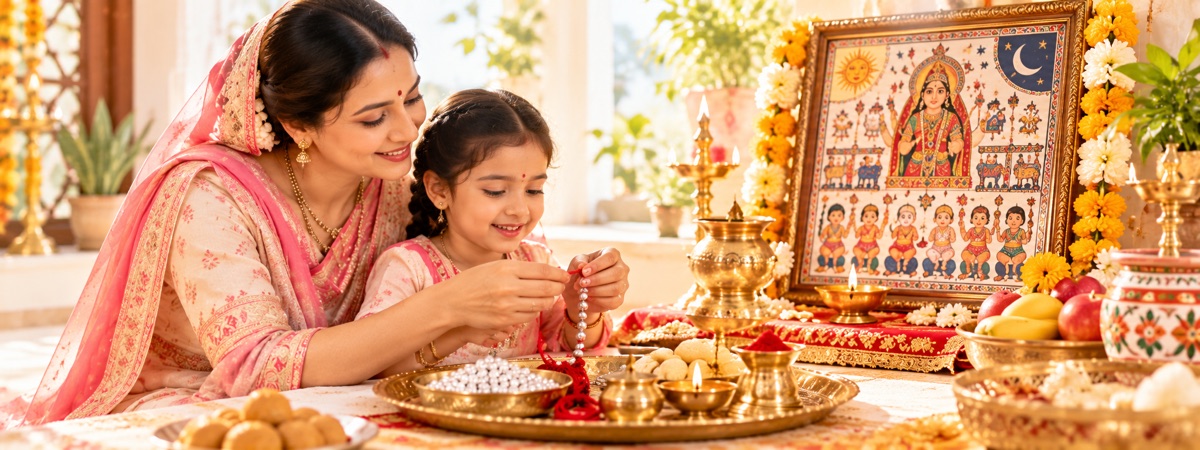
What the Syahu mala is
On Ahoi Ashtami, the fast mothers keep for their children, many women in North India, especially in Uttar Pradesh, Delhi, Haryana and Rajasthan, wear a special necklace for the puja: the Syahu mala, also called the Ahoi mala or Syau ki mala. In its usual form it has two parts:
- The Ahoi or Syahu pendant, a small silver locket, either a stamped image of Ahoi Mata or a little silver shape of the syahu (porcupine) and her young.
- Silver beads (manke or dane) strung on either side of the pendant, on kalava (the red-yellow sacred thread) or on a silver chain.
Each bead stands for a child. That is what makes the mala unusual among ritual objects: it is not bought finished and kept as it is, but grows with the family. A mother who has worn it for thirty years carries on her neck a record of every child, and often every grandchild, born in that time.
In 2026, Ahoi Ashtami falls on Sunday, 1 November. The evening puja muhurat in Delhi is 5:36 to 6:54 pm, and the stars can be seen from about 6:00 pm. Silver for the mala is often bought ahead of the festival, which is why the questions below come up in the last week of October.
Why a porcupine? The katha behind the mala
The syahu in the name comes straight from the Ahoi Ashtami katha. A woman digging earth in the forest before Diwali struck a porcupine's den with her spade and killed one of its young by accident. Within the year her own seven sons died. When she confessed and, on the elders' advice, worshipped Ahoi Bhagwati on Kartik Krishna Ashtami, drawing the syahu and her young beside the goddess and asking forgiveness, her sons were restored to her.
So the syahu is not a random animal in the worship. It is the mother whose loss started the story, and honouring her is part of asking protection for one's own children. The silver syahu on the mala keeps that idea in the puja every year: the mother wearing it remembers that every mother's grief is the same, including an animal's.
How beads are added: the common customs
There is no single scripture that sets the number of beads, and families differ. What follows are the patterns most commonly kept. If your mother-in-law or mother has her own custom, follow hers; the mala is a family tradition before it is anything else.
- The first mala: a newly married woman, or a woman keeping her first Ahoi fast, starts with the silver pendant on kalava. Some begin with two beads, one on each side of the pendant.
- On the birth of a child: the most widespread custom is to add one silver bead for each child, on the first Ahoi Ashtami after the birth. Many families add a pair, one on each side, to keep the mala balanced.
- On a child's marriage: many families add another bead, or a pair, in the year a son or daughter marries, so the new daughter- or son-in-law is included in the mother's prayer.
- Every year: in some families a bead is added at every Ahoi Ashtami, whether or not there is a birth or wedding, so the mala lengthens year by year.
- For grandchildren: grandmothers in many homes add beads for grandchildren too.
Beads are never removed, not even if a child has died; the bead stays as part of the mother's prayer. When the kalava wears thin, the beads are restrung on fresh kalava at the next Ahoi puja.
How the mala is worshipped and tied on
- Before the puja, the new beads are bought (pure silver is customary) and threaded on the kalava with the existing mala, or kept beside it to be tied on during the puja.
- In the evening, the mala is placed before the picture of Ahoi Mata with the filled karwa. Offer it roli, akshat and a flower, as you do the goddess, the syahu and the karwa.
- Listen to or read the katha while holding a few grains of wheat or rice and the mala in your hands, as many families do.
- Wear the mala after the katha, before offering arghya to the stars. In many homes the mother-in-law or an elder woman ties it on, and the mother touches her feet.
- After the arghya, the fast is opened, usually after the stars have been sighted. Some families open it at moonrise instead; follow your own.
How long to wear the mala, and keeping it safe
The most common custom is to wear the Syahu mala from Ahoi Ashtami until Diwali. In 2026 that is from Sunday 1 November to Sunday 8 November. On Diwali, or the morning after, it is taken off, sprinkled with a little water, and kept with the puja things. Some families keep it on until Dev Uthani Ekadashi, which this year is on 20 November; a few wear it for longer.
When you take it off, don't throw it in a jewellery box with everyday pieces. Wrap it in a clean cloth and keep it in the mandir or with the karwa and the other Ahoi items, so that it is ready for next year.
If the silver darkens, it can be cleaned gently before next year's puja, with plain water or a soft cloth. Avoid harsh dips that dissolve the kalava.
Without silver, or without children
- If silver is beyond your budget, a kalava with a small silver Ahoi pendant alone, or even just a kalava, is accepted. The custom is the prayer, not the metal.
- Women hoping for a child also keep the Ahoi fast. Many wear the pendant on kalava without beads, and add the first bead when the child comes.
- Grandmothers and elders often pass part of their mala, or a pendant, to a daughter-in-law in her first year, which is a moving way for the tradition to continue.
Frequently asked questions
How many beads should be in a Syahu mala?
No text fixes a number. The most common custom is one silver bead, or a pair, for each child, added on the first Ahoi Ashtami after the birth. Many families add more on a child's marriage, and some add one every year.
Should a bead be added when a son marries?
In many families, yes: one bead or a pair is added in the year of a son's or daughter's marriage. Others add beads only for births. Follow your family's custom.
When should the Syahu mala be taken off?
Most commonly on Diwali, which is 8 November in 2026, or the morning after. It is sprinkled with water and kept safely for next year. Some families wear it until Dev Uthani Ekadashi on 20 November.
Can I wear the mala at the puja if I can't buy new silver this year?
Yes. Wear last year's mala, or a pendant on kalava. The bead can be added the following year.
Do I need a Syahu mala if I have a daughter, not a son?
The fast was traditionally kept for sons, but today most families keep it for all children, and add beads for daughters the same way.
Can the old kalava of the mala be changed?
Yes. When it wears thin, restring the beads and pendant on fresh kalava at the next Ahoi puja. Immerse the old thread in water or put it in a plant pot.
Is the Syahu mala the same as the karwa from Karwa Chauth?
No. The karwa is the water pot from which the arghya is offered; many women use the Karwa Chauth karwa for Ahoi too. The mala is worn by the mother.
Was this article helpful?
Spotted a mistake?
If you find any grammatical, Hindi, English, mantra-text or other mistake on this page, tell us — we will correct it within 24 hours.