
Ahoi Ashtami 2026 at a glance
Ahoi Ashtami is the fast mothers keep for their children's long life and well-being. It falls on the Ashtami (eighth day) of the dark fortnight of Kartik in the purnimanta calendar of North India, which is why it comes just a few days after Karwa Chauth and about a week before Diwali. In 2026 it falls on Sunday, 1 November.
- Ahoi Ashtami puja muhurat: 5:36 pm to 6:54 pm (1 hour 18 minutes)
- Evening time for sighting the stars: 6:00 pm
- Moonrise: 11:40 pm
- Ashtami tithi: from 2:51 pm on 1 November to 1:10 pm on 2 November
These timings are for New Delhi. The Ashtami tithi begins in the afternoon of 1 November, so that evening is the one with Ashtami at puja time, and the fast is kept on 1 November, not 2 November. In other cities the muhurat and the time the stars appear move with local sunset. Use your own city's sunset as the guide: the stars usually become visible about 25 to 30 minutes after it.
Who Ahoi Mata is, and why mothers keep this fast
Ahoi Mata, also called Ahoi Bhagwati, is worshipped as a form of Parvati who protects children. The name is usually explained as a form of anhoni, "that which should not happen": the fast is a mother's prayer that no misfortune touch her children. Traditionally the fast was kept for sons, but today most families keep it for all their children, daughters and sons alike. Women who are hoping for a child also keep it.
The worship is unusual in one way: alongside the goddess, mothers draw and worship a syahu (also written sei or sehi), a porcupine, with her young. The reason is in the katha below.
The Ahoi Ashtami vrat katha: the mother and her seven sons
A moneylender's wife had seven sons. A few days before Diwali she went to the forest to dig soil to plaster her house. While digging, her spade struck a den and killed one of a porcupine's young by accident. Grief-stricken, she went home, but within a year all seven of her sons died, one after another.
When she poured out her sorrow to the older women of the village, they told her that her open confession had already washed away half her fault, and that she should worship Ahoi Bhagwati on Kartik Krishna Ashtami, drawing the porcupine and her young beside the goddess and asking forgiveness. She kept the fast with full devotion year after year, and by the goddess's grace her seven sons were restored to her.
Many families read a second telling, in which a daughter-in-law kills the syahu's young while cutting earth, and must win back the syahu mother's blessing by serving a cow. The heart of both is the same: a mother's prayer, a fault accepted honestly, and the goddess who protects children. The katha is read or heard at the evening puja, before the arghya to the stars.
Puja samagri
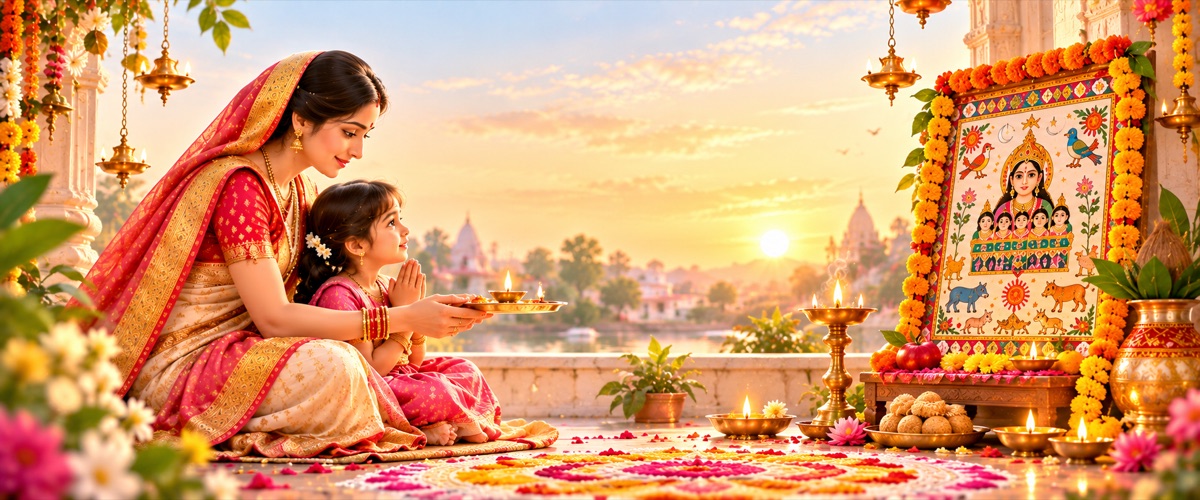
- A picture of Ahoi Mata: drawn on the wall with geru (red ochre) or bought as a printed calendar, showing the goddess, the syahu and her young, and often eight small squares or corners for the Ashtami
- A karwa (clay or metal pot with a spout) filled with water, its mouth tied with kalava; many women use the karwa from Karwa Chauth
- The Syahu mala (see below), or a kalava with a silver Ahoi pendant
- Roli, akshat, kalava, a ghee lamp, incense, flowers
- Bhog: halwa, puri, puas or mathri, whatever your family offers; some families offer singhara (water chestnut) and other seasonal produce
- A baya for the mother-in-law or an elder woman: sweets, fruit, a little money, sometimes clothes
The karwa and the Syahu mala
The karwa is filled with water and placed beside Ahoi Mata during the puja. The arghya to the stars is offered from it. What happens to the water afterwards depends on the family: in many homes it is kept carefully until Diwali and used in the Diwali puja or sprinkled through the house, and in some it is used to bathe the children. Ask the elders of your family which custom they keep.
The Syahu mala is a string of silver beads, usually threaded on kalava, with a pendant of Ahoi Mata or the syahu. It is worshipped at the puja with roli and akshat and then worn by the mother. Families add beads for their children, commonly one for each child, and many add another when a child is born or married. The mala is usually worn from Ahoi Ashtami until Diwali, then taken off and kept safely for next year's puja. The silver is meant to last for years, so the same mala grows with the family.
Ahoi Ashtami puja vidhi, step by step
- Before sunrise. Many women eat a light pre-dawn meal, then bathe and take the sankalp (resolve) for the fast before their household deity, saying the names of their children.
- Through the day. The fast lasts from sunrise until the stars are seen. Many keep it nirjala (without water); others take water or fruit (see the cautions below).
- Afternoon. Draw or put up the picture of Ahoi Mata facing the place where you will sit. Clean the puja place and set out the samagri.
- Evening puja (5:36 to 6:54 pm in Delhi). Place the filled karwa beside Ahoi Mata. Offer roli, akshat, flowers and a lamp to the goddess, the syahu and her young, and to the karwa. Worship the Syahu mala and put it on.
- The katha. Read or listen to the Ahoi Ashtami katha, holding a few grains of akshat in your hand, and offer them to Ahoi Mata at the end.
- Bhog and baya. Offer the bhog. Set aside the baya and give it to your mother-in-law or an elder woman, touching her feet.
- Arghya to the stars (from 6:00 pm in Delhi). Go to the roof or an open place, offer water from the karwa to the stars, and pray for your children. Then break the fast.
A few families wait for the moon instead of the stars. On Ahoi Ashtami the moon rises late, at 11:40 pm in Delhi in 2026, so most break the fast with the stars.
Rules and cautions
- Break the fast only after seeing the stars, or after your city's star-sighting time if the sky is overcast.
- Health first. If you are pregnant, breastfeeding, diabetic, on medication or unwell, keep the fast with water, milk or fruit. A fast kept with devotion is complete without the nirjala form.
- Many women avoid digging soil, gardening or cutting with sharp tools on this day, in memory of the katha.
- Keep the karwa clean and unbroken, and the Syahu mala safe after Diwali.
- Follow your family's custom where it differs. Ahoi Ashtami is a household tradition, and its details vary more from family to family than most festivals.
Radha Kund snan on Ahoi Ashtami night
In the Braj region, Ahoi Ashtami is also the night of the Radha Kund snan at Govardhan. Couples hoping for a child bathe in Radha Kund at midnight, and couples whose wish was fulfilled return to give thanks. Thousands come every year, so if you plan to go, reach early.
Since Ahoi Mata is worshipped as a form of Parvati, many mothers also read the Parvati Chalisa or sing Jai Parvati Mata after the puja. If you kept Karwa Chauth a few days earlier, our Karwa Chauth 2026 guide has that day's timings.
Frequently asked questions
When is Ahoi Ashtami in 2026?
Sunday, 1 November 2026. Ashtami tithi begins at 2:51 pm that day and ends at 1:10 pm on 2 November, so the evening puja falls on 1 November.
What is the Ahoi Ashtami puja muhurat in 2026?
In New Delhi, 5:36 pm to 6:54 pm. Stars can be seen from about 6:00 pm, and that is when the arghya is offered and the fast is broken.
Can I drink water during the Ahoi Ashtami fast?
The traditional fast is nirjala, but many women drink water, and anyone pregnant, nursing, diabetic or on medication should. Ask your family's elders about your custom, and your doctor about your health.
Can the fast be kept for daughters?
Yes. The older custom spoke of sons, but most families today keep Ahoi Ashtami for all their children, and there is nothing in the worship that limits it to sons.
Can women without children keep the Ahoi Ashtami fast?
Yes. Women hoping for a child often keep it, and in Braj many couples also take the midnight Radha Kund snan on this night for the same wish.
What should be done with the Syahu mala after the puja?
Most mothers wear it from Ahoi Ashtami until Diwali, then take it off and keep it safely to be worshipped again next year, adding beads as the family grows.
Is Ahoi Ashtami kept in Gujarat, Maharashtra and the South?
It is mainly a North Indian fast. In the amanta calendar used in the West and South, the same day falls in the month of Ashwin, so you may see it listed as Ashwin Krishna Ashtami there, but the date is the same.
What if I see the stars before the muhurat is over?
That is normal: the stars appear during the muhurat. Finish the puja and the katha, then offer the arghya and break the fast.