
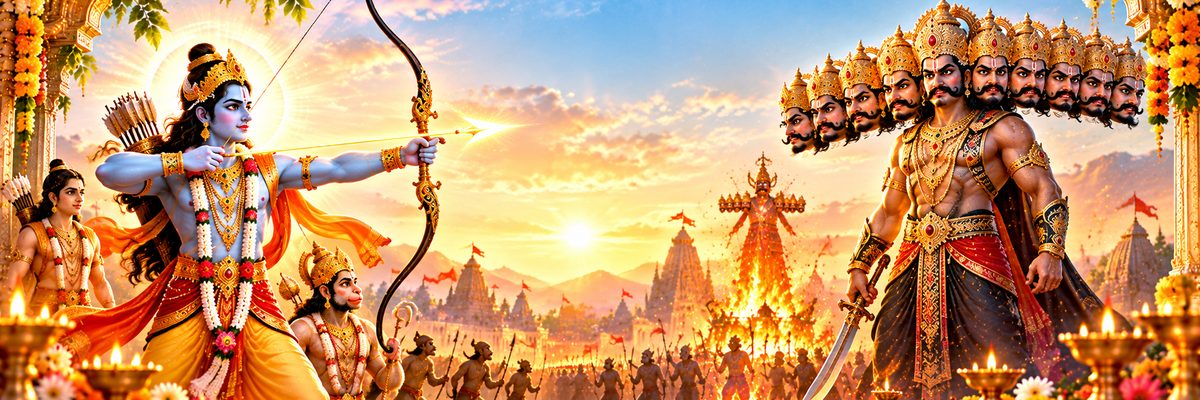
On the evening of Tuesday, 20 October 2026, effigies of Ravana will go up in flames across India, from neighbourhood Ramlila grounds to the big ones in Delhi and Kota. Every one of them has the same feature that children point at first: ten heads. Most of us grow up taking the heads as simply part of the demon king's look. But for a long time, storytellers and teachers have read them as something closer to home: ten faults that live in every human mind, which no effigy can burn for us.
This article separates the two layers. First, what the Ramayana itself says about the ten heads. Then the symbolic reading: what each head stands for, where that fault shows up in Ravana's own story, and what you can actually do about it this Dussehra.
What the Ramayana says about Ravana's ten heads
Ravana's first name was not Ravana. In the Uttara Kanda of Valmiki's Ramayana he is born to the sage Vishrava and the rakshasi Kaikasi, and because he is born with ten heads he is called Dashagriva, "the ten-necked one." Dashanana and Dashamukha, "ten-faced," are the same idea.
The heads matter again in his tapas. Dashagriva and his brothers went to Gokarna to win a boon from Brahma. Ravana's penance was the most terrible: he cut off his own heads one at a time and offered them into the sacred fire. Nine had gone, and he was about to cut the tenth, when Brahma appeared, restored all his heads and offered a boon. Immortality was refused, since everything born must die, so Ravana asked never to be killed by devas, asuras, yakshas, gandharvas, rakshasas or nagas. He didn't bother to name humans or monkeys. He considered them too weak to matter, and that gap is exactly where his death came from.
The name "Ravana" came later, at Mount Kailash. Ravana tried to lift the mountain. Shiva pressed it down with his toe and pinned his arms beneath it, and Ravana's cry of pain shook the worlds. After he had sung Shiva's praises for a long time, Shiva released him and named him Ravana, from rava, a roar or cry.
And in the final battle, the heads became the problem. In Valmiki, every head Rama cut off grew back, a hundred of them, until Rama used the Brahma weapon Agastya had given him. Tulsidas's Ramcharitmanas adds that Ravana lived on the strength of amrit held in his navel. Both versions are told in full in our story of Dussehra.
Where the "ten vices" reading comes from
To be clear: neither Valmiki nor Tulsidas lists the ten heads as ten vices. That reading belongs to the tradition of katha and pravachan, the way teachers have long drawn lessons out of the epics. It is built on a much older idea in Hindu thought: the shadripu, the six enemies of the mind. They are kama (desire), krodha (anger), lobha (greed), moha (delusion and clinging), mada (intoxicated pride) and matsarya (envy). The Bhagavad Gita singles out three of them as the gates to ruin:
त्रिविधं नरकस्येदं द्वारं नाशनमात्मनः ।
कामः क्रोधस्तथा लोभस्तस्मादेतत्त्रयं त्यजेत् ॥"Desire, anger and greed: these three are the gates of hell that destroy the self, so give all three up." (Gita 16.21)
Ravana makes these abstract enemies easy to see. He was a learned king, a great devotee of Shiva and the ruler of a golden city, and he still lost everything to faults anyone can recognise. The ten-head reading takes the six enemies and adds four more that his story shows clearly. The exact list differs a little from one teacher to the next. The ten below are the ones most commonly given.
Ravana's ten heads: names and meanings
1. Kama: desire that ignores consent and limits
In Ravana's story: the Uttara Kanda tells how Ravana forced himself on the apsara Rambha, who was promised to Kubera's son Nalakubara. Nalakubara cursed him: if he ever took a woman against her will again, his head would burst into seven pieces. That curse is why Ravana never laid a hand on Sita in Lanka, even though he abducted her and held her there for months.
In us: wanting what isn't ours to take, whether a person, a position or a pleasure, and calling it love or ambition.
To cut it down: practise santosh, contentment, in one concrete area. Each time you catch yourself wanting more, name one thing you already have.
2. Krodha: anger
In Ravana's story: when Vibhishana advised him in open court to return Sita and make peace, Ravana raged at his own brother. In Tulsidas's telling he kicked him. Vibhishana left Lanka and went over to Rama, taking with him the knowledge that later helped bring Ravana down.
In us: the outburst that drives away the one person who was telling us the truth.
To cut it down: make a rule never to reply to criticism in the same sitting. Sleep on it. Most anger doesn't last until morning.
3. Lobha: greed
In Ravana's story: Lanka wasn't originally his. It belonged to his half-brother Kubera, the god of wealth. After his boon, Ravana drove Kubera out, took the city, and seized the Pushpaka vimana, Kubera's flying chariot.
In us: treating every gain as a reason to need the next one.
To cut it down: give something away regularly, with no announcement. The secret giving that families do on Dussehra is a good place to start.
4. Moha: clinging that blinds
In Ravana's story: Mandodari begged him to return Sita. His elder minister Malyavan advised peace. Kumbhakarna, woken from his long sleep, told him he had acted wrongly before going out to die for him anyway. Ravana heard them all and changed nothing. He couldn't let go of Sita, or of the decision he had made.
In us: holding on to a person, a plan or an old belief long after every sign says it's time to let go.
To cut it down: ask one honest person, "What am I not seeing?" Then listen to the answer without defending yourself.
5. Mada: the intoxication of power
In Ravana's story: his boon covered every powerful being he could think of. He left out humans and vanaras because he couldn't imagine them threatening him. A human prince and an army of monkeys ended his reign.
In us: the drunkenness of money, rank, looks or success, which makes us think the rules have stopped applying.
To cut it down: spend time doing real service where no one knows your title. Cleaning up at a temple, a langar or a shelter works better than any argument.
6. Matsarya: envy
In Ravana's story: taking Kubera's city wasn't enough. Ravana went to war against Indra himself, and his son Meghanada captured Indra, which is how he earned the name Indrajit. Wherever someone else had glory, Ravana needed to take it.
In us: feeling smaller every time someone else does well, whether a colleague, a cousin or a stranger on social media.
To cut it down: congratulate, out loud and sincerely, the person you envy most. It feels hard the first time and gets easier.
7. Ahankara: ego
In Ravana's story: he tried to lift Kailash, Shiva's own mountain, simply because it stood in his way. All it took was Shiva's toe to pin him underneath it.
In us: the quiet belief that "I am the doer" and that the world should move for me.
To cut it down: begin your work with an offering. The Gita's idea is to act fully but hand over the result. A one-line prayer before an important task is enough.
8. Svartha: selfishness
In Ravana's story: he sent his brother Kumbhakarna, his son Indrajit and many other sons and warriors to die one after another, rather than give up a war fought for his own desire.
In us: letting family, friends or a team pay the price for what we alone want.
To cut it down: before a big decision, ask, "Who else pays for this?" Let the answer carry real weight.
9. Anyaya: injustice
In Ravana's story: when Hanuman was captured in Lanka, Ravana ordered him killed, though Hanuman had come as Rama's envoy. Vibhishana had to remind him that putting a messenger to death was against every rule of kingship. Ravana settled for setting Hanuman's tail on fire, and Hanuman used the flames to burn Lanka.
In us: one set of rules for ourselves and another for everyone else, or bending what's fair whenever we have the power to.
To cut it down: in any dispute, argue the other side's case honestly to yourself before you decide.
10. Amanavata: cruelty
In Ravana's story: in the Sundara Kanda, Ravana gave Sita a deadline of two months to accept him or be killed. He left the rakshasis guarding her to threaten and frighten her every day.
In us: using fear and pressure on people weaker than us, such as staff, children or anyone who can't push back.
To cut it down: take one practice of daya, compassion: each day, do one kindness for someone who can do nothing for you.
Other ways the ten heads are read
- Ten branches of learning. Ravana was a famous scholar. The Shiva Tandava Stotram is traditionally said to be his. Some teachers read the ten heads as the four Vedas and six shastras that he had mastered. The lesson then is sharper: knowledge without self-control saves no one.
- Ten senses. Another reading counts the five organs of perception and five of action. A popular play on words contrasts Dashanana, the one ruled by ten faces, with Dasharatha, the one who drives a chariot of ten, the father of Rama. One is pulled in ten directions by his senses; the other holds the reins.
- Why the heads grew back. Many pravachans dwell on this. Cut off one fault and another rises in its place: give up anger and pride grows, give up greed and envy grows. In the Manas, Ravana falls only when the amrit in his navel, the root, is dried up. For a person, that root is usually taken to be ego, the "I" that all ten faults feed.
The real spiritual meaning of Ravan Dahan
The custom of burning effigies grew out of the Ramlila tradition of North India, most of which follows Tulsidas's Ramcharitmanas. The play ends on Vijayadashami with Rama's victory, and the effigy is set alight as the last scene. The fire is a public way of saying that adharma doesn't last.
The spiritual meaning lies in what the effigy can't do. It burns in a few minutes, and next year it is built again, because the Ravana it stands for lives in people, not in a field. The festival invites each person to light a smaller fire of their own. Even in Valmiki, Rama's victory doesn't end in gloating: after Ravana's death he tells Vibhishana that enmity ends with death, and asks him to perform his brother's last rites with honour. The aim is the defeat of the fault, not hatred of the person.
How to end your own ten vices this Vijayadashami
No one drops ten faults in one evening, and trying to usually means dropping none. Here is a practice that is small enough to actually do:
- Before Dussehra, list the ten. Read the list above and, for each fault, write one honest line about where it shows up in your life. Keep it private.
- Choose one head. Pick the fault that costs you or the people around you the most, not the easiest one.
- Take a sankalp at Ravan Dahan. When the effigy is lit, or at your own evening prayer if you are at home, silently name that fault and resolve to work on it. Some families write it on a slip of paper and tear it up or drop it in a diya's flame. If you do, keep the fire small and safe.
- Replace it, don't just resist it. Every head above comes with a practice: contentment for desire, a night's wait for anger, giving for greed. A habit you add holds better than one you only fight.
- Check after three weeks. Three weeks after Dussehra brings you close to Diwali, when Rama returns to Ayodhya. Ask whether this one head is smaller. If it is, choose the next one. If not, keep going.
On the evening itself, reciting the Hanuman Chalisa or the Ram Raksha Stotra is a fitting way to close the day.
Frequently asked questions
What are the names of Ravana's ten heads?
The Ramayana gives the heads no individual names. Ravana himself is called Dashagriva, Dashanana and Dashamukha because of them. The "names" commonly given today come from the symbolic reading: kama, krodha, lobha, moha, mada, matsarya, ahankara, svartha, anyaya and amanavata. Lists vary a little from teacher to teacher, but the first six, the shadripu, are almost always included.
Was Ravana really born with ten heads?
Valmiki's Uttara Kanda says so: he was named Dashagriva at birth because of them. Later retellings and folk tales offer other explanations. Whether you read it literally or symbolically, the meaning taught at Dussehra stays the same.
When is Ravan Dahan in 2026?
Vijayadashami is on Tuesday, 20 October 2026, and Ravan Dahan takes place that evening after sunset. Exact times are set by each Ramlila committee, so check with your local organisers.
Why are Kumbhakarna and Meghnad burned along with Ravana?
They were the two greatest warriors on Ravana's side, and their deaths in battle come just before his. Burning all three together shows his whole army falling. In symbolic readings, Kumbhakarna, who slept for months at a time, is often taken to stand for laziness and inertia, and Meghnad for skill and power used for the wrong cause.
If Ravana was a great scholar and devotee of Shiva, why is he burned?
That's exactly the lesson. Learning and devotion didn't protect him, because he never brought his desire, anger and pride under control. What burns on Dussehra is the adharma, not the scholar. Several places, including the Dashanan temple in Kanpur, which opens only on Dussehra, honour Ravana's learning and devotion, and many families there don't take part in effigy burning.
Which vice should I work on first?
The one that does the most harm to the people around you. For many people that's anger or ego, because they hurt others most directly. Pick only one, and give it at least three weeks before you add another.
Can women and children take part in this sankalp?
Yes. It's an inner resolution, not a ritual that needs a priest, a particular caste or anything else. Children often take to it readily if you keep it simple: one bad habit, one good habit to replace it.
Related content
- The Story of Dussehra: Rama, Durga, the Shami Tree and Raghu's Gold
- Dussehra (Vijayadashami)
- 5 Traditional Vijayadashami 2026 Upay: Dussehra Customs for Good Fortune, Peace and Prosperity at HomePublished11 min read
- Vijayadashami Shastra Puja Vidhi: How to Worship Weapons, Tools and Vehicles at Home and at WorkPublished11 min read
- Shiva Tandava Stotram
- Shri Ram Raksha Stotra