
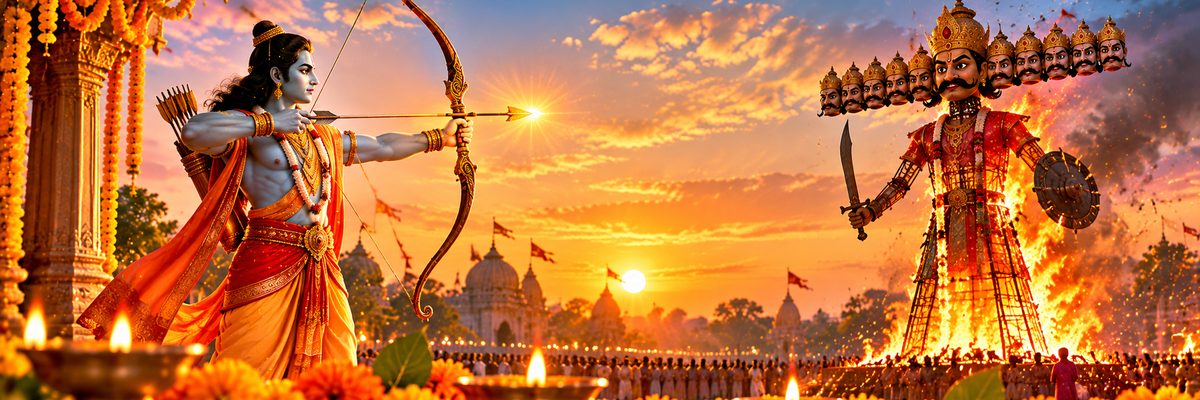
Vijayadashami falls on Tuesday, 20 October 2026. It is one of the very few days in the Hindu calendar that is considered auspicious from start to finish: an abujh muhurat, a day on which good work needs no separately calculated muhurat. That is exactly why families take its rules seriously. A day this auspicious is a day to begin well, and the don'ts that have come down with it are mostly about not spoiling that beginning.
Below are the customs that come up most often: what to avoid, why, and what tradition says is worth starting on this day. Some come from texts, many from long family and regional practice; where a rule is regional rather than universal, it says so.
Dussehra 2026 at a glance
- Vijayadashami: Tuesday, 20 October 2026
- Dashami tithi: from 12:50 pm on 20 October to 2:11 pm on 21 October
- Aparajita puja (aparahna): 1:14 pm to 3:30 pm
- Vijay muhurat: 1:59 pm to 2:45 pm
- Rahu Kaal (Tuesday): roughly 3:00 to 4:30 pm
These timings are for New Delhi; check a local panchang for your city. In Bengal, Durga visarjan and Bijoya Dashami are observed the next day, Wednesday 21 October.
What not to do on Dussehra
1. Don't cut trees or strip their branches
This is the rule people ask about most, and the reason lies in what the day actually worships. Vijayadashami is a day of tree puja. The Shami tree is worshipped because, in the Virata Parva of the Mahabharata, the Pandavas hid their weapons in one for their year in disguise, and Arjuna took them back from it to win the battle that followed. In Maharashtra the apta tree's leaves are exchanged as "gold." Goddess Aparajita is worshipped in the afternoon. Felling or hacking at a green tree on the very day you worship trees as the givers of victory cuts against the meaning of the festival. No major scripture issues a separate ban for Dussehra; the custom follows from the day's own puja, and from the wider respect for trees that runs through Hindu practice.
The practical side matters more than the rule. Every year, apta and Shami trees in towns are stripped bare, and branches are broken off to sell leaves at markets. If you take leaves for the puja:
- Many families take only leaves that have fallen beneath the tree; others pluck a few by hand after the puja. Either way, never break off branches, and bow to the tree first.
- Take them from a tree you can return to, not one already stripped.
- If you buy leaves, buy a small bunch, not armfuls. The custom needs a handful.
- A potted Shami plant at home serves the puja just as well, and lasts for years.
The full Shami and Aparajita puja is in our Shami and Aparajita puja vidhi.
2. Don't insult anyone, especially elders, women and those who serve you
The story of Dussehra is, at heart, the story of what insult costs. When Vibhishana advised Ravana to return Sita, Ravana humiliated him before the whole court (in Tulsidas's telling, he kicked him), and Vibhishana walked out of Lanka to join Rama. When Hanuman came as Rama's envoy, Ravana mocked him and set his tail on fire, and Hanuman burned Lanka with it. Ravana's ruin began with the people he treated with contempt.
Rama shows the other side. After the battle he tells Vibhishana that enmity ends with death, and asks him to give Ravana his last rites with full honour. Even the defeated enemy is not insulted. So on this day, families keep a few simple rules:
- No harsh words, quarrels or taunts at home. If there is a dispute pending, this is a good day to end it, not to start one.
- Touch the feet of elders and take their blessing. In Bengal, Bijoya pranam to elders and embraces among equals close the festival; in Nepal, elders give tika and blessings through Dashain.
- Treat household help, drivers, workers and shopkeepers with extra respect. Many businesses give staff sweets or a bonus on this day, and it is part of the day's meaning, not just a courtesy.
- Don't mock anyone's faith or custom. Some communities honour Ravana as a scholar and devotee of Shiva and don't burn effigies; others celebrate Dashami with non-vegetarian food. Respect both.
3. Don't begin the day's puja or a new venture in Rahu Kaal
Dussehra is an abujh day, but most families still avoid Rahu Kaal for the main puja or a new start. On a Tuesday it falls in the late afternoon, roughly 3:00 to 4:30 pm in Delhi. The Vijay muhurat ends before it, so it is easy to stay clear.
4. Don't stand too close at Ravan Dahan
This is the caution that has cost lives. Effigies are packed with crackers and can fall or throw burning pieces into the crowd. In 2018 in Amritsar, a train ran into people who had gathered on the railway tracks to watch Ravan Dahan, and many died.
- Stay behind the barricades; never watch from railway tracks, roads or weak rooftops.
- Keep children's hands held and away from the front.
- Don't light crackers near the effigy or in the crowd.
- Wait until the fire is completely out before going near the remains, if your family collects a piece of the burnt wood.
5. Don't pay to see a caged Neelkanth bird
Seeing the Neelkanth (Indian roller) on Dussehra is an old and lovely belief, but the bird is protected under the Wildlife (Protection) Act, 1972. People who trap it and carry it around for money are breaking the law and hurting the bird. A caged bird gives no darshan. Look for one in the open instead; our Vijayadashami upay article explains where and when.
6. Don't pollute the river at visarjan
If you immerse a Durga idol or puja materials, take off plastic, cloth and metal first, and use the artificial tanks that many cities set up. Flowers and leaves can go into a garden pit. Immersion is a farewell to the goddess, and leaving a river choked with waste is no way to say it.
7. Don't rush weddings or griha pravesh just because the day is abujh
Dussehra is excellent for new ventures, purchases and learning, but it falls within Chaturmas, the months when Vishnu is said to rest. Most families in North India still wait for Devuthani Ekadashi for weddings and often for griha pravesh. If your family priest says otherwise for your community, follow that.
What is auspicious to do on Dussehra
1. Begin something new
Because the day is abujh, families save beginnings for it. In Maharashtra it is one of the sade teen muhurat, the three and a half most auspicious days of the year, along with Gudi Padwa, Akshaya Tritiya and half of Bali Pratipada. Things commonly started on Dussehra:
- Opening a shop or office, signing a first deal, or starting new account books (see vyapar arambh muhurat)
- Buying a vehicle, tools, machinery or gold (see vahan kharid muhurat)
- Booking land, a flat or a house. Starting construction is different: Chaturmas is avoided for that, so the bhoomi pujan usually waits until after Devuthani Ekadashi
- Starting a new course, skill, instrument or practice
If you can, make the start in the Vijay muhurat, 1:59 to 2:45 pm.
2. Vidyarambham: a child's first letters
In Kerala, Karnataka and Tamil Nadu, books and instruments are placed before Saraswati on Navami and taken up again on Vijayadashami. Small children are initiated into learning that morning: guided by a parent, teacher or priest, they write their first letters, often "Om" or "Hari Shri," with a finger in a plate of rice, and the letters are traced on their tongue with gold. Adults too take up a new subject or art on this day. Anyone can do a simple version at home: a lamp before Saraswati, the child's first letters, and a sweet.
3. Shastra puja: honour your tools of work
Weapons, tools, vehicles, books, laptops and account books are cleaned and worshipped, because Rama, the Pandavas and the goddess all won with the arms they had. The step-by-step method is in our shastra puja vidhi.
4. Shami puja, Aparajita puja and Seemollanghan
The three rites that tradition names for this day are all done in the afternoon: Aparajita puja, Shami puja and Seemollanghan, crossing the boundary of your village or town as a sign of setting out to win. In Maharashtra, apta leaves are then exchanged with the greeting sona ghya, sona sarkha raha, "take gold, and stay as precious as gold."
5. Seek blessings, give, and pray
- Visit elders and take their blessings; send sweets to neighbours and those you have quarrelled with.
- Give quietly to someone in need. Gupt daan is one of the day's oldest customs.
- In the evening, recite the Hanuman Chalisa, Ram Raksha Stotra or Sundarkand, or simply sit with a lamp before Ram.
- Take a sankalp to drop one inner fault. Our article on what Ravana's ten heads symbolise gives a simple way to do it.
Frequently asked questions
Is it really wrong to cut a tree on Dussehra?
No major scripture names Dussehra specifically, but the custom is old and widely kept, because the day's puja is itself tree worship: Shami, apta and Aparajita. If a dangerous or dead tree has to be cleared, do it on another day. Taking a few fallen leaves, or plucking a handful by hand after the puja as some families do, is part of the custom.
Can we buy a new car, gold or property on Dussehra 2026?
Yes, buying is fine; only starting construction is usually put off until after Chaturmas. Vijayadashami is an abujh muhurat and one of the most popular days of the year for such purchases. If possible, complete the purchase or booking during the Vijay muhurat (1:59 to 2:45 pm in Delhi) and avoid Rahu Kaal (about 3:00 to 4:30 pm).
Can a wedding be held on Vijayadashami?
The day is abujh, but in 2026 it falls in Chaturmas, so most North Indian families wait for Devuthani Ekadashi to restart weddings. Some communities do hold engagements or roka ceremonies on Dussehra. Follow your family priest.
Is non-vegetarian food or alcohol allowed on Dussehra?
It depends on the family and region. Many North Indian Hindu households keep the day sattvik, especially when it ends the Navratri fast. In Bengal, Odisha, Nepal and parts of South India, a non-vegetarian meal on Dashami is a long-standing tradition. Alcohol has no place in the puja in any tradition, and none at Ravan Dahan, where crowds and fire mix.
What should we do if we can't go to Ravan Dahan?
Nothing is lost. The essential observances are the afternoon puja, blessings from elders, giving and prayer, all of which can be done at home. Many families light a lamp in the evening and read the Hanuman Chalisa or a chapter of the Ramayana instead.
Can women and children do Shami puja and shastra puja?
Yes. Both pujas are household rites and anyone in the family can perform them. Keep children away from sharp or loaded weapons; they can worship their books and pens instead.
Is Dashami tithi on 21 October also good for these customs?
Dashami lasts until 2:11 pm on 21 October, so the morning of the 21st still falls within it, which is why Bengal observes Bijoya Dashami that day. For North Indian customs such as Aparajita puja and Seemollanghan, the afternoon of 20 October is the time tradition prefers.
Related content
- How to Worship the Shami Tree on Dussehra: Vidhi, Mantra and SignificancePublished8 min read
- Vijayadashami Shastra Puja Vidhi: How to Worship Weapons, Tools and Vehicles at Home and at WorkPublished11 min read
- 5 Traditional Vijayadashami 2026 Upay: Dussehra Customs for Good Fortune, Peace and Prosperity at HomePublished11 min read
- What Do Ravana's 10 Heads Symbolise? How to End the 10 Vices Within This VijayadashamiPublished12 min read
- Dussehra (Vijayadashami)
- Abujh Muhurat: Days So Auspicious They Need No Calculation