
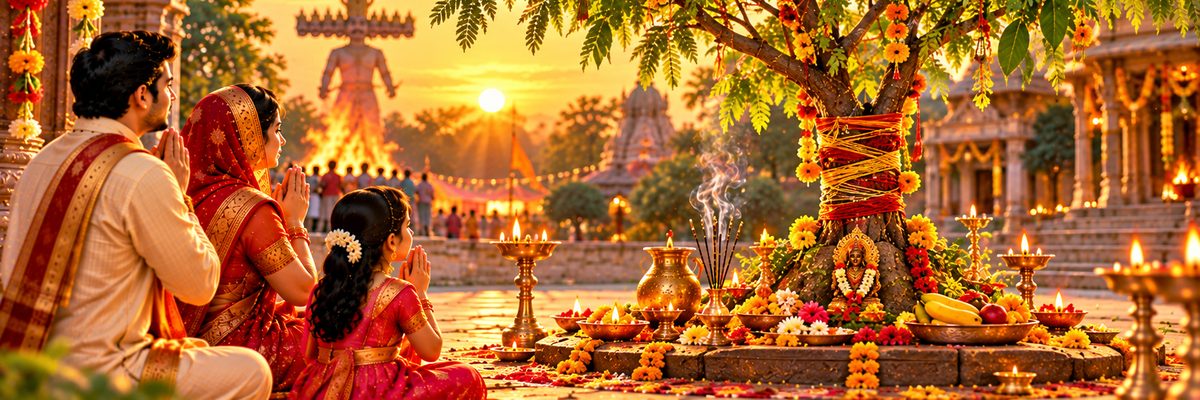
Dussehra 2026: muhurat for Shami and Aparajita puja
- Vijayadashami: Tuesday, 20 October 2026
- Dashami tithi: from 12:50 pm on 20 October to 2:11 pm on 21 October
- Aparajita puja time (aparahna): 1:14 pm to 3:30 pm
- Vijay muhurat: 1:59 pm to 2:45 pm
These timings are for New Delhi; other cities will differ by a few minutes with their own sunrise and sunset, so check your local panchang. In Bengal, Vijayadashami (Durga visarjan) is observed the next day, Wednesday 21 October. For the full festival calendar see Shardiya Navratri 2026.
Tradition names three special rites for Vijayadashami — Aparajita puja, Shami puja and Seemollanghan (crossing the boundary of one's village or town) — all performed in the aparahna, the afternoon portion of Dashami, which is regarded as the hour of victory. Many families do the Shami puja at dusk (pradosh) instead; both customs are followed.
The Mahabharata story: the Pandavas' weapons in the Shami tree
After twelve years in the forest, the Pandavas had to spend one more year in agyatvas — living undiscovered. If they were recognised, the whole exile would begin again. They chose to live in disguise in King Virata's city. The problem was their weapons: Arjuna's Gandiva bow, Bhima's mace and the inexhaustible quivers would have given them away at once.
According to the Virata Parva of the Mahabharata, Arjuna picked a tall, dense Shami tree outside the city, next to a cremation ground — a lonely spot no one visited. Nakula climbed it and tied all the weapons firmly among its branches, and to keep people away the Pandavas also bound a corpse to the tree.
Near the end of the year, when the Kauravas raided Virata's cattle, Arjuna — living as Brihannala — rode out as charioteer to the young prince Uttar. He sent Uttar up the same Shami tree for the weapons. Uttar hesitated at the sight of the corpse, but at Arjuna's word he opened the bundle and was amazed to find the divine Gandiva. There Arjuna revealed who he and his brothers really were, and single-handedly drove back the Kaurava army.
The Shami had guarded the Pandavas' strength for a year, and victory came from the weapons it kept. That is why it is called the tree of victory, and why its prayer calls it Arjunasya dhanurdhari — "bearer of Arjuna's bow". Tradition also holds that Shri Ram worshipped the Shami before marching on Lanka, which is why the prayer calls it Ramasya priyadarshini — "dear to Ram".
Who Goddess Aparajita is
Aparajita means "the one who is never defeated". On Vijayadashami, this victory-giving power of Goddess Durga is worshipped. Shri Ram is believed to have worshipped Aparajita before setting out for Lanka, so it is the custom to seek her blessing before any journey, new venture or struggle. Two attendant powers, Jaya and Vijaya, are worshipped on either side of her.
Note: there is also a blue-flowered creeper called Aparajita (butterfly pea, Vishnukanta) whose flowers are offered to the goddess this day — but Aparajita puja is worship of the goddess, not only of the plant.
Aparajita puja vidhi, step by step
- Place: during the aparahna, choose a clean spot in the north-east (Ishan) of the home — a courtyard, garden or the puja room.
- Ashtadal: purify the spot and draw an eight-petalled lotus (ashtadal chakra) with sandalwood paste, roli or rice flour.
- Sankalpa: holding water, unbroken rice and a flower, resolve to perform the Aparajita puja for your family's wellbeing and success in your work.
- Invocation: invoke Goddess Aparajita at the centre of the lotus with "Om Aparajitayai Namah". On her right, invoke Goddess Jaya with "Om Kriyashaktyai Namah", and on her left, Goddess Vijaya with "Om Umayai Namah".
- Worship: with "Om Aparajitayai Namah", "Om Jayayai Namah" and "Om Vijayayai Namah", offer water, roli, rice, flowers (blue Aparajita flowers if you can), incense, a lamp and sweets — the full sixteen-step shodashopachara or a simple five-step panchopachara.
- Prayer: with folded hands, recite —
हारेण तु विचित्रेण भास्वत्कनकमेखला।
Meaning: May Goddess Aparajita — adorned with a wondrous necklace and a shining golden girdle, devoted to the good — grant me victory.
अपराजिता भद्ररता करोतु विजयं मम॥
Harena tu vichitrena bhasvatkanakamekhala, aparajita bhadrarata karotu vijayam mama. - Farewell: close the puja by asking the goddess's pardon and bidding her farewell —
इमां पूजां मया देवि यथाशक्ति निवेदिताम्।
Meaning: O Devi, accept this worship I have offered as best I could, for our protection, and return to your supreme abode.
रक्षार्थं तु समादाय व्रजस्व स्थानमुत्तमम्॥
Imam pujam maya devi yathashakti niveditam, rakshartham tu samadaya vrajasva sthanamuttamam.
Shami puja vidhi on Dussehra, step by step
- Bathe, put on clean clothes, and prepare a thali: a lota of water (with a little Gangajal if you have it), roli, rice, flowers, incense, a ghee or oil lamp, sweets and a kalava (sacred thread).
- Go to the Shami tree and bow to it. If there is no tree nearby, a potted Shami plant can be worshipped.
- Pour water at its roots, apply a tilak of roli and rice, and offer flowers.
- Light the lamp before the tree and wave the incense.
- Following tradition, place your weapons or the tools of your work — or a symbol of them — under the tree: books and pens for students, account books for traders, implements for farmers. This recalls the Pandavas' weapons kept in the Shami.
- Walk around the tree (3 or 7 times) while winding the kalava, and offer the sweets.
- With folded hands, recite the Shami prayer (below) and pray for obstacles in your work to be removed.
The special Shami mantra
शमी शमयते पापं शमी शत्रुविनाशिनी।
अर्जुनस्य धनुर्धारी रामस्य प्रियदर्शिनी॥
करिष्यमाणयात्रायां यथाकालं सुखं मया।
तत्र निर्विघ्नकर्त्री त्वं भव श्रीरामपूजिते॥
Shami shamayate papam shami shatruvinashini, arjunasya dhanurdhari ramasya priyadarshini. Karishyamanayatrayam yathakalam sukham maya, tatra nirvighnakartri tvam bhava shriramapujite.
Meaning: The Shami quells sin; the Shami destroys enemies. You bore Arjuna's bow and you are dear to Shri Ram. O Shami, worshipped by Shri Ram, in the journey (or undertaking) I am about to begin, grant happiness in due time and remove every obstacle.
In some regions the first couplet is recited a little differently — "Shami shamayate papam shami lohitakantaka, dharinyarjunabananam ramasya priyavadini" ("red-thorned, holder of Arjuna's arrows") — with the same meaning. For offering water to the Shami on ordinary days and Saturdays, see Shami Jal Arpan.
Keeping Shami leaves in the tijori
After the Dussehra puja, many families bring a few Shami leaves home and keep them in the tijori (safe), cash box, wallet or puja shelf. The beliefs behind it:
- A blessing of victory and stability: the tree that kept the Pandavas' strength safe for a year is asked to guard the household's wealth and savings.
- "Gold" for the new season: in Karnataka, Shami leaves (banni in Kannada) are exchanged on Vijayadashami as a token of gold. In Maharashtra the same custom uses the leaves of the apta tree, called sona — a different tree from Shami.
- Shani and Ganesh: in jyotish, Shami is Shani Dev's tree, and its leaves are dear to Ganesh — so it is seen as removing obstacles and easing Saturn's afflictions.
How to keep them: do not pluck leaves from the tree. Tradition says to take only leaves that have fallen beneath the tree after the puja, as its blessing. Wrap them in red cloth with a few grains of rice and a coin, and keep them in the safe or puja place. On the next Dussehra, return the old leaves to the roots of a tree or to flowing water, and keep fresh ones.
This is a custom of faith, not a guaranteed remedy. Its real meaning is a reminder that wealth and success last only alongside dharma and honest effort.
Seemollanghan and shastra puja
After Aparajita and Shami puja, the traditional next step is Seemollanghan — walking to the boundary of the village or neighbourhood and back, a symbol of setting out on new journeys and campaigns; kings once began military expeditions on this day. It is also the day of shastra puja (Ayudha puja in South India), when tools, vehicles and instruments of work are worshipped. Ravan Dahan follows in the evening. Read the Dussehra katha and the festival guide to Dussehra.
Things to keep in mind
- Shami is a thorny tree — take care while circling it and tying the kalava, especially with children.
- Don't break branches or pluck green leaves; take only fallen leaves.
- Do the Aparajita puja in the aparahna; if that isn't possible, do it while Dashami lasts in a good choghadiya, avoiding Rahu Kaal.
- Vijayadashami is itself an Abujh muhurat — no separate muhurat is needed to start new work, buy a vehicle or begin a child's education.
Frequently asked questions
When should Shami puja be done on Dussehra?
The classical time is the aparahna (1:14 pm to 3:30 pm in New Delhi in 2026); many families also worship the Shami at dusk.
What if there is no Shami tree nearby?
Worship a potted Shami plant, or visit a temple that has one. Bringing a Shami plant home and planting it on Dussehra is itself considered auspicious.
Which mantras are used in Aparajita puja?
"Om Aparajitayai Namah" to invoke the goddess, "Om Kriyashaktyai Namah" for Jaya, "Om Umayai Namah" for Vijaya, and the prayer "Harena tu vichitrena bhasvatkanakamekhala, aparajita bhadrarata karotu vijayam mama."
Related content
- Maa Durga
- How to Offer Water to the Shami Tree – Mantra, Vidhi & Rules
- Dussehra (Vijayadashami)
- The Story of Dussehra: Rama, Durga, the Shami Tree and Raghu's Gold
- Shardiya Navratri 2026: Kalash Sthapana Muhurat and Day-by-Day Puja DatesPublished4 min read
- Abujh Muhurat: Days So Auspicious They Need No Calculation