
Shardiya Navratri 2026 at a glance
Shardiya Navratri — the autumn Navratri of the month of Ashwin, and the one most households and pandals celebrate — runs this year from Sunday, 11 October 2026 (kalash sthapana) to Tuesday, 20 October 2026 (Vijayadashami). The dates and timings below are as calculated by Jyotishacharya Harendra Chaubey. Muhurat times are worked out from sunrise, which shifts by a few minutes from city to city, so if you are performing the kalash sthapana at the edge of a window, confirm it against your local panchang or family purohit.
Day 1 — Kalash sthapana and Maa Shailputri (Sunday, 11 October)
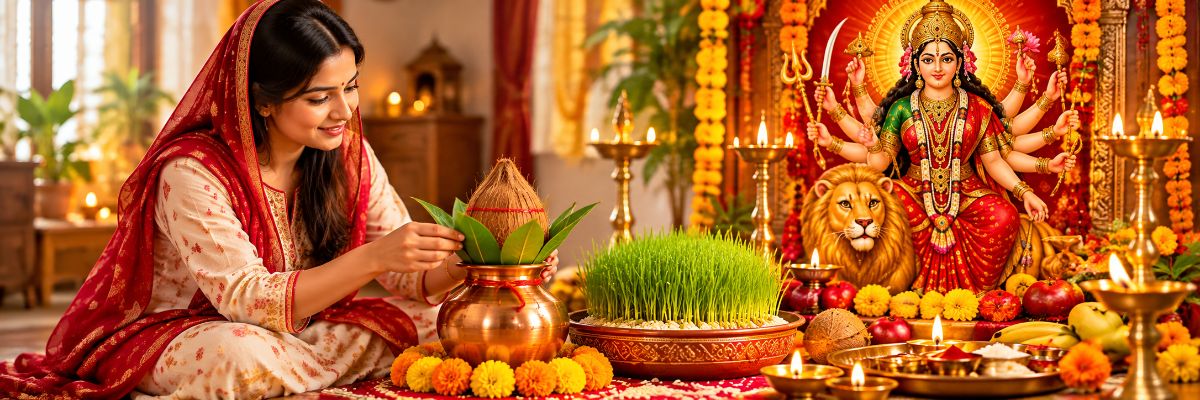
Navratri begins by establishing the kalash — a water pot representing the Devi's presence, usually set beside a bed of soil sown with barley (jau) that is tended for all nine days. On this day Maa Shailputri, the daughter of the mountain king Himavan and the first of the nine forms (Navadurga), is worshipped.
- Kalash sthapana: favourable from 7:03 am until sunset.
- First muhurat: 6:31 am to 11:00 am is also named as excellent.
- Special Abhijit muhurat: 11:35 am to 12:23 pm — the best window of the day.
If your day allows only one choice, the Abhijit muhurat is the one Panditji marks as the most auspicious.
Days 2 to 6 — the next five forms of the Devi
- Day 2, Monday 12 October: Maa Brahmacharini, the Devi as a young ascetic in penance.
- Day 3, Tuesday 13 October: Maa Chandraghanta, who wears a crescent moon shaped like a bell.
- Day 4 (Chaturthi), Wednesday 14 October: Maa Kushmanda, worshipped as the creator of the cosmic egg.
- Day 5 (Panchami), Thursday 15 October: Maa Skandamata, the mother of Kartikeya (Skanda).
- Day 6 (Shashthi), Friday 16 October: Maa Katyayani, born in the ashram of sage Katyayana.
Shashthi evening — bilva abhimantran (16 October)
On the evening of Shashthi, the Devi is formally invited into a branch of the bel (bilva) tree — the rite known as bilva abhimantran, which prepares for her installation the next morning. This year it can be performed by anyone at any time between 2 pm and 6 pm on 16 October.
Maha Saptami — Maa Kalaratri, navapatrika and the opening of the pat (Saturday, 17 October)
Saptami is when pandal worship truly begins. Maa Kalaratri, the fierce dark form who destroys fear, is worshipped, and several rites happen together: the doli yatra (the Devi carried in procession), navapatrika pravesh (a bundle of nine plants representing the nine Durgas is bathed and brought in), the pran pratishtha of the murti, and pat pradarshan — the curtain in front of the idol is opened and devotees have their first darshan. Worship continues through the day after the pat opens.
Maha Ashtami — Maa Mahagauri, kumarika puja and Mahanisha puja (Sunday, 18 October)
Ashtami carries the Ashtami vrat, the worship of Maa Mahagauri, and kumarika puja, in which young girls are honoured as living forms of the Devi. At night comes the Mahanisha puja, the most intense worship of Navratri, held in the deep of night — this year from 11:00 pm to 1:30 am.
Maha Navami — Durga Navami and the Navratri havan (Monday, 19 October)
Navami is traditionally dedicated to Maa Siddhidatri, the ninth form, who grants spiritual accomplishment. After the Navami vrat puja, the Navratri havan can be performed from 7:00 am on 19 October — through the day and the night — until 9:40 am on Tuesday, 20 October, when the purnahuti (final offering) must be complete.
Dashami — Vijayadashami and breaking the fast (Tuesday, 20 October)
Homes and pandals complete their Navami puja by 9:40 am. After 9:40 am, in Shravan nakshatra, the Dashami rites follow: Dashami puja, Shami puja, Aparajita puja, jayanti grahan (receiving the barley shoots grown beside the kalash since Day 1 as the Devi's blessing), and the visarjan of Saraswati and of the Devi. Those who kept the fast for all nine days then do their parana — the formal breaking of the Navratri vrat.
Panditji's blessing for this year
This year the Mother arrives on a Sunday and departs on a Tuesday. Panditji's wish for every devotee is long life and good health, happiness and good fortune, children and descendants, plenty of food and wealth, complete contentment, and an open path forward — may the coming times make everyone's life happy and auspicious. May this Shardiya Navratri be joyful, blessed and auspicious for every devotee of Maa.