
Before you begin
Navratri at home rests on three things: the kalash sthapana on the first morning, the vrat (fast) you keep for the nine days, and the puja you offer each morning and evening. None of it needs a priest, though many families call one for the sthapana. What matters is that you do it with attention and keep it up for all nine days. This guide follows the order in which you will actually do things. For this year's dates and muhurat, see Shardiya Navratri 2026: Kalash Sthapana Muhurat and Day-by-Day Puja Dates.
The Devi Bhagavata Purana, which gives the oldest detailed account of the Navratri vow (Book 3, chapter 26), says preparation starts the day before. On Amavasya, gather everything you will need and eat only one simple sattvic meal. Clean the house thoroughly, especially the place where the kalash will stand.
What to gather (samagri)
- For the kalash: a kalash of copper, brass or clay; Ganga water, or clean water with a little Ganga jal mixed in; a coin; a whole betel nut (supari); a little turmeric, akshat (unbroken rice) and durva grass; 5 mango or ashoka leaves; a dry coconut with its husk (jata wala nariyal); red cloth or chunri; and moli (red-yellow sacred thread).
- For sowing jau: a wide clay pot or tray, clean soil (ideally from a field or riverbank), and barley seeds soaked overnight.
- For the Devi: a picture or murti of Maa Durga, a wooden chauki with a red cloth, red chunri, flowers (red ones especially, such as hibiscus), roli, kumkum, sindoor, chandan, and shringar items (bangles, bindi, mehendi, a small mirror and comb).
- For the puja: a ghee lamp (and a large one if you keep an akhand jyoti), dhoop or agarbatti, camphor, a bell, a conch if you have one, and naivedya: fruit, mishri, batashe, and a sweet you make yourself.
- For the later days: havan samagri, mango wood and ghee for Ashtami or Navami, and gifts for kanya pujan.
Kalash sthapana, step by step
The kalash is set up on the morning of Pratipada, the first day of the bright fortnight. Choose the muhurat given in your panchang. The Abhijit muhurat around midday is widely considered the best window if the morning is not possible.
- Bathe and sit facing east or north. Wear clean clothes, preferably unstitched or freshly washed. The north-east corner of the house (ishan kon) is the traditional place for the sthapana.
- Take the sankalp. Hold water, akshat and a flower in your right hand, and say your name, gotra, the place and the date, and that you are beginning the Navratri vow for the Devi's grace. The Devi Bhagavata gives the essence in one line: "O Mother of the world, I will perform this excellent Navratri vow; be pleased to help me in every way." Then let the water fall to the ground.
- Worship Ganesh first. Every puja begins with Ganesh. A betel nut wrapped in moli on a little heap of rice serves as Ganesh if you have no murti.
- Sow the jau. Spread the soil in the pot, scatter the soaked barley over it evenly, cover it with a thin layer of soil, and sprinkle a little water.
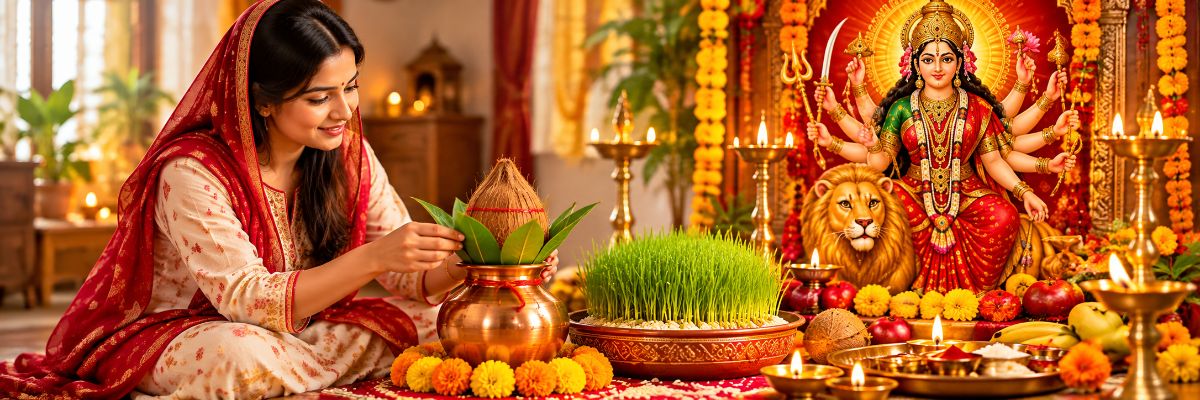
- Prepare the kalash. Draw a swastik on it with roli and tie moli three times around its neck. Fill it with water and add the Ganga jal, coin, supari, turmeric, akshat and durva. Place it on the soil in the middle of the jau, or on a small heap of rice beside it.
- Add the leaves and coconut. Arrange the five mango or ashoka leaves in the mouth of the kalash so their tips point outward. The Devi Bhagavata also asks for five sprigs of young leaves. Wrap the coconut in red cloth, tie it with moli, and set it on the leaves with its tuft (the pointed end) facing up.
- Invoke the deities in the kalash. With folded hands, recite the kalash prayer:
The kalash now holds all the gods, the sacred rivers and the Vedas, and it is worshipped as the Devi's seat for the nine days.कलशस्य मुखे विष्णुः कण्ठे रुद्रः समाश्रितः ।
मूले त्वस्य स्थितो ब्रह्मा मध्ये मातृगणाः स्मृताः ॥"In the mouth of the kalash dwells Vishnu, in its neck Rudra, at its base Brahma, and in its middle the Mother goddesses."
- Install the Devi. Spread the red cloth on the chauki, place the picture or murti of Maa Durga facing you, offer the chunri and shringar, and do the first puja (below). The Devi Bhagavata allows the kalash alone if you have no image, so a family without a murti is not doing anything incomplete.
- Light the akhand jyoti (if you keep one). An akhand jyoti is a ghee lamp that burns day and night for all nine days. It is a vow in itself, so only take it on if someone can watch it and top up the ghee. A lamp lit at each morning and evening puja is entirely enough.
The daily puja
Do the puja twice a day, morning and evening, at roughly the same time. It takes 20 to 40 minutes. A simple order (panchopachar, the five-fold offering):
- Sprinkle water on yourself and the place, light the lamp and dhoop, and ring the bell.
- Offer a little water to the kalash and to the jau.
- Offer roli or kumkum, akshat and flowers to the Devi and the kalash.
- Offer naivedya (fruit, mishri or the day's bhog) and a little water after it.
- Chant or read. The most common choices are the Durga Chalisa, the Durga Kavach, or the Durga Saptashati (Devi Mahatmya). The Saptashati can be read in full every day, or spread over the nine days. You can also do japa of the navarna mantra, ॐ ऐं ह्रीं क्लीं चामुण्डायै विच्चे, on a rudraksha or red sandalwood mala.
- Do the aarti, usually Jai Ambe Gauri, with camphor or a ghee lamp, and end with this prayer from the Saptashati (11.10):
सर्वमङ्गलमङ्गल्ये शिवे सर्वार्थसाधिके ।
शरण्ये त्र्यम्बके गौरि नारायणि नमोऽस्तु ते ॥"O auspicious one, source of all that is auspicious, who fulfils every aim, refuge of all, three-eyed Gauri, Narayani, salutations to you."
- Ask forgiveness for any mistakes in the puja, and share the prasad.
Each of the nine days is dedicated to one form of the Navadurga, from Shailputri on the first day to Siddhidatri on the ninth. Many families offer that form's favourite bhog and wear a colour of the day. The date-wise list for this year is in the Navratri 2026 calendar.
How to keep the vrat
Choose a fast you can keep
The fast is a vow, so choose one you can keep for all nine days rather than one that breaks on the third. Families commonly follow one of these:
- All nine days, phalahar: one or two meals a day of fasting food (below), the most common choice.
- All nine days, one meal: a single phalahari meal after the evening puja, with fruit, milk or water through the day.
- First and last day only: fasting on Pratipada and on Ashtami (or Navami), for those who cannot fast all nine days. This is a recognised practice in many families, not a shortcut.
- Nirjal (without water): some devotees keep it on Ashtami. It is not recommended for the full nine days.
What you can eat
- Fruits, milk, curd, paneer, buttermilk and makhana.
- Flours that are not grains: kuttu (buckwheat), singhara (water chestnut), rajgira (amaranth), and samak (barnyard millet, also called vrat ke chawal).
- Sabudana, potato, sweet potato, arbi (colocasia), raw banana, pumpkin and lauki.
- Peanuts, dry fruits and nuts.
- Sendha namak (rock salt) instead of ordinary salt. Black pepper, cumin, green chilli and ginger are generally accepted.
What to avoid
- Wheat, rice, dal and other grains and pulses.
- Ordinary table salt.
- Onion, garlic, meat, eggs, alcohol and tobacco, for the whole household if possible.
Customs differ from family to family, for example on turmeric or tomato, so follow your own tradition where it is clear.
Beyond food
The fast is not only about food. The Devi Bhagavata asks the person keeping the vow to sleep on the ground and keep the senses restrained for the nine days. In practice, that means brahmacharya, avoiding anger, gossip and harsh words, keeping the kalash area clean, and not cutting hair or nails during the nine days, which is a common custom. Many people also give up something they enjoy, such as television, for the nine days.
A word on health
If you are diabetic, pregnant, elderly, on regular medication or recovering from illness, keep a gentler fast: phalahar twice a day, plenty of water, and no nirjal days. Ask your doctor if you are unsure. Devotion is measured by sincerity, not by how hungry you are. Fried kuttu puris three times a day are not much of a fast either. Keep the food light.
Ashtami, Navami and kanya pujan
On Ashtami or Navami, according to family custom, many households do a small havan with the navarna mantra or the Saptashati verses, and then kanya pujan, worshipping young girls as forms of the Devi. The Devi Bhagavata names the girls by age, from two to ten years: Kumari (2), Trimurti (3), Kalyani (4), Rohini (5), Kalika (6), Chandika (7), Shambhavi (8), Durga (9) and Subhadra (10). Usually nine girls are invited, along with one boy as "Langur" (Bhairav).
- Wash their feet, sit them on a clean mat, and apply roli and akshat.
- Tie moli on their wrists, offer a chunri or flowers, and feed them halwa, puri and black chana, the traditional kanya bhog.
- Give them a gift and some dakshina, touch their feet, and see them off with respect.
Parana and visarjan
Parana (breaking the fast) is done according to family custom: after the kanya pujan and havan on Navami, or on the morning of Dashami. Break it with the prasad, and keep the first meal simple.
On Dashami, after a final puja, the kalash is ceremonially moved, which is the visarjan.
- Sprinkle the kalash water around the house with the mango leaves as a blessing, and pour the rest at the root of a tulsi or another plant.
- Take the coconut as prasad and share it in the family.
- The jau, now grown into green shoots (jayanti), is a sign of the Devi's blessing. Keep a few blades in the puja place, your wallet or your locker. Immerse the rest, with the soil, in a river or put it under a tree.
- Keep the coin and supari in the puja place or in your locker.
Then fold your hands and ask the Devi to return next year.
Common questions
The akhand jyoti went out. What now?
Relight it from another lamp or with a matchstick, ask the Devi's forgiveness, and carry on. It is not a bad omen. The vow is your care, not the flame.
The jau didn't sprout well. Does it mean something?
Barley sprouts depend on seed, soil, water and warmth. Use fresh seed, soak it overnight, keep the soil damp but not soaked, and keep the pot away from direct heat. Don't read omens into it.
Can I do Navratri without a kalash?
Yes. Lighting a lamp before the Devi's picture every morning and evening and reading the Chalisa or Saptashati is a complete observance. The kalash sthapana is the fuller form, not a requirement.
I work in an office. Can I still keep the fast?
Yes. Do a short morning puja before work and the main puja in the evening, carry fruit and makhana, and choose phalahar rather than a single meal. Keeping it up quietly for nine days is worth more than a strict fast you can't sustain.