Original text
जय अम्बे गौरी, मैया जय श्यामा गौरी । तुमको निशदिन ध्यावत, हरि ब्रह्मा शिव री ॥ ॥ ॐ जय अम्बे गौरी… ॥ मांग सिंदूर विराजत, टीको मृगमद को । उज्ज्वल से दोउ नैना, चंद्रवदन नीको ॥ ॥ ॐ जय अम्बे गौरी… ॥ कनक समान कलेवर, रक्ताम्बर राजै । रक्तपुष्प गल माला, कंठन पर साजै ॥ ॥ ॐ जय अम्बे गौरी… ॥ केहरि वाहन राजत, खड्ग खप्पर धारी । सुर-नर-मुनिजन सेवत, तिनके दुखहारी ॥ ॥ ॐ जय अम्बे गौरी… ॥ कानन कुण्डल शोभित, नासाग्रे मोती । कोटिक चंद्र दिवाकर, सम राजत ज्योती ॥ ॥ ॐ जय अम्बे गौरी… ॥ शुंभ-निशुंभ बिदारे, महिषासुर घाती । धूम्र विलोचन नैना, निशदिन मदमाती ॥ ॥ ॐ जय अम्बे गौरी… ॥ चण्ड-मुण्ड संहारे, शोणित बीज हरे । मधु-कैटभ दोउ मारे, सुर भयहीन करे ॥ ॥ ॐ जय अम्बे गौरी… ॥ ब्रह्माणी, रुद्राणी, तुम कमला रानी । आगम निगम बखानी, तुम शिव पटरानी ॥ ॥ ॐ जय अम्बे गौरी… ॥ चौंसठ योगिनी मंगल गावत, नृत्य करत भैरों । बाजत ताल मृदंगा, अरु बाजत डमरू ॥ ॥ ॐ जय अम्बे गौरी… ॥ तुम ही जग की माता, तुम ही हो भरता । भक्तन की दुख हरता, सुख संपति करता ॥ ॥ ॐ जय अम्बे गौरी… ॥ भुजा चार अति शोभित, वर मुद्रा धारी । मनवांछित फल पावत, सेवत नर नारी ॥ ॥ ॐ जय अम्बे गौरी… ॥ कंचन थाल विराजत, अगर कपूर बाती । श्रीमालकेतु में राजत, कोटि रतन ज्योती ॥ ॥ ॐ जय अम्बे गौरी… ॥ श्री अंबेजी की आरति, जो कोइ नर गावे । कहत शिवानंद स्वामी, सुख-संपति पावे ॥ ॥ ॐ जय अम्बे गौरी… ॥
Transliteration
Jai Ambe Gauri, Maiya Jai Shyama Gauri. Tumko Nishdin Dhyavat, Hari Brahma Shiv Ri. (Refrain: Om Jai Ambe Gauri) Maang Sindoor Virajat, Tiko Mrigmad Ko. Ujjval Se Dou Naina, Chandravadan Niko. (Refrain) Kanak Saman Kalevar, Raktambar Rajai. Raktapushp Gal Mala, Kanthan Par Sajai. (Refrain) Kehari Vahan Rajat, Khadag Khappar Dhari. Sur-Nar-Munijan Sevat, Tinke Dukhhari. (Refrain) Kanan Kundal Shobhit, Nasagre Moti. Kotik Chandra Divakar, Sam Rajat Jyoti. (Refrain) Shumbh-Nishumbh Bidare, Mahishasur Ghati. Dhumra Vilochan Naina, Nishdin Madmati. (Refrain) Chand-Mund Sanhare, Shonit Beej Hare. Madhu-Kaitabh Dou Mare, Sur Bhayheen Kare. (Refrain) Brahmani, Rudrani, Tum Kamala Rani. Agam Nigam Bakhani, Tum Shiv Patrani. (Refrain) Chaunsath Yogini Mangal Gavat, Nritya Karat Bhairon. Bajat Taal Mridanga, Aru Bajat Damru. (Refrain) Tum Hi Jag Ki Mata, Tum Hi Ho Bharta. Bhaktan Ki Dukh Harta, Sukh Sampati Karta. (Refrain) Bhuja Char Ati Shobhit, Var Mudra Dhari. Manvanchhit Phal Pavat, Sevat Nar Nari. (Refrain) Kanchan Thaal Virajat, Agar Kapoor Baati. Shrimalketu Mein Rajat, Koti Ratan Jyoti. (Refrain) Shri Ambeji Ki Aarti, Jo Koi Nar Gave. Kahat Shivanand Swami, Sukh-Sampati Pave. (Refrain)
Who wrote it
Unlike many aartis, this one is signed. The last verse says kahat Shivanand Swami, "so says Shivanand Swami": whoever sings Shri Ambe's aarti gains happiness and prosperity. That signature line is the only certain fact we have about its author. The aarti itself has become the standard Durga aarti across North and West India, and it is the one most people mean when they say "Mata ki aarti".
Her form
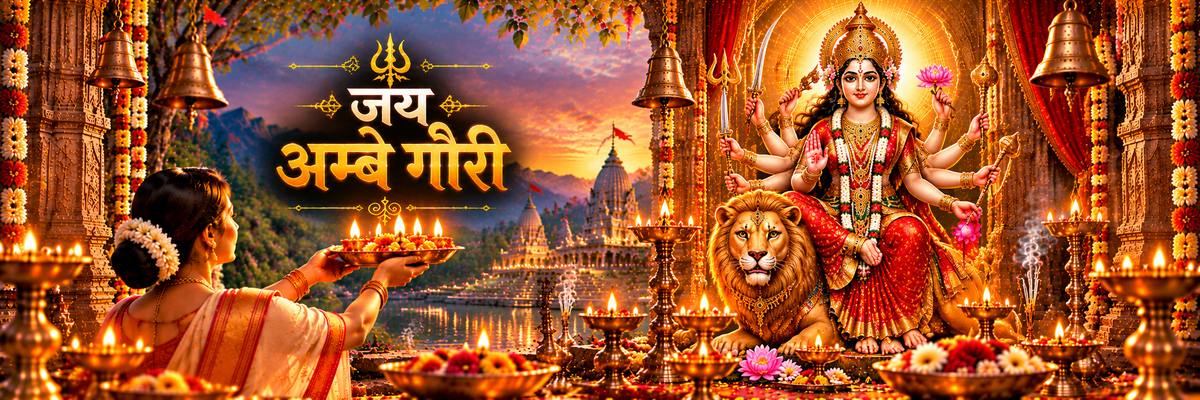
The first half of the aarti is a dhyana, a picture to hold in the mind while the lamp is waved. Hari, Brahma and Shiva meditate on her day and night. She has sindoor in the parting of her hair and a tilak of musk (mrigmad). Her two eyes are bright and her face is lovely as the moon. Her body is the colour of gold, she wears red, and a garland of red flowers lies at her throat. She rides a lion (kehari) and carries a sword and a skull-bowl (khappar). Earrings shine at her ears, a pearl hangs at the tip of her nose, and her radiance equals ten million moons and suns.
The battles it names
Two verses list her victories, and every one comes from the Durga Saptashati (the Devi Mahatmya):
- Madhu and Kaitabh, the two demons killed in the first episode, when the goddess as Yoganidra releases Vishnu from sleep.
- Mahishasura, the buffalo demon of the middle episode. Navratri and Vijayadashami celebrate this victory.
- Dhumralochana ("smoke-eyed"), Chanda and Munda, and Raktabija. The aarti calls him shonit beej, the demon from whose every drop of blood (shonit) a new demon sprang.
- Shumbha and Nishumbha, the two brothers whose defeat closes the Saptashati.
Every one of these victories ends with the same result the aarti names: sur bhayheen kare, "she made the gods free of fear."
All goddesses in one
The later verses widen the picture. She is Brahmani, Rudrani and Kamala (Lakshmi), praised by the Agamas and the Vedas (agam nigam), and Shiva's chief queen. The sixty-four yoginis sing auspicious songs, Bhairav dances, and drums and the damru sound. She is mother and sustainer of the world, who takes away the devotees' pain and gives happiness and wealth. With four arms she shows the vara mudra, the gesture of granting boons, and men and women who serve her receive what they long for. The next verse describes the aarti itself: a golden plate with agar and a camphor wick, shining like countless jewels.
When it is sung
It is sung morning and evening through both Navratris, at mata ki chowki and all-night jagrans, on Fridays, and in Durga Puja pandals. It is also sung on vrat days like Karva Chauth and Gangaur, when women worship the goddess as Gauri. After the aarti many families recite the Durga Chalisa or the Durga Kavach. For the dates of this year's festival, see our Shardiya Navratri 2026 guide.
Spotted a mistake?
If you find any grammatical, Hindi, English, mantra-text or other mistake on this page, tell us — we will correct it within 24 hours.