
Original text
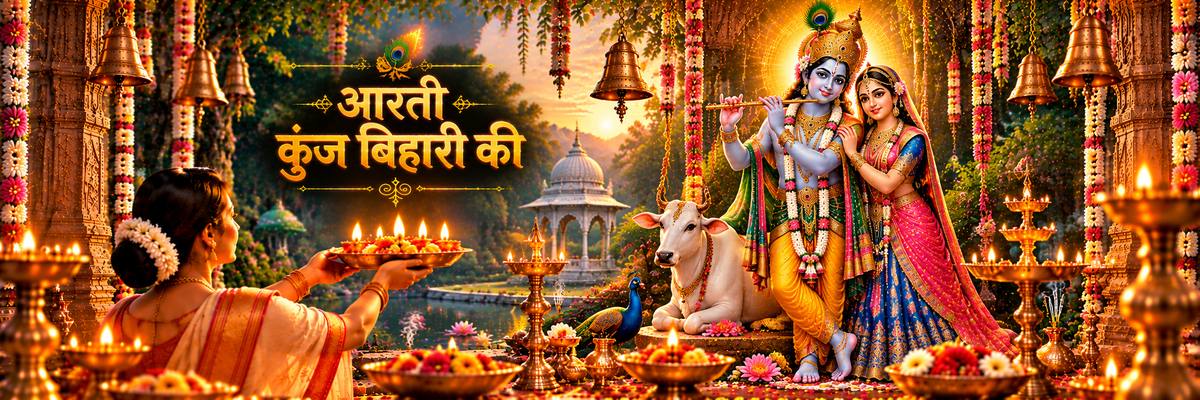
आरती कुंजबिहारी की, श्री गिरिधर कृष्ण मुरारी की ॥ गले में बैजंती माला, बजावै मुरली मधुर बाला । श्रवण में कुण्डल झलकाला, नंद के आनंद नंदलाला । गगन सम अंग कांति काली, राधिका चमक रही आली । लतन में ठाढ़े बनमाली, भ्रमर सी अलक, कस्तूरी तिलक, चंद्र सी झलक, ललित छवि श्यामा प्यारी की ॥ श्री गिरिधर कृष्ण मुरारी की ॥ ॥ आरती कुंजबिहारी की… ॥ कनकमय मोर मुकुट बिलसै, देवता दरसन को तरसैं । गगन सों सुमन रासि बरसै, बजे मुरचंग, मधुर मिरदंग, ग्वालिन संग, अतुल रति गोप कुमारी की ॥ श्री गिरिधर कृष्ण मुरारी की ॥ ॥ आरती कुंजबिहारी की… ॥ जहां ते प्रकट भई गंगा, कलुष कलि हारिणि श्री गंगा । स्मरन ते होत मोह भंगा, बसी शिव सीस, जटा के बीच, हरै अघ कीच, चरन छवि श्री बनवारी की ॥ श्री गिरिधर कृष्ण मुरारी की ॥ ॥ आरती कुंजबिहारी की… ॥ चमकती उज्ज्वल तट रेनू, बज रही वृंदावन बेनू । चहुं दिसि गोपि ग्वाल धेनू, हंसत मृदु मंद, चांदनी चंद, कटत भव फंद, टेर सुन दीन दुखारी की ॥ श्री गिरिधर कृष्ण मुरारी की ॥ आरती कुंजबिहारी की, श्री गिरिधर कृष्ण मुरारी की ॥
Transliteration
Aarti Kunj Bihari Ki, Shri Girdhar Krishna Murari Ki. Gale Mein Baijanti Mala, Bajavai Murli Madhur Bala. Shravan Mein Kundal Jhalkala, Nand Ke Anand Nandlala. Gagan Sam Ang Kanti Kali, Radhika Chamak Rahi Aali. Latan Mein Thadhe Banmali, Bhramar Si Alak, Kasturi Tilak, Chandra Si Jhalak, Lalit Chhavi Shyama Pyari Ki. Shri Girdhar Krishna Murari Ki. (Refrain) Kanakmay Mor Mukut Bilsai, Devta Darsan Ko Tarsain. Gagan Son Suman Rasi Barsai, Baje Murchang, Madhur Mirdang, Gvalin Sang, Atul Rati Gop Kumari Ki. Shri Girdhar Krishna Murari Ki. (Refrain) Jahan Te Prakat Bhai Ganga, Kalush Kali Harini Shri Ganga. Smaran Te Hot Moh Bhanga, Basi Shiv Sees, Jata Ke Beech, Harai Agh Keech, Charan Chhavi Shri Banvari Ki. Shri Girdhar Krishna Murari Ki. (Refrain) Chamakti Ujjval Tat Renu, Baj Rahi Vrindavan Benu. Chahun Disi Gopi Gval Dhenu, Hansat Mridu Mand, Chandani Chand, Katat Bhav Phand, Ter Sun Deen Dukhari Ki. Shri Girdhar Krishna Murari Ki. Aarti Kunj Bihari Ki, Shri Girdhar Krishna Murari Ki.
What the refrain calls him
The refrain packs three of Krishna's names into two lines. Kunj Bihari is "the one who wanders in the kunj": the shaded groves of creepers along the Yamuna at Vrindavan, where his childhood and the ras lila take place. Girdhar is "the holder of the mountain", from the story of Krishna lifting Govardhan to shelter Braj from Indra's storm. Murari is "the enemy of Mura", the demon he killed. The aarti is written in Braj Bhasha, the language of the Krishna country, which is why you hear forms like bajavai, tarsain and gagan son instead of standard Hindi. Unlike many aartis it has no closing signature line naming a poet, and its author isn't reliably recorded.
Verse by verse
- First verse, his form: the Vaijayanti garland at his neck, the sweet flute he plays, earrings shining at his ears, the joy of Nanda. His body is dark like the sky, and Radha shines beside him. He stands among the creepers as Banmali, the one who wears a garland of forest flowers. His curls are dark as a black bee, there is a musk tilak on his brow and a glow like the moon, and the verse ends on the lovely image of Shyama's beloved.
- Second verse, the ras: a golden peacock crown gleams on his head, and the gods themselves long for a glimpse of him. Flowers rain from the sky, and the murchang (jaw harp) and mridang play. He is among the gopis, and the verse speaks of the incomparable love of the cowherd girls.
- Third verse, his feet: the aarti turns to the feet "from which the Ganga appeared". This follows the tradition that the Ganga flows from Vishnu's foot, which is why she is called Vishnupadi. It calls her kalush kali harini, the one who takes away the impurity of the Kali age: remembering her breaks delusion, she came to rest in Shiva's matted hair, and she washes away the mire of sin. So the verse honours the beauty of Banvari's (Krishna's) feet.
- Fourth verse, the plea: the sand of the Yamuna's banks glitters, the flute sounds through Vrindavan, and gopis, cowherds and cows are all around. He smiles softly under the moonlight, and the bonds of worldly existence are cut. The last line is the devotee's own request: ter sun deen dukhari ki, "hear the cry of this suffering, helpless one."
When it is sung
This is the aarti most North Indian homes sing to Krishna at the evening lamp. It is also the aarti of Janmashtami, sung at midnight when the image of baby Krishna is bathed, dressed and placed in the cradle. In Vrindavan and across Braj it is part of the ordinary daily round of temple worship. As with any aarti, the lamp is circled in front of the image while it is sung. Many families follow it with Om Jai Jagdish Hare, and it pairs naturally with the Krishna Chalisa or a short Krishna mantra.
Variant readings
Printed versions differ in a couple of places. In the third verse, some read sakal man harini Shri Ganga ("Ganga who captivates every heart") instead of kalush kali harini. In the last verse, some read deen bhikhari ("the poor beggar") instead of deen dukhari ("the poor sufferer"). Neither changes the sense. We give the readings found in the published sources we checked, and if your family sings the other, there's no need to change.
Spotted a mistake?
If you find any grammatical, Hindi, English, mantra-text or other mistake on this page, tell us — we will correct it within 24 hours.