
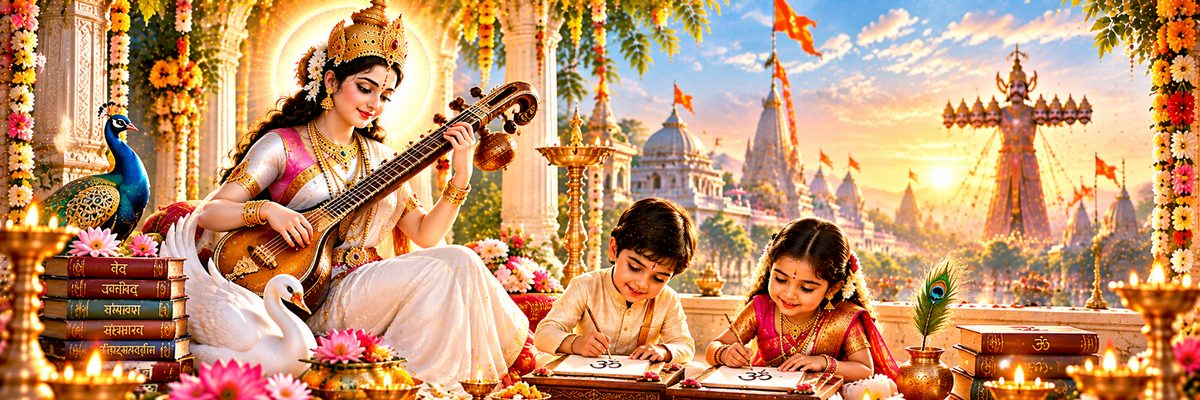
Few moments in a child's life are as simple and as moving as this one. A parent or teacher sits the child on their lap, takes the small right hand, and guides one finger through a plate of raw rice to trace the first letters the child will ever write. In Kerala it is Vidyarambham, in Andhra Pradesh and Telangana Aksharabhyasam, in Tamil Nadu Mutal Eluttu ("the first letter"), and in North India the Vidyarambh sanskar. Across all of them, the favourite day is Vijayadashami.
This guide gives the 2026 dates and timings, the full vidhi you can do at home, the Saraswati puja rules that go with it, and what the ritual means.
Vidyarambh muhurat 2026
This year the date depends on which tradition your family follows, because Dashami tithi begins in the afternoon of one day and ends in the afternoon of the next:
- Dashami tithi: from 12:50 pm on Tuesday 20 October to 2:11 pm on Wednesday 21 October
- Kerala and Karnataka: Vidyarambham is on Wednesday, 21 October 2026, the day on which Dashami prevails at sunrise (Mysuru Dasara is also on the 21st). Temples hold ceremonies from early morning. Complete it before Dashami ends at 2:11 pm; the earlier the better.
- Tamil Nadu, Andhra Pradesh and Telangana: local calendars can differ on whether Vijayadashami is the 20th or the 21st, so confirm with your temple. If it is the 21st, follow the morning window above; if the 20th, the afternoon window below.
- North Indian families doing it on Dussehra itself (Tuesday, 20 October): the morning of the 20th is still Navami, so wait until Dashami begins at 12:50 pm. The best window is the Vijay muhurat, 1:59 to 2:45 pm, the same window used for shastra puja.
- Avoid Rahu Kaal: roughly 3:00 to 4:30 pm on Tuesday, and roughly 12:00 noon to 1:30 pm on Wednesday.
These timings are for New Delhi; sunrise-based windows shift a few minutes from city to city. If your temple or family priest has fixed a time, follow it.
What the Vidyarambh sanskar is
Vidyarambha, "the beginning of learning," is one of the sanskaras, the rites that mark the stages of a Hindu life. In the classical order it comes after the first haircut (chudakarana or mundan) and before upanayana, the sacred-thread initiation that once marked the start of Vedic study. It was the moment a child was introduced to letters, before formal schooling began. Today it is done for girls and boys alike, by families of every background.
Children are usually between two and five years old, most often around three. There is no rule that a child must be any particular age. The best time is when the child is ready to sit for a few minutes and hold a finger out.
Why Vijayadashami?
The last days of Navratri are dedicated to Saraswati, goddess of learning, music and speech. In Kerala and the South, books, instruments and the tools of one's trade are placed before her for puja (puja vaippu) and not used until Dashami morning, when they are taken back (puja eduppu). Starting a child's learning at the very moment the goddess's blessing is received back into the home's books makes a natural beginning. Vijayadashami is also one of the most auspicious days of the year for any new start, an abujh muhurat that needs no separate calculation. In North India the other favourite day for Vidyarambh is Vasant Panchami, Saraswati's own festival.
What you will need
- A picture or murti of Maa Saraswati, and a small Ganesh (a supari wrapped in moli will do)
- A ghee or oil lamp (in Kerala, the brass nilavilakku), incense and flowers, preferably white or yellow
- A plate (thali) or banana leaf with a layer of raw rice. Some families use fine sand.
- A clean gold ring, if you follow the Kerala custom of writing on the tongue
- A new book, notebook or slate, and a pen or pencil
- Roli or chandan, akshat and a little honey or a sweet
- Gurudakshina for whoever guides the child: a betel leaf, a supari and a coin, or a small gift
Vidyarambh sanskar vidhi at home, step by step
- Prepare the child and the place. Bathe the child and dress them in new or clean clothes. Set up Saraswati's picture facing east or north, light the lamp and arrange the rice plate in front of it.
- Worship Ganesh first. Offer roli, akshat and a flower, with ॐ गं गणपतये नमः, so the new beginning is free of obstacles.
- Worship Saraswati. Offer chandan, flowers, akshat and a sweet. Recite the Saraswati Vandana or simply chant ॐ ऐं सरस्वत्यै नमः 11 or 108 times. The opening verse of the vandana:
या कुन्देन्दुतुषारहारधवला या शुभ्रवस्त्रावृता,
या वीणावरदण्डमण्डितकरा या श्वेतपद्मासना ।
या ब्रह्माच्युत शंकरप्रभृतिभिर्देवैः सदा वन्दिता,
सा मां पातु सरस्वती भगवती निःशेषजाड्यापहा ॥"She who is white as the jasmine, the moon and a garland of frost, who wears white, whose hands are adorned with the veena, who sits on a white lotus, who is always worshipped by Brahma, Vishnu, Shiva and the gods: may that goddess Saraswati, who removes all dullness, protect me." (full text: Saraswati Vandana)
- Place the child on the guru's lap. The guide sits facing east with the child on their lap. Traditionally this is the father, a grandparent, a teacher or a respected elder; a mother is just as fitting, and many families today choose her.
- Write on the tongue (Kerala custom). With the clean gold ring, the guide gently traces "Hari Shri" on the child's tongue, a prayer that the child's speech and learning be blessed. A little honey on the ring makes this easier for small children.
- The first letters in rice. Holding the child's right index finger, the guide traces the first words in the rice while saying them aloud. In Kerala it is "Om Hari Shri Ganapataye Namah" in Malayalam script. Elsewhere families write ॐ, श्री गणेशाय नमः, or a mantra such as Om Namah Shivaya or Om Namo Narayanaya. Then come the first letters of the child's mother tongue, usually the vowels: अ आ इ ई in Hindi.
- Bless the book. Put a dot of roli on the new book or slate and have the child make a first mark in it with the pen.
- Gurudakshina. The child (with a parent's help) offers the betel leaf, supari and coin to the guide and touches their feet.
- Sweet and aarti. Feed the child a little sweet and do the aarti, Jai Saraswati Mata if you know it. The rice from the plate is cooked for the family or fed to birds, never thrown away.
The whole ceremony takes 15 to 20 minutes. If the child cries or won't sit, don't force it. Comfort them, try again in a few minutes, or let a familiar person hold them. The rite is about beginning learning with joy.
Saraswati puja rules to keep
- Treat books as sacred. Don't put them on the floor, step over them or touch them with your feet. If a book falls, pick it up and touch it to your forehead. This is the habit the ceremony starts.
- Books placed for puja stay closed until Dashami. In the southern custom, books and instruments placed before Saraswati are not used until they are taken back on Dashami morning. Vidyarambham is the first use.
- Keep the puja sattvik. Many families keep the day free of onion, garlic and non-vegetarian food until the ceremony is over.
- Use clean things only. The ring should be washed, the rice new, and the plate one kept for puja.
- Thank the teacher. The gurudakshina, however small, is part of the rite. Many families also give a small gift to the child's first school teacher that week.
Where Vidyarambham is held in temples
Many families prefer to do it at a temple. In Kerala, thousands of children are initiated each year at Thunchan Parambu in Tirur, the birthplace of Thunchath Ezhuthachan, revered as the father of Malayalam literature, and at Saraswati temples such as the Dakshina Mookambika temple at Panachikkad near Kottayam. In Karnataka, the Mookambika temple at Kollur draws families from across the South. In Telangana, the Gnana Saraswati temple at Basar is famous for Aksharabhyasam, especially on Vasant Panchami and in Navratri. In Odisha the same rite is called Khadi Chuan and is held mainly on Ganesh Chaturthi and Vasant Panchami. Temples get very crowded on the day, so reach early and check the timings with the temple office.
What the ritual means
Every detail carries a meaning. The child begins with God's name, not with "A for apple," because learning is meant to start in humility. Rice, the food that sustains life, is used as the first writing surface because knowledge is meant to nourish just as food does. Gold on the tongue asks that the child's speech be precious and true. And the guiding hand reminds everyone in the room that no one learns alone. As the well-known verse says, vidya dadati vinayam: learning gives humility. On the day of Dussehra, when good triumphs over arrogance, it is a fitting first lesson.
Frequently asked questions
What is the Vidyarambh muhurat in 2026?
In Kerala and Karnataka, Vidyarambham is on Wednesday 21 October 2026, in the morning, before Dashami ends at 2:11 pm. North Indian families doing it on Dussehra (Tuesday 20 October) should do it after Dashami begins at 12:50 pm, ideally in the Vijay muhurat, 1:59 to 2:45 pm (Delhi).
At what age should Vidyarambham be done?
Usually between two and five, most commonly around three. What matters more than the exact age is that the child can sit for a few minutes. Children who are already in school can still have the ceremony; it is never too late.
Who should guide the child's hand?
Traditionally the father, a grandparent, a teacher or a respected elder. A mother, a priest or any learned person the family respects is equally fitting.
Can Vidyarambham be done at home without a priest?
Yes. The home vidhi above is complete in itself. A priest or temple is a choice, not a requirement.
What should the child write first?
In Kerala, "Om Hari Shri Ganapataye Namah." In Hindi-speaking homes, ॐ or "Shri Ganeshaya Namah," followed by the first vowels, अ आ इ ई. Families who prefer a Shiva or Vishnu mantra may write Om Namah Shivaya or Om Namo Narayanaya.
What do we do with the rice afterwards?
It is treated as prasad. Cook it for the family, mix it into the household's rice, or feed it to birds. Don't throw it away.
We missed Vijayadashami. Is there another good day?
Yes. Vasant Panchami is the other great day for Vidyarambh, especially in North India. Guru Purnima is also chosen by some families, and a priest can fix a Vidyarambha muhurat on other dates in the year.
Related content
- Saraswati Puja Vidhi: Vasant Panchami and Puja for Students
- Saraswati Vandana: Ya Kundendu
- Om Aim Saraswatyai Namah (Saraswati Beej Mantra)
- Jai Saraswati Mata
- Vijayadashami Shastra Puja Vidhi: How to Worship Weapons, Tools and Vehicles at Home and at WorkPublished11 min read
- Dussehra Do's and Don'ts: What Not to Do on Vijayadashami, and What Is Auspicious to BeginPublished10 min read