
Original text
जय सरस्वती माता, मैया जय सरस्वती माता । सदगुण वैभव शालिनी, त्रिभुवन विख्याता ॥ ॥ जय सरस्वती माता… ॥ चन्द्रवदनि पद्मासिनि, द्युति मंगलकारी । सोहे शुभ हंस सवारी, अतुल तेजधारी ॥ ॥ जय सरस्वती माता… ॥ बाएं कर में वीणा, दाएं कर माला । शीश मुकुट मणि सोहे, गल मोतियन माला ॥ ॥ जय सरस्वती माता… ॥ देवी शरण जो आए, उनका उद्धार किया । पैठी मंथरा दासी, रावण संहार किया ॥ ॥ जय सरस्वती माता… ॥ विद्या ज्ञान प्रदायिनि, ज्ञान प्रकाश भरो । मोह अज्ञान और तिमिर का, जग से नाश करो ॥ ॥ जय सरस्वती माता… ॥ धूप दीप फल मेवा, माँ स्वीकार करो । ज्ञानचक्षु दे माता, जग निस्तार करो ॥ ॥ जय सरस्वती माता… ॥ माँ सरस्वती की आरती, जो कोई जन गावे । हितकारी सुखकारी, ज्ञान भक्ति पावे ॥ ॥ जय सरस्वती माता… ॥ जय सरस्वती माता, जय जय सरस्वती माता । सदगुण वैभव शालिनी, त्रिभुवन विख्याता ॥
Transliteration
Jai Saraswati Mata, Maiya Jai Saraswati Mata. Sadgun Vaibhav Shalini, Tribhuvan Vikhyata. (Refrain) Chandravadani Padmasini, Dyuti Mangalkari. Sohe Shubh Hans Savari, Atul Tejdhari. (Refrain) Bayen Kar Mein Veena, Dayen Kar Mala. Sheesh Mukut Mani Sohe, Gal Motiyan Mala. (Refrain) Devi Sharan Jo Aaye, Unka Uddhar Kiya. Paithi Manthara Dasi, Ravan Sanhar Kiya. (Refrain) Vidya Gyan Pradayini, Gyan Prakash Bharo. Moh Agyan Aur Timir Ka, Jag Se Naash Karo. (Refrain) Dhoop Deep Phal Meva, Maa Sveekar Karo. Gyanchakshu De Mata, Jag Nistar Karo. (Refrain) Maa Saraswati Ki Aarti, Jo Koi Jan Gave. Hitkari Sukhkari, Gyan Bhakti Pave. (Refrain) Jai Saraswati Mata, Jai Jai Saraswati Mata. Sadgun Vaibhav Shalini, Tribhuvan Vikhyata.
What kind of wealth she holds
The first line sets the tone: she is sadgun vaibhav shalini, the goddess whose riches (vaibhav) are good qualities. Lakshmi's wealth is gold and grain. Saraswati's is virtue, skill and understanding, and she is famous across the three worlds for it. The aarti keeps asking for that kind of wealth until the end.
How it pictures her
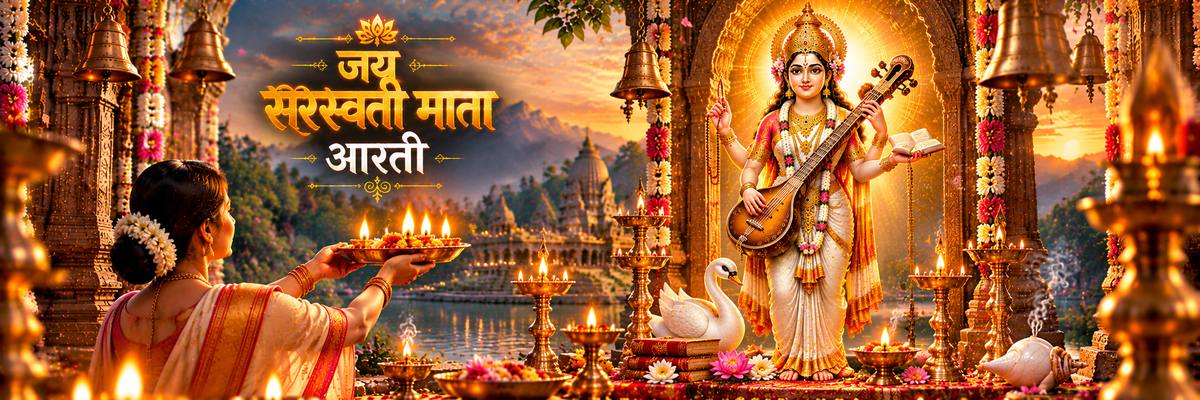
The next two verses are a portrait. Her face is like the moon and she sits on a lotus (padmasini), with a radiance that brings auspiciousness. She rides a swan and her brilliance has no equal. She holds the veena in her left hand and a mala in her right. A jewelled crown sits on her head and a string of pearls at her throat. Her usual symbols carry meaning. Traditionally, the swan is said to separate milk from water, as discernment separates truth from falsehood. The veena is music and the arts, and the mala is japa and inner discipline.
The Manthara verse
The fourth verse surprises people: paithi Manthara dasi, Ravan sanhar kiya, "she entered the maid Manthara and destroyed Ravana." It refers to a turn in the Ramayana that Tulsidas's Ramcharitmanas makes explicit in the Ayodhya Kand. The gods, anxious that Ram's coronation would keep him in Ayodhya and away from his work of ending Ravana, asked Saraswati to turn the mind of Kaikeyi's maid Manthara. Manthara's advice led to Ram's exile, the exile led to Lanka, and Lanka led to Ravana's end. So the aarti credits the goddess of speech and intellect with setting the whole story moving. The verse's first line says the same in general terms: she raises up whoever takes refuge in her.
What it asks for
The last verses are a prayer for students of every age: gyan prakash bharo, fill us with the light of knowledge, and destroy the darkness of delusion and ignorance in the world. The devotee offers incense, lamp, fruit and dry fruit, and asks for gyanchakshu, the "eye of knowledge", the inner sight that ordinary eyes don't give. The closing verse promises that whoever sings it gains both gyan and bhakti, knowledge and devotion.
When it is sung
It is the aarti of Vasant Panchami and Saraswati Puja, in homes, schools and colleges. In many parts of India, Saraswati is also worshipped in the last days of Navratri, when books and instruments are placed before her. Students often sing it before exams, and musicians before practice or a performance. Before the aarti, you can recite the Ya Kundendu vandana. Afterwards there is the Saraswati Chalisa, whose own Kaikeyi episode takes up the same Ramayana thread as this aarti.
Frequently asked questions
When is the Saraswati aarti sung?
Above all on Vasant Panchami (Magha Shukla Panchami), Saraswati's festival, and during Saraswati Puja in the last days of Shardiya Navratri. Many students sing it before exams, at the start of a new course, or every morning before study.
What should be offered to Saraswati?
White or yellow flowers, white sweets or yellow kesari dishes on Vasant Panchami, fruit, and — in many homes — the books, pens and musical instruments themselves, placed before her for blessing.
Is the aarti the same as "Ya Kundendu Tushara Hara Dhavala"?
No. "Ya Kundendu" is a Sanskrit vandana (salutation verse) to Saraswati, often recited in schools. "Jai Saraswati Mata" is the Hindi aarti sung while the lamp is waved. Many pujas use both: the vandana first, the aarti at the end.
Can the Saraswati aarti be sung daily?
Yes. There is no fixed weekday for Saraswati; students and musicians often sing it every day before practice or study.
Why is yellow worn on Vasant Panchami?
Vasant Panchami marks the arrival of spring, when mustard fields bloom yellow across North India. Yellow clothes, yellow rice and yellow sweets are part of the festival, though Saraswati herself is pictured in white.
Who is Manthara in the aarti?
Kaikeyi's maid in the Ramayana, whose words turned Kaikeyi against Rama. The aarti alludes to the tradition that Saraswati moved her speech so that Rama's exile, needed for Ravana's defeat, would come to pass.
Spotted a mistake?
If you find any grammatical, Hindi, English, mantra-text or other mistake on this page, tell us — we will correct it within 24 hours.