
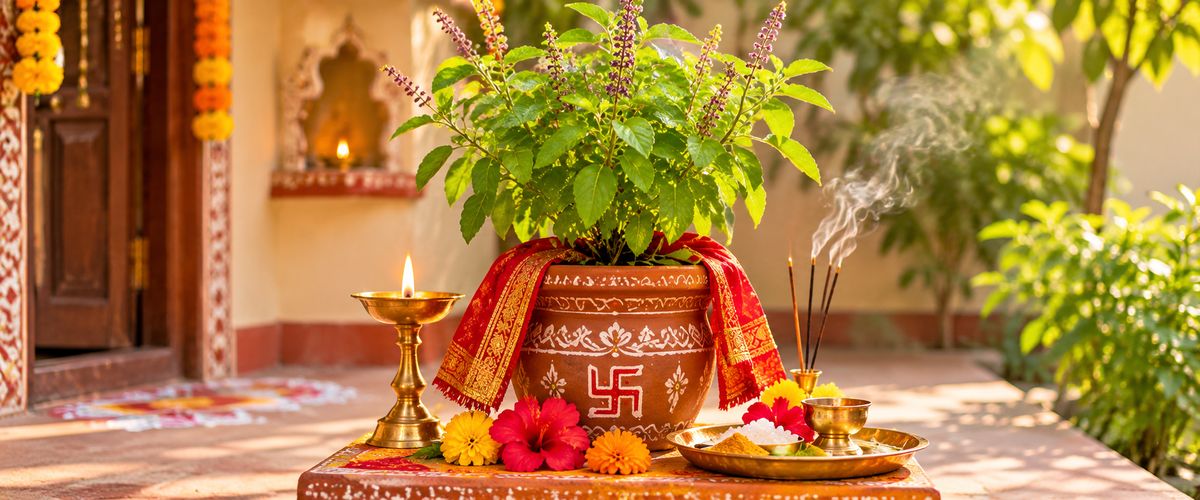
Why tulsi has rules at all
In most Hindu homes the tulsi plant is not treated as a houseplant. It is worshipped as Tulsi Devi, beloved of Vishnu, and is called a form of Lakshmi. No Vishnu or Krishna puja is complete without a tulsi leaf. Because the plant is treated as a goddess living in the courtyard, the family follows a few rules about when to water her, when to take her leaves, and where she stands.
These rules are household tradition, written about in religious guides and repeated by priests. They vary a little between regions and families. Where your family's practice differs, follow it.
Offering water to tulsi
The daily rule is simple. Offer water in the morning, after your bath, ideally from a copper or brass lota, and light a lamp at the plant in the evening.
When water is not offered
- On Sundays. The belief is that Tulsi keeps a nirjala (waterless) fast for Vishnu on Sunday, so watering her would break it. Flowers may still be offered.
- On Ekadashi. For the same reason: Tulsi fasts without water for Vishnu on every Ekadashi. Light a lamp before her that evening instead, and chant a Vishnu mantra.
- During a solar or lunar eclipse. Nothing is offered to tulsi, and she is not touched, while the grahan lasts.
- After dark. Water is offered in the morning, not at night, when the plant is considered to be at rest.
A practical note: in the heat of summer, families who follow the Sunday rule water the plant well on Saturday, so it doesn't suffer.
Picking tulsi leaves
When not to pick them
- On Sundays and Ekadashi.
- During a solar or lunar eclipse.
- After sunset.
Leaves for Ekadashi worship are picked the day before, on Dashami, and kept clean.
How to pick them
- Join your hands and ask before you pick, as you would before taking something from an elder.
- Use your fingers, gently. Don't pinch them off with your fingernails, and don't use scissors or a knife.
- Take only what you need, preferably the tender leaves at the tips (manjari and the leaves around it), so the plant keeps growing well.
- Bathe first. Tulsi is not touched without bathing.
Tulsi leaves don't go stale
Like Gangajal, tulsi leaves are not considered stale (basi). A leaf picked the day before, or one already offered, can be washed and offered again. This is why the rules against picking on certain days cause no difficulty.
Where the plant should stand
- North, east or north-east of the house is the traditional placement. A courtyard, a balcony or a sunny window all work.
- Keep the area clean: no shoes, rubbish or dustbins near the plant.
- Many homes keep tulsi in a raised tulsi chaura (vrindavan), which keeps the plant clean and makes the daily lamp and parikrama easy.
- Tulsi needs sun. A plant kept in a dark corner will wilt whatever rules are followed.
Which deities tulsi is offered to
- Offered to: Vishnu and all his forms (Krishna, Rama, Narasimha), Shaligram, and Hanuman, who is offered tulsi as Rama's devotee. Lakshmi is worshipped together with Vishnu.
- Not offered to Shiva. In the Puranic story Tulsi was Vrinda, wife of Jalandhar, whom Shiva killed. Our article on what to offer on a Shivling explains the rule.
- Not offered to Ganesha, by long tradition, which tells of a quarrel between the two.
Tulsi in Kartik and on Tulsi Vivah
Kartik is Tulsi's month. A lamp is lit at the plant every evening, and on Dev Uthani Ekadashi Tulsi is married to Shaligram in the Tulsi Vivah. The evening lamp and its restricted days are explained in our guide to the Tulsi lamp, and the marriage in Dev Uthani Ekadashi and Tulsi Vivah vidhi.
When a tulsi plant dries up
A tulsi plant that dries up is not thrown in the rubbish.
- Take the dry plant out gently and immerse it in flowing water, or lay it in clean soil in the garden or in a large pot.
- The dry wood can be kept and used. Tulsi wood beads are made into kanthi malas and japa malas.
- Plant a new tulsi soon. Many families sow seeds from the old plant's manjari.
Most tulsi plants dry up from too much water in winter, too little sun, or the end of their natural life after a few years. It is not a bad omen.
Frequently asked questions
Why is water not offered to tulsi on Sunday?
The tradition is that Tulsi keeps a waterless fast for Vishnu on Sundays, so watering her would break it. Flowers can still be offered.
Can I offer water to tulsi on Ekadashi?
Traditionally no, because Tulsi fasts for Vishnu on Ekadashi. Light a lamp before her that evening instead.
Can tulsi leaves be picked at night?
No. Leaves are not picked after sunset. Pick them in the morning and keep them for later.
Can I use tulsi leaves picked yesterday?
Yes. Tulsi leaves, like Gangajal, are not considered stale, so a leaf picked the day before, or already offered, can be washed and used.
Can tulsi be offered to Shiva or Ganesha?
No. By tradition, tulsi is offered to Vishnu and his forms, and to Hanuman, but not to Shiva or Ganesha.
Where should the tulsi plant be kept?
In the north, east or north-east of the house, in a clean, sunny place, away from shoes and rubbish.
What should I do with a dried tulsi plant?
Immerse it in flowing water or lay it in clean soil, keep the wood if you wish, and plant a new tulsi soon. Don't throw it in the rubbish.
Can women touch tulsi or offer water during their periods?
Customs differ by family. Many families ask that the plant not be touched during those days, while others have no such rule. Follow your family's practice.
Was this article helpful?
Spotted a mistake?
If you find any grammatical, Hindi, English, mantra-text or other mistake on this page, tell us — we will correct it within 24 hours.

Reviewed by
Harendra ChaubeyAcharya (Jyotish & Sahitya), Sampurnanand Sanskrit University, Varanasi
Reviews our articles for accuracy of facts, scriptural references and ritual practice.
Published by Bhakti Arohan
Related content
- The Tulsi Deepam Protocol: How to Light the Diwali Lamp for Tulsi Mata, and the Days Not to Touch HerPublished6 min read
- Dev Uthani Ekadashi 2026: When Does Lord Vishnu Wake? Tulsi Vivah Vidhi and the Return of Auspicious CeremoniesPublished9 min read
- The Story of Tulsi Vivah: Vrinda, Jalandhar and the Shaligram
- Tulsi Chalisa