
What aarti is
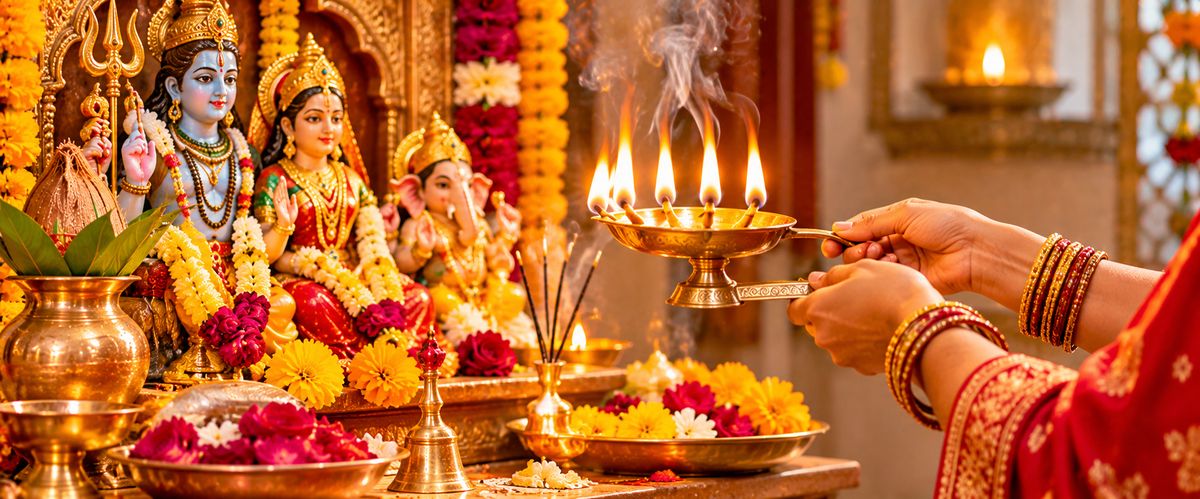
Aarti, from the Sanskrit aratrika and also called nirajana, is the waving of a lit lamp before a deity, usually while an aarti song is sung and a bell is rung. It comes at the end of a puja, as the closing offering of light. In daily worship at home it is often the one part nobody skips: even on a busy morning, a lamp is lit and waved for a minute.
Two ideas sit behind it. The lamp shows the deity in full, from feet to face, as if lighting up the form for the worshipper to see. And the flame is offered back: when you pass your hands over it afterwards, you take the deity's blessing into yourself.
What goes on the aarti thali
- A lamp: a ghee diya with one wick, or a five-wick lamp (panch-aarti), which many homes and temples use. A mustard or sesame oil lamp is also used, especially for Shani and Hanuman.
- Camphor (kapur), if you do camphor aarti, in a small holder.
- Kumkum or roli, akshat (unbroken rice) and a few flowers.
- A small bell (ghanti), and a conch if your family blows one.
- A small vessel of water.
Keep the plate clean and dry, and use a lamp that sits steady so the flame doesn't tip while you move it.
Ghee lamp or camphor?
Both are traditional, and many families use both: the ghee lamp for the aarti itself, and a piece of camphor lit at the end. Camphor burns away completely and leaves no residue, which is read as the ego burning away before God. A ghee lamp gives a steady, gentle flame and is the usual choice for daily aarti. Oil lamps are common in Shani and Hanuman worship. What matters most is a clean lamp and a steady flame. There is no rule that one is always better than the other.
How to wave the aarti: the 4-2-1-7 order
The order most families and priests follow:
- Four times at the feet of the deity.
- Twice at the navel.
- Once at the face.
- Seven times over the whole form, from head to feet.
Move the lamp clockwise each time, the same direction as a parikrama, because aarti is understood as a pradakshina made with light. Some traditions move the plate so that it traces an Om. A few Shiva aarti traditions wave three times at the face instead of once. If your family has its own count, keep to it.
Ring the bell with your other hand while you wave the lamp, and sing the aarti: Om Jai Jagdish Hare for Vishnu and as a general aarti, Om Jai Shiv Omkara for Shiva, Hanuman aarti on Tuesdays and Saturdays. Stand while doing aarti if you can.
After the aarti
- Take the aarti. Pass both palms over the flame and touch them to your eyes and forehead. Offer the plate to everyone present to do the same.
- Don't rush off. Stand or sit for a moment in prayer before leaving. Walking away as soon as the song ends is considered leaving the puja unfinished.
- Cool the lamp. In many homes a little water is circled around the lamp after aarti, then sprinkled. Let the lamp burn out by itself, or put it out with a flower or by fanning it with your hand, not by blowing on it.
- Money in the plate. In temples, people often place money in the aarti plate as they take it. It is an offering for the temple and its seva. At home it is not needed.
- Then give prasad, and keep the puja place in order.
When to do aarti
Morning aarti after the daily puja, and evening aarti at dusk (sandhya), are the two times most homes keep. Temples add more: mangala aarti before dawn, aarti at the noon bhog, and shayan aarti when the deity is put to rest at night. On festival days aarti follows the main puja. You can also do aarti on its own when there is no time for a full puja. It is often called the part that completes worship.
Common mistakes
- Waving the lamp anticlockwise, or in fast circles that make the flame jump.
- A lamp so full of ghee or oil that it spills, or a wick so long it smokes.
- Blowing out the lamp or camphor.
- Talking, or checking a phone, through the aarti.
- Leaving straight away without taking the aarti or saying a short prayer.
Frequently asked questions
How many times should the aarti be waved?
Four times at the feet, twice at the navel, once at the face, and seven times over the whole form. Some Shiva traditions wave three times at the face. Follow your family's count if it differs.
Which direction should the aarti go?
Clockwise, the same direction as a parikrama around the deity.
Ghee or oil for the aarti lamp?
Ghee is the usual choice for daily aarti. Mustard or sesame oil lamps are common for Shani and Hanuman. Both are acceptable. A clean lamp and steady flame matter more.
How many wicks should the aarti lamp have?
A single-wick ghee lamp is enough for daily aarti. Many homes and temples use a five-wick lamp (panch-aarti) for festivals and fuller pujas.
Can aarti be done without a full puja?
Yes. On a busy day, lighting a lamp, singing one aarti and taking it is a complete short act of worship in itself.
Can women do aarti?
Yes. Women do the aarti in homes and temples every day. Some families have customs about specific days, so follow your family's practice on those.
What do I do with camphor ash or the burnt wick?
Let it cool and put it in a plant pot or in flowing water with the old flowers. Don't throw it in the household rubbish.
Should the lamp be blown out after aarti?
No. Let it burn out by itself, or put it out with a flower or by fanning it with your hand.
Was this article helpful?
Spotted a mistake?
If you find any grammatical, Hindi, English, mantra-text or other mistake on this page, tell us — we will correct it within 24 hours.
Reviewed by
Harendra ChaubeyAcharya (Jyotish & Sahitya), Sampurnanand Sanskrit University, Varanasi
Reviews our articles for accuracy of facts, scriptural references and ritual practice.
Published by Bhakti Arohan