
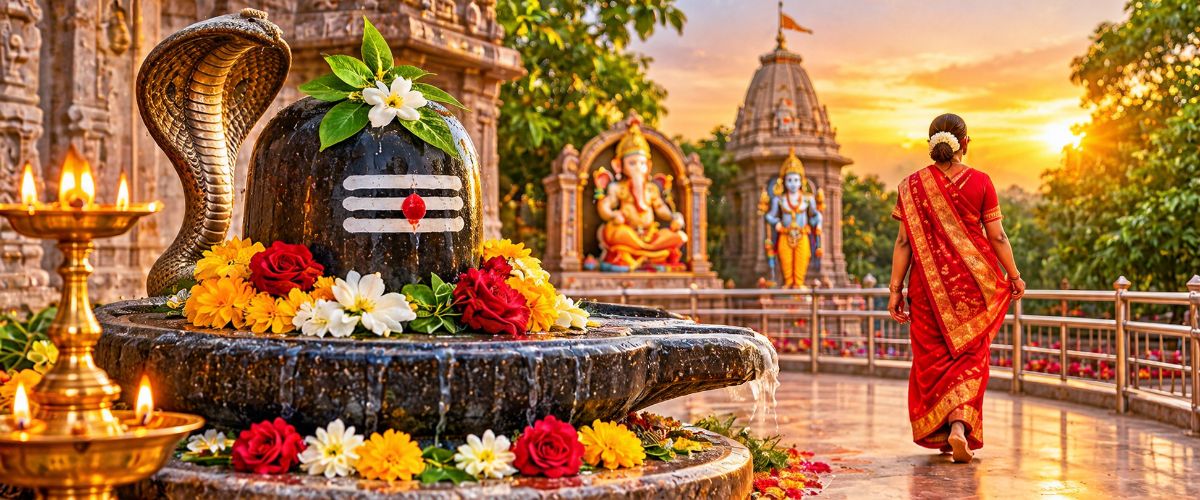
What a parikrama is
A parikrama (Sanskrit pradakshina) is walking around something sacred: a murti, a temple, a sacred tree, a river or a whole hill. It is done at the end of worship, after the aarti, and it says with the body what the puja said with words: that the deity is the centre and you move around it.
The word itself carries the rule. Pradakshina comes from dakshina, "right": you walk so that the deity is always on your right-hand side. That is a clockwise circle when seen from above.
The same movement appears everywhere in Hindu worship. The aarti plate is waved clockwise because aarti is understood as a parikrama made with light (see how to do aarti). Bride and groom walk the saptapadi rounds around the sacred fire. Pilgrims walk around Govardhan, Arunachala and the whole course of the Narmada. A temple's outer corridor, the pradakshina patha, is built for exactly this.
Why always clockwise
The explanation given in devotional guides is that the presence of a consecrated murti spreads around it and moves in the clockwise direction, so walking with it keeps you in harmony with it, while walking against it does the opposite. The simpler explanation is the one the word gives: the right side is the side of respect. You keep an elder, a guru or a guest of honour on your right, and the deity the same way.
The one deliberate exception is the Shivling, where you turn back rather than complete the circle. That is explained below.
How many rounds for each deity
For most deities a single round is enough, and that is what most people do in a busy temple. Devotional guides, however, give a traditional number for each deity, and these are the ones most commonly followed:
- Devi (Durga, Lakshmi, Parvati and other forms of the Goddess): one round.
- Ganesha: three rounds. Some sources say one, and a few say four; three is the most widely given.
- Hanuman: three rounds.
- Vishnu and all his avatars (Rama, Krishna, Narasimha): four rounds.
- Surya: seven rounds, in a Surya temple. At home, turning once in place after the morning arghya is the usual custom (see how to offer water to the sun).
- Shiva (the Shivling): half a round, without crossing the abhishek water.
These numbers are not laid down in one text that every family follows. They vary by region, by sampradaya and by temple, and many temples post their own custom at the entrance. If your family or your temple has a different count, keep to it. The parikrama is complete when it is done with attention, not when a number is reached.
When more rounds are done, odd numbers (3, 5, 7) are generally preferred for most deities, while for Vishnu the count is kept at four or a multiple of it.
The half parikrama of the Shivling
A Shivling stands on a base called the jalaheri (or yoni-pitha), with a channel or spout through which the water, milk and other offerings poured during abhishek flow out. This spout, called the nirmali or somasutra, is traditionally not stepped over. The offered water is regarded as carrying the sanctity of Shiva and Shakti, and crossing it is treated as disrespect.
So the parikrama of a Shivling is done in two halves:
- Begin from the front, as you would any parikrama, and walk around with the Shivling on your right until you reach the spout.
- Stop there. Do not cross the stream of water.
- Turn back and walk the same way back to the front, then continue past your starting point on the other side until you reach the spout again from that side.
Some guides describe it slightly differently, as walking to the spout and simply returning, but the principle is the same everywhere: the circle is never closed over the outflowing water. Because the spout usually lies to one side rather than directly behind, what you walk is often more than half a circle, which is why some writers call it a three-quarter round. Our guides to what to offer on a Shivling and to Shiva puja at home follow the same rule.
In temples where the outflow runs under the floor and cannot be seen, priests usually still ask devotees to turn back at the point where it leaves the sanctum.
Sacred trees and the tulsi
- Peepal: the peepal is worshipped as an abode of Vishnu. Seven rounds are common, especially on Saturdays, with water offered at the root and a lamp lit in the evening. On Somvati Amavasya many women walk 108 rounds, winding thread around the trunk.
- Banyan (vat): on Vat Savitri, married women walk around the banyan, winding raw cotton thread around it, usually seven times and in some families 108 (see Vat Savitri vrat).
- Tulsi: after the evening lamp, a round of the tulsi plant is part of the daily practice in many homes, most of all in Kartik. The other tulsi customs are in our guide to tulsi rules.
Rules while walking
- Walk at an even pace and don't stop midway. A round broken off in the middle is not counted; finish where you began.
- Don't talk. Keep your mind on the deity you are walking around, or repeat their name or mantra.
- Remove footwear, as everywhere in the temple.
- Keep your hands joined or holding the puja plate, not swinging.
- At the end of each round, bow briefly to the deity from the front before starting the next.
- Never walk anticlockwise (keeping the deity on your left), except for the turn back at the Shivling's spout.
When there is no space: atma pradakshina
A home shrine usually stands against a wall, so there is no way to walk around it. The custom then is the atma pradakshina: standing before the deity with hands joined, you turn slowly on the spot, clockwise, once or three times. This counts as the parikrama. It is also what devotees do in a crowded sanctum, and what many people do after the morning water offering to the sun.
The shloka said during parikrama
A short verse is traditionally recited while walking or turning in place:
यानि कानि च पापानि जन्मान्तरकृतानि च।
तानि सर्वाणि नश्यन्ति प्रदक्षिणः पदे पदे॥
yāni kāni ca pāpāni janmāntara-kṛtāni ca, tāni sarvāṇi naśyanti pradakṣiṇaḥ pade pade
Meaning: "Whatever sins there are, even those committed in earlier births, all of them are destroyed with every step of the pradakshina."
Some versions read brahmahatyā-samāni ca ("even those equal to killing a Brahmin") in the first line in place of janmāntara-kṛtāni ca. The verse is a prayer, not a promise to be used mechanically: its point is that each step is taken in remorse and surrender.
Frequently asked questions
Why is parikrama done clockwise?
Pradakshina means keeping the deity on your right, the side of respect, which makes a clockwise circle. Devotional guides add that the presence around a consecrated murti moves in that direction.
How many times should I go around Ganesha?
Three is the number most often given. Some sources say one; follow your temple's custom if it differs.
How many rounds for Vishnu or Krishna?
Four, for Vishnu and all his avatars, including Rama and Krishna.
Why is only half a parikrama done around a Shivling?
Because the water and offerings flowing out of the jalaheri's spout are not stepped over. You walk to the spout, turn back, and complete the other side up to the spout.
Can I do parikrama at home?
Yes. If the shrine stands against a wall, turn slowly on the spot clockwise, once or three times, with hands joined. This atma pradakshina counts as the parikrama.
Should parikrama be done before or after aarti?
After. Parikrama comes at the end of worship, after the aarti and before taking prasad.
What if I lose count or stop in the middle?
Finish the round you are on, returning to where you began, and then continue. A broken round is simply done again; nothing is spoiled.
Can women do parikrama during their periods?
Customs differ. Many families and temples ask that women not enter the temple or do parikrama during those days, while others have no such rule. Follow your family's practice.
Was this article helpful?
Spotted a mistake?
If you find any grammatical, Hindi, English, mantra-text or other mistake on this page, tell us — we will correct it within 24 hours.
Reviewed by
Harendra ChaubeyAcharya (Jyotish & Sahitya), Sampurnanand Sanskrit University, Varanasi
Reviews our articles for accuracy of facts, scriptural references and ritual practice.
Published by Bhakti Arohan
Related content
- How to Do Aarti the Right Way: How Many Rounds, Ghee or Camphor, the Thali and What to Do AfterPublished5 min read
- What to Offer on a Shivling and What Not To: Bel Patra, Milk, Tulsi, Haldi and the Prasad QuestionPublished7 min read
- Shiva Puja Vidhi: Shivling Worship at Home on Monday and Shivratri
- Tulsi Rules at Home: When Not to Offer Water, When Not to Pick Leaves, and Caring for the PlantPublished5 min read