
Why Shiva needs so little
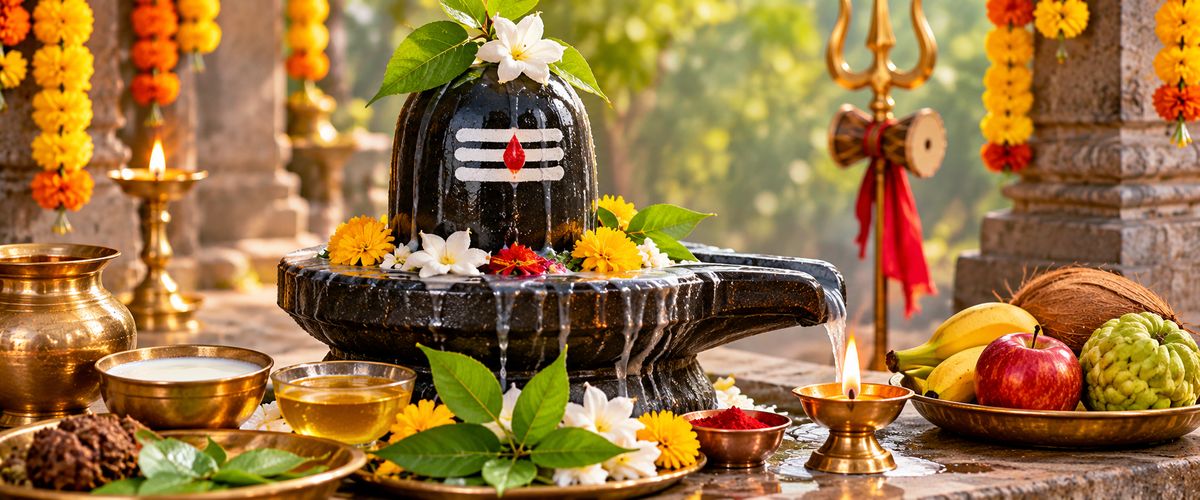
Shiva is called Ashutosh, the one who is quickly pleased. A lota of water poured with attention, a whole bel leaf and his five-syllable name, Om Namah Shivaya, make a complete offering. Most of the rules people worry about are not about adding more. They are about keeping a few specific things off the Shivling. The Shivling is Shiva's formless form, and the base it stands on (the jalaheri or yoni-peeth) represents Parvati, so the whole stone is treated with care.
Some of the rules below come from Puranic stories. Others are household custom handed down in families and temples. This guide says which is which, so you know what is scripture and what is tradition.
What is offered on a Shivling
Water first
Water is the heart of Shiva worship. Abhishek recalls Shiva holding the Ganga in his hair and drinking the halahal poison at the churning of the ocean, so cooling him with water is the oldest offering. Use a copper or brass lota, add a few drops of Gangajal if you have it, and pour in a thin, steady stream rather than throwing the water at once. A Varanasi priest quoted by Patrika says the worshipper should face north while offering water.
The abhishek items
- Raw milk: cow's milk, unboiled. Many people avoid packaged milk for abhishek and prefer fresh milk.
- Curd, honey and ghee: with milk and water (or sugar), these make panchamrit, used for a fuller abhishek.
- Sugarcane juice: a traditional Mahashivratri offering.
- Gangajal: on its own or mixed into plain water.
Finish with plain water to wash the Shivling clean, especially after milk, curd or honey.
Leaves and flowers
- Bel patra (bilva): Shiva's favourite. See the next section for how to pick and offer it.
- Dhatura flowers and fruit, and aak (crown flower). Both are poisonous plants, offered to the god who drank poison.
- Shami leaves, bhang leaves and white flowers.
Tilak and the rest
- Sandalwood paste and bhasma (sacred ash) in place of haldi or kumkum.
- Akshat: whole, unbroken rice. Broken rice is not offered.
- A ghee lamp, incense, and fruit or a simple sweet as naivedya.
How to pick and offer bel patra
- Three leaflets on one stalk count as one bel patra. A sprig with more leaflets is considered better.
- Whole leaves only. Do not offer a torn or cut leaf, or one marked with spots or patterns. If you have only one good sprig, offer that one rather than several damaged ones.
- Face up, smooth side towards the Shivling. Leaves grow facing upward, so they are offered that way.
- With the right hand, holding the leaf between the middle finger, ring finger and thumb. Old flowers and leaves are removed with the thumb and index finger.
- Days not to pick bel patra: Chaturthi, Ashtami, Navami, Chaturdashi and Amavasya, at Sankranti, and on Mondays. Pick the leaves a day earlier and keep them clean.
- Bel patra does not go stale. If you cannot get fresh leaves, a bel patra already offered can be washed and offered again.
- Bow to the tree before and after picking, and pick only the leaves, not whole branches.
What is not offered, and why
Tulsi
Tulsi belongs to Vishnu. In the Puranic story, Tulsi in her earlier life was Vrinda, wife of the asura Jalandhar, whom Shiva killed. For this reason tulsi leaves are not placed on the Shivling, even though they are central to Vishnu and Krishna worship.
Ketaki (screwpine) flower
In the Shiva Purana's story of the endless pillar of light (the Lingodbhava), Brahma and Vishnu set out to find the ends of the column. Brahma claimed he had reached the top and brought the ketaki flower as a false witness. Shiva rejected the flower from his worship for lying. It is the clearest scriptural "no" on this list.
Haldi and kumkum
Haldi and kumkum are marks of a married woman's saubhagya and belong to the Devi's worship. The Shivling is worshipped as Shiva's ascetic, formless form, so sandal and bhasma are used instead. Haldi and kumkum can be offered to Parvati on the jalaheri or in her own image.
Water from a conch (shankh)
The shankh is linked with the asura Shankhachud, whom Shiva slew. So water is not poured on the Shivling from a conch, though the conch is blown in Shiva temples and is used freely in Vishnu worship.
Other common don'ts (family and temple custom)
- Coconut water for abhishek. The coconut itself can be offered as naivedya.
- Broken rice, and torn or wilted leaves and flowers.
- Packaged milk, avoided by many in favour of fresh milk.
Parikrama: only half way
Go around the Shivling clockwise only as far as the spout of the jalaheri, where the abhishek water flows out, then turn back. That water is considered too sacred to step over, so a full circle is not made.
What to do with the abhishek water
The water that has flowed over the Shivling is treated like charanamrit, not waste. A Varanasi priest quoted by Patrika advises taking a little on the fingertips and touching it to the eyes, throat and forehead. At home, collect it in a clean vessel and pour it into a potted plant, or into flowing water. Do not throw it in a drain or let it fall where people walk.
Can you eat prasad offered on a Shivling?
This is the most argued question about Shiva worship, and the honest answer is that traditions differ.
- The common rule: what is poured or placed directly on the Shivling (water, milk, flowers, bel patra) is not eaten. Many temples say these offerings belong to Shiva's attendant Chandeshvara.
- What the Shiva Purana says: the Vidyeshvara Samhita (chapter 22) praises receiving Shiva's naivedya with devotion, and calls refusing it a fault.
- In practice: sweets and fruit placed before Shiva, not on the Shivling, are distributed as prasad in most homes and temples. Many people also accept prasad from metal lingas and jyotirlingas.
Follow the practice of your temple or your family's tradition. If unsure, offer the naivedya in front of the Shivling, then share it as prasad.
A simple Shivling puja at home
- Bathe, sit facing the Shivling, and remove yesterday's flowers and leaves.
- Offer water with Om Namah Shivaya, then milk or panchamrit if you have it, then water again.
- Apply sandal or bhasma, and offer akshat, bel patra and flowers.
- Light a ghee lamp and incense, and offer naivedya in front of the Shivling.
- Chant the five-syllable mantra, or read the Rudrashtakam.
- Do the aarti, Om Jai Shiv Omkara, and half parikrama.
For the full daily vidhi, see Shiva puja vidhi.
Frequently asked questions
Why is tulsi not offered on a Shivling?
Tulsi belongs to Vishnu, and in the Puranic story Tulsi as Vrinda was the wife of Jalandhar, whom Shiva killed. Tulsi is offered to Vishnu, Krishna and Rama, not to Shiva.
Can women offer water and milk on a Shivling?
Yes. Women offer jal and milk on the Shivling every day, in homes and in temples. Some families keep a separate custom about touching the Shivling. Follow your family's practice on that.
On which days should bel patra not be picked?
Chaturthi, Ashtami, Navami, Chaturdashi and Amavasya, at Sankranti, and on Mondays. Pick the leaves a day earlier. An already offered bel patra can also be washed and offered again.
Can I offer packaged milk?
Many people avoid it and use fresh, unboiled cow's milk. If packaged milk is all you have, plain water with devotion is a complete offering in itself.
Which side of the bel leaf faces the Shivling?
The smooth side, with the leaf facing up, the way it grows on the tree.
What should I do with the water from the abhishek?
Treat it as charanamrit: touch a little to the eyes and forehead, and pour the rest into a plant or flowing water, never into a drain.
Can I eat the prasad offered on a Shivling?
Offerings placed directly on the Shivling are traditionally not eaten. Naivedya offered in front of Shiva is distributed as prasad in most homes and temples, and the Shiva Purana praises receiving Shiva's prasad with devotion.
Why only half a parikrama around a Shivling?
Because the abhishek water flowing from the jalaheri's spout is not stepped over. Devotees turn back at the spout instead of completing the circle.
Was this article helpful?
Spotted a mistake?
If you find any grammatical, Hindi, English, mantra-text or other mistake on this page, tell us — we will correct it within 24 hours.

Reviewed by
Harendra ChaubeyAcharya (Jyotish & Sahitya), Sampurnanand Sanskrit University, Varanasi
Reviews our articles for accuracy of facts, scriptural references and ritual practice.
Published by Bhakti Arohan