
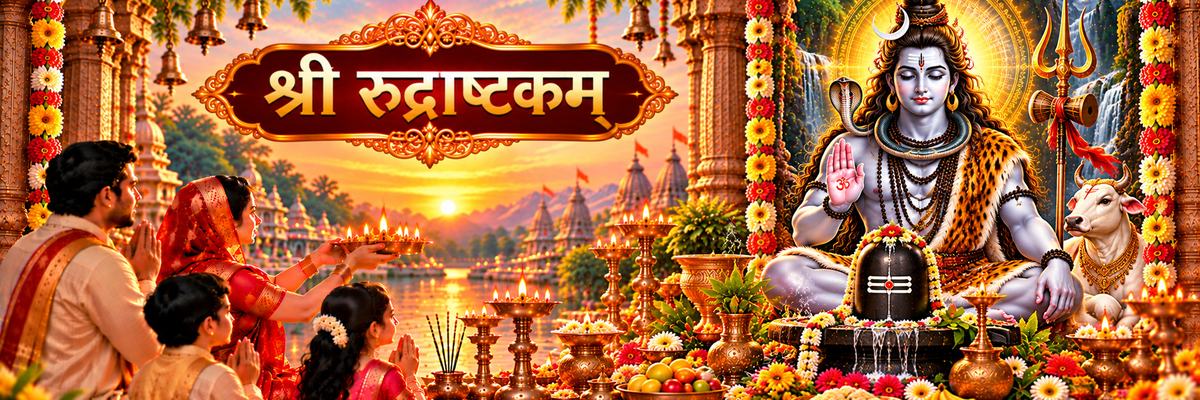
Original text
नमामीशमीशाननिर्वाणरूपं विभुं व्यापकं ब्रह्मवेदस्वरूपम् । निजं निर्गुणं निर्विकल्पं निरीहं चिदाकाशमाकाशवासं भजेऽहम् ॥ १ ॥ निराकारमोंकारमूलं तुरीयं गिराज्ञानगोतीतमीशं गिरीशम् । करालं महाकालकालं कृपालं गुणागारसंसारपारं नतोऽहम् ॥ २ ॥ तुषाराद्रिसंकाशगौरं गभीरं मनोभूतकोटिप्रभाश्रीशरीरम् । स्फुरन्मौलिकल्लोलिनीचारुगङ्गा लसद्भालबालेन्दु कण्ठे भुजङ्गा ॥ ३ ॥ चलत्कुण्डलं भ्रूसुनेत्रं विशालं प्रसन्नाननं नीलकण्ठं दयालम् । मृगाधीशचर्माम्बरं मुण्डमालं प्रियं शङ्करं सर्वनाथं भजामि ॥ ४ ॥ प्रचण्डं प्रकृष्टं प्रगल्भं परेशमखण्डमजं भानुकोटिप्रकाशम् । त्रयःशूलनिर्मूलनं शूलपाणिं भजेऽहं भवानीपतिं भावगम्यम् ॥ ५ ॥ कलातीतकल्याणकल्पान्तकारी सदा सज्जनानन्ददाता पुरारी । चिदानन्दसन्दोहमोहापहारी प्रसीद प्रसीद प्रभो मन्मथारी ॥ ६ ॥ न यावदुमानाथपादारविन्दं भजन्तीह लोके परे वा नराणाम् । न तावत्सुखं शान्ति सन्तापनाशं प्रसीद प्रभो सर्वभूताधिवासम् ॥ ७ ॥ न जानामि योगं जपं नैव पूजां नतोऽहं सदा सर्वदा शम्भु तुभ्यम् । जराजन्मदुःखौघतातप्यमानं प्रभो पाहि आपन्नमामीशशम्भो ॥ ८ ॥ रुद्राष्टकमिदं प्रोक्तं विप्रेण हरतोषये । ये पठन्ति नरा भक्त्या तेषां शम्भुः प्रसीदति ॥ ॥ इति श्रीरामचरितमानसे उत्तरकाण्डे श्रीगोस्वामितुलसीदासकृतं श्रीरुद्राष्टकं सम्पूर्णम् ॥
Transliteration
Namamishamishana nirvanarupam vibhum vyapakam brahmavedasvarupam Nijam nirgunam nirvikalpam niriham chidakashamakashavasam bhaje'ham ||1|| Nirakaramonkaramulam turiyam girajnanagotitamisham girisham Karalam mahakalakalam kripalam gunagarasamsaraparam nato'ham ||2|| Tusharadrisankashagauram gabhiram manobhutakotiprabhashrishariram Sphuranmaulikallolinicharuganga lasadbhalabalendu kanthe bhujanga ||3|| Chalatkundalam bhrusunetram vishalam prasannananam nilakantham dayalam Mrigadhishacharmambaram mundamalam priyam shankaram sarvanatham bhajami ||4|| Prachandam prakrishtam pragalbham pareshamakhandamajam bhanukotiprakasham Trayahshulanirmulanam shulapanim bhaje'ham bhavanipatim bhavagamyam ||5|| Kalatitakalyanakalpantakari sada sajjananandadata purari Chidanandasandohamohapahari prasida prasida prabho manmathari ||6|| Na yavadumanathapadaravindam bhajantiha loke pare va naranam Na tavatsukham shanti santapanasham prasida prabho sarvabhutadhivasam ||7|| Na janami yogam japam naiva pujam nato'ham sada sarvada shambhu tubhyam Jarajanmaduhkhaughatatapyamanam prabho pahi apannamamisha shambho ||8|| Rudrashtakamidam proktam viprena haratoshaye Ye pathanti nara bhaktya tesham shambhuh prasidati ||
A hymn inside a story
Rudrashtakam is not a free-standing stotra. It belongs to a scene in the Uttarakanda of Tulsidas's Ramcharitmanas, and the closing note says so: iti Shri Ramcharitmanase Uttarkande… Shri Rudrashtakam sampurnam. The scene is part of the crow-sage Kakbhushundi's account of his own past lives. In one of them, in Ujjain, he was a proud Shiva worshipper who looked down on Vishnu's devotees. One day, in the Mahakal temple, he did not even rise when his own gentle guru came in. A voice from the sanctum cursed him to be born a serpent.
The guru did not take offence. He was frightened for his disciple, and with folded hands he sang these eight verses to soothe Shiva. That is what the closing verse means by viprena haratoshaye, "spoken by a Brahmin to please Hara". Shiva relented and softened the curse. So the stotra was first a teacher's prayer for a student who had wronged him. Many readers find that its most moving feature.
From the formless to the form
The eight verses, all in the swinging bhujangaprayata metre, move deliberately:
- Verses 1–2: Shiva as the Absolute: "of the nature of nirvana", all-pervading, Brahman and the Veda itself, without qualities, without change, without desire, consciousness itself, "clothed in the sky". He is formless, the root of Om, the fourth state beyond waking, dream and sleep, beyond speech and the senses, and also Mahakala-kala, death to Death himself.
- Verses 3–4: Shiva as the image the devotee sees: fair as the snow mountains, with the beauty of a crore Kamadevas, the Ganga rippling on his head, the young moon on his brow and serpents at his throat, swaying earrings, wide eyes, a blue throat, a tiger-skin, a garland of skulls, "dear Shankara, lord of all".
- Verses 5–6: Shiva as the conqueror: blazing like a crore suns, the trident-bearer who uproots the three kinds of suffering (a play on shula, both "trident" and "pain"), Bhavani's husband reached through love, destroyer of the three cities and of Kama.
- Verses 7–8: the devotee's own condition. Until people worship Uma's lord, they find no happiness, peace or end of pain, in this world or the next.
"I know no yoga, no japa, no puja"
The eighth verse is one of the most quoted lines in Hindi-belt devotion: na janami yogam japam naiva pujam, nato'ham sada sarvada Shambhu tubhyam, "I know neither yoga nor japa nor ritual worship; I simply bow to you, Shambhu, always." The singer then describes himself as burning in the flood of sorrows of old age and birth and asks to be protected. After seven verses of high theology, the hymn ends with someone who has nothing to offer but surrender, which is exactly the lesson of the story around it.
When it is recited
Rudrashtakam is chanted daily by many Shiva devotees, and above all on Mondays of Shravan, on Mahashivratri and at Pradosh, the twilight of the thirteenth lunar day. Some traditions especially recommend it on Nag Panchami, perhaps because of the serpent curse in its story. Its strong rhythm makes it easy to sing in a group, and it is widely performed at Shiva temples, including Ujjain's Mahakaleshwar, the setting of its original scene. The phala verse promises simply that Shambhu is pleased with those who read it with devotion.
Spotted a mistake?
If you find any grammatical, Hindi, English, mantra-text or other mistake on this page, tell us — we will correct it within 24 hours.