
Original text
न मन्त्रं नो यन्त्रं तदपि च न जाने स्तुतिमहो न चाह्वानं ध्यानं तदपि च न जाने स्तुतिकथाः । न जाने मुद्रास्ते तदपि च न जाने विलपनं परं जाने मातस्त्वदनुसरणं क्लेशहरणम् ॥ १ ॥ विधेरज्ञानेन द्रविणविरहेणालसतया विधेयाशक्यत्वात्तव चरणयोर्या च्युतिरभूत् । तदेतत् क्षन्तव्यं जननि सकलोद्धारिणि शिवे कुपुत्रो जायेत क्वचिदपि कुमाता न भवति ॥ २ ॥ पृथिव्यां पुत्रास्ते जननि बहवः सन्ति सरलाः परं तेषां मध्ये विरलतरलोऽहं तव सुतः । मदीयोऽयं त्यागः समुचितमिदं नो तव शिवे कुपुत्रो जायेत क्वचिदपि कुमाता न भवति ॥ ३ ॥ जगन्मातर्मातस्तव चरणसेवा न रचिता न वा दत्तं देवि द्रविणमपि भूयस्तव मया । तथापि त्वं स्नेहं मयि निरुपमं यत्प्रकुरुषे कुपुत्रो जायेत क्वचिदपि कुमाता न भवति ॥ ४ ॥ परित्यक्ता देवा विविधविधसेवाकुलतया मया पञ्चाशीतेरधिकमपनीते तु वयसि । इदानीं चेन्मातस्तव यदि कृपा नापि भविता निरालम्बो लम्बोदरजननि कं यामि शरणम् ॥ ५ ॥ श्वपाको जल्पाको भवति मधुपाकोपमगिरा निरातङ्को रङ्को विहरति चिरं कोटिकनकैः । तवापर्णे कर्णे विशति मनु वर्णे फलमिदं जनः को जानीते जननि जपनीयं जपविधौ ॥ ६ ॥ चिताभस्मालेपो गरलमशनं दिक्पटधरो जटाधारी कण्ठे भुजगपतिहारी पशुपतिः । कपाली भूतेशो भजति जगदीशैकपदवीं भवानि त्वत्पाणिग्रहणपरिपाटीफलमिदम् ॥ ७ ॥ न मोक्षस्याकाङ्क्षा भवविभववाञ्छापि च न मे न विज्ञानापेक्षा शशिमुखि सुखेच्छापि न पुनः । अतस्त्वां संयाचे जननि जननं यातु मम वै मृडानी रुद्राणी शिव शिव भवानीति जपतः ॥ ८ ॥ नाराधितासि विधिना विविधोपचारैः किं रुक्षचिन्तनपरैर्न कृतं वचोभिः । श्यामे त्वमेव यदि किञ्चन मय्यनाथे धत्से कृपामुचितमम्ब परं तवैव ॥ ९ ॥ आपत्सु मग्नः स्मरणं त्वदीयं करोमि दुर्गे करुणार्णवेशि । नैतच्छठत्वं मम भावयेथाः क्षुधातृषार्ता जननीं स्मरन्ति ॥ १० ॥ जगदम्ब विचित्रमत्र किं परिपूर्णा करुणास्ति चेन्मयि । अपराधपरम्परावृतं न हि माता समुपेक्षते सुतम् ॥ ११ ॥ मत्समः पातकी नास्ति पापघ्नी त्वत्समा न हि । एवं ज्ञात्वा महादेवि यथायोग्यं तथा कुरु ॥ १२ ॥ ॥ इति श्रीमच्छङ्कराचार्यविरचितं देव्यपराधक्षमापणस्तोत्रं सम्पूर्णम् ॥
Transliteration
Na mantram no yantram tadapi cha na jane stutimaho Na chahvanam dhyanam tadapi cha na jane stutikathah Na jane mudraste tadapi cha na jane vilapanam Param jane matastvadanusaranam kleshaharanam ||1|| Vidherajnanena dravinavirahenalasataya Vidheyashakyatvattava charanayorya chyutirabhut Tadetat kshantavyam janani sakaloddharini shive Kuputro jayeta kvachidapi kumata na bhavati ||2|| Prithivyam putraste janani bahavah santi saralah Param tesham madhye viralataralo'ham tava sutah Madiyo'yam tyagah samuchitamidam no tava shive Kuputro jayeta kvachidapi kumata na bhavati ||3|| Jaganmatarmatastava charanaseva na rachita Na va dattam devi dravinamapi bhuyastava maya Tathapi tvam sneham mayi nirupamam yatprakurushe Kuputro jayeta kvachidapi kumata na bhavati ||4|| Parityakta deva vividhavidhasevakulataya Maya panchashiteradhikamapanite tu vayasi Idanim chenmatastava yadi kripa napi bhavita Niralambo lambodarajanani kam yami sharanam ||5|| Shvapako jalpako bhavati madhupakopamagira Niratanko ranko viharati chiram kotikanakaih Tavaparne karne vishati manu varne phalamidam Janah ko janite janani japaniyam japavidhau ||6|| Chitabhasmalepo garalamashanam dikpatadharo Jatadhari kanthe bhujagapatihari pashupatih Kapali bhutesho bhajati jagadishaikapadavim Bhavani tvatpanigrahanaparipatiphalamidam ||7|| Na mokshasyakanksha bhavavibhavavanchhapi cha na me Na vijnanapeksha shashimukhi sukhechchhapi na punah Atastvam sanyache janani jananam yatu mama vai Mridani rudrani shiva shiva bhavaniti japatah ||8|| Naradhitasi vidhina vividhopacharaih Kim rukshachintanaparairna kritam vachobhih Shyame tvameva yadi kinchana mayyanathe Dhatse kripamuchitamamba param tavaiva ||9|| Apatsu magnah smaranam tvadiyam Karomi durge karunarnaveshi Naitachchhathatvam mama bhavayethah Kshudhatrisharta jananim smaranti ||10|| Jagadamba vichitramatra kim Paripurna karunasti chenmayi Aparadhaparamparavritam Na hi mata samupekshate sutam ||11|| Matsamah pataki nasti papaghni tvatsama na hi Evam jnatva mahadevi yathayogyam tatha kuru ||12|| Iti shrimachchhankaracharyavirachitam devyaparadhakshamapanastotram sampurnam ||
An apology at the end of worship
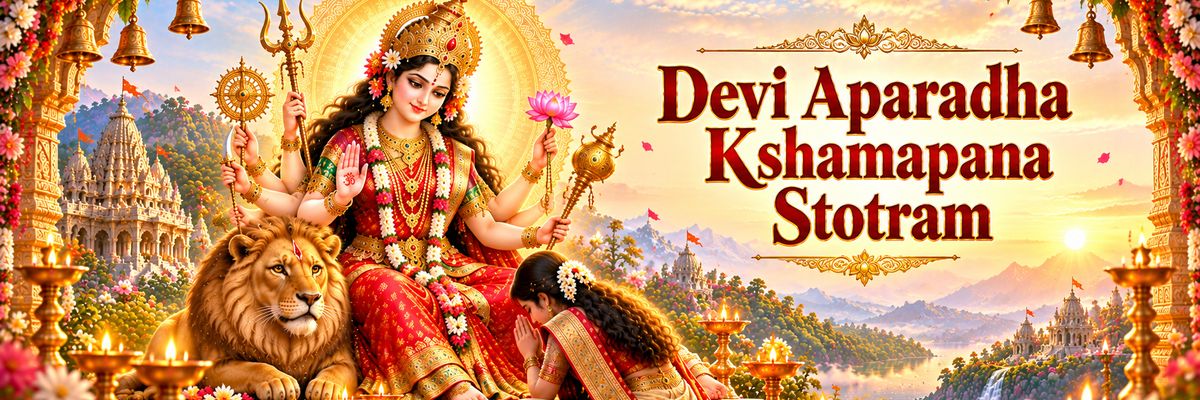
Every formal puja ends by asking forgiveness for what went wrong in it — the missed step, the wrong word, the wandering mind. The Devi Aparadha Kshamapana Stotram, "the hymn asking pardon for faults against the Devi", turns that moment into poetry. It is traditionally attributed to Adi Shankaracharya, though the attribution has been questioned. Whoever wrote it, its line "Kuputro jayeta kvachidapi kumata na bhavati" — "a bad son may sometimes be born, but there is never a bad mother" — has become one of the best-known sayings in Hindu devotion.
What the verses say
- "Na mantram no yantram": I know no mantra, no yantra, not even how to praise you; no invocation, no meditation, no stories of praise; I don't know your mudras, nor even how to cry out to you — I only know that following you, Mother, takes away all suffering.
- Through ignorance and laziness: through ignorance of the rules, lack of money, laziness and inability, I have failed at your feet — forgive it, Mother who uplifts all; a bad son may be born, but never a bad mother.
- The worst of your children: you have many simple, good children on earth; among them I am the most fickle. Yet abandoning me would not suit you.
- Given nothing: I never served your feet nor gave you wealth, and still you love me beyond compare.
- Now in old age: past eighty-five years, having abandoned the gods in the confusion of their many rituals — if you too do not show mercy, Mother of Lambodara, where shall I go?
- The power of your mantra: when your mantra enters the ear, the outcaste speaks sweet as honey and the pauper roams with crores of gold — who, then, can know the fruit of actually chanting it?
- Shiva's fortune: ash-smeared, poison-eating, sky-clad, snake-garlanded, skull-bearing Pashupati is lord of the world only because he took your hand, Bhavani.
- What I ask: I don't want liberation, wealth, knowledge or pleasure; I ask only that my life pass chanting "Mridani, Rudrani, Shiva, Shiva, Bhavani".
- No proper worship: I never worshipped you by the rules — if you still show me mercy, dark one, it is worthy only of you.
- Not deceit: sunk in trouble, I remember you, Durga — don't think it cunning; the hungry and thirsty think of their mother.
- Nothing strange: if your compassion for me is complete, what is surprising? A mother does not abandon a son covered in faults.
- The final verse: there is no sinner like me, no destroyer of sin like you; knowing this, Mahadevi, do what is fitting.
When to recite it
- At the end of any Devi puja, after the aarti — especially on each day of Navratri and after a Durga Saptashati path.
- Whenever a vow or practice has been broken or done badly.
- Many recite only the first verse and the last as a short closing prayer, or the final verse alone: "Matsamah pataki nasti...".
It is the natural companion of Shankara's Bhavani Ashtakam, which is likewise a hymn with nothing to offer but surrender.
Frequently asked questions
What does "Kuputro jayeta kvachidapi kumata na bhavati" mean?
"A bad son may sometimes be born, but a bad mother never is." It is the refrain of verses 2–4.
When should the Devi Aparadha Kshamapana Stotram be recited?
At the end of Devi puja, especially in Navratri and after the Durga Saptashati, to ask forgiveness for any faults in the worship.
Who wrote it?
It is traditionally attributed to Adi Shankaracharya. Some have doubted this, noting verse 5's reference to the speaker being over eighty-five, while Shankara is said to have died young.
What does the devotee ask for in verse 8?
Not liberation or wealth, but only that life pass in chanting the Mother's names.
Can I recite only part of it?
Yes. Many people recite the first and last verses as a short closing prayer.
Spotted a mistake?
If you find any grammatical, Hindi, English, mantra-text or other mistake on this page, tell us — we will correct it within 24 hours.