
Original text
न तातो न माता न बन्धुर्न दाता न पुत्रो न पुत्री न भृत्यो न भर्ता । न जाया न विद्या न वृत्तिर्ममैव गतिस्त्वं गतिस्त्वं त्वमेका भवानि ॥ १ ॥ भवाब्धावपारे महादुःखभीरु पपात प्रकामी प्रलोभी प्रमत्तः । कुसंसारपाशप्रबद्धः सदाहं गतिस्त्वं गतिस्त्वं त्वमेका भवानि ॥ २ ॥ न जानामि दानं न च ध्यानयोगं न जानामि तन्त्रं न च स्तोत्रमन्त्रम् । न जानामि पूजां न च न्यासयोगं गतिस्त्वं गतिस्त्वं त्वमेका भवानि ॥ ३ ॥ न जानामि पुण्यं न जानामि तीर्थं न जानामि मुक्तिं लयं वा कदाचित् । न जानामि भक्तिं व्रतं वापि मातर्- गतिस्त्वं गतिस्त्वं त्वमेका भवानि ॥ ४ ॥ कुकर्मी कुसङ्गी कुबुद्धिः कुदासः कुलाचारहीनः कदाचारलीनः । कुदृष्टिः कुवाक्यप्रबन्धः सदाहं गतिस्त्वं गतिस्त्वं त्वमेका भवानि ॥ ५ ॥ प्रजेशं रमेशं महेशं सुरेशं दिनेशं निशीथेश्वरं वा कदाचित् । न जानामि चान्यत् सदाहं शरण्ये गतिस्त्वं गतिस्त्वं त्वमेका भवानि ॥ ६ ॥ विवादे विषादे प्रमादे प्रवासे जले चानले पर्वते शत्रुमध्ये । अरण्ये शरण्ये सदा मां प्रपाहि गतिस्त्वं गतिस्त्वं त्वमेका भवानि ॥ ७ ॥ अनाथो दरिद्रो जरारोगयुक्तो महाक्षीणदीनः सदा जाड्यवक्त्रः । विपत्तौ प्रविष्टः प्रनष्टः सदाहं गतिस्त्वं गतिस्त्वं त्वमेका भवानि ॥ ८ ॥ ॥ इति श्रीमदादिशङ्कराचार्यविरचितं भवान्यष्टकं सम्पूर्णम् ॥
Transliteration
Na tato na mata na bandhurna data Na putro na putri na bhrityo na bharta Na jaya na vidya na vrittirmamaiva Gatistvam gatistvam tvameka bhavani ||1|| Bhavabdhavapare mahaduhkhabhiru Papata prakami pralobhi pramattah Kusansarapashaprabaddhah sadaham Gatistvam gatistvam tvameka bhavani ||2|| Na janami danam na cha dhyanayogam Na janami tantram na cha stotramantram Na janami pujam na cha nyasayogam Gatistvam gatistvam tvameka bhavani ||3|| Na janami punyam na janami tirtham Na janami muktim layam va kadachit Na janami bhaktim vratam vapi matar- Gatistvam gatistvam tvameka bhavani ||4|| Kukarmi kusangi kubuddhih kudasah Kulacharahinah kadacharalinah Kudrishtih kuvakyaprabandhah sadaham Gatistvam gatistvam tvameka bhavani ||5|| Prajesham ramesham mahesham suresham Dinesham nishitheshvaram va kadachit Na janami chanyat sadaham sharanye Gatistvam gatistvam tvameka bhavani ||6|| Vivade vishade pramade pravase Jale chanale parvate shatrumadhye Aranye sharanye sada mam prapahi Gatistvam gatistvam tvameka bhavani ||7|| Anatho daridro jararogayukto Mahakshinadinah sada jadyavaktrah Vipattau pravishtah pranashtah sadaham Gatistvam gatistvam tvameka bhavani ||8|| Iti shrimadadishankaracharyavirachitam bhavanyashtakam sampurnam ||
A hymn with nothing to offer
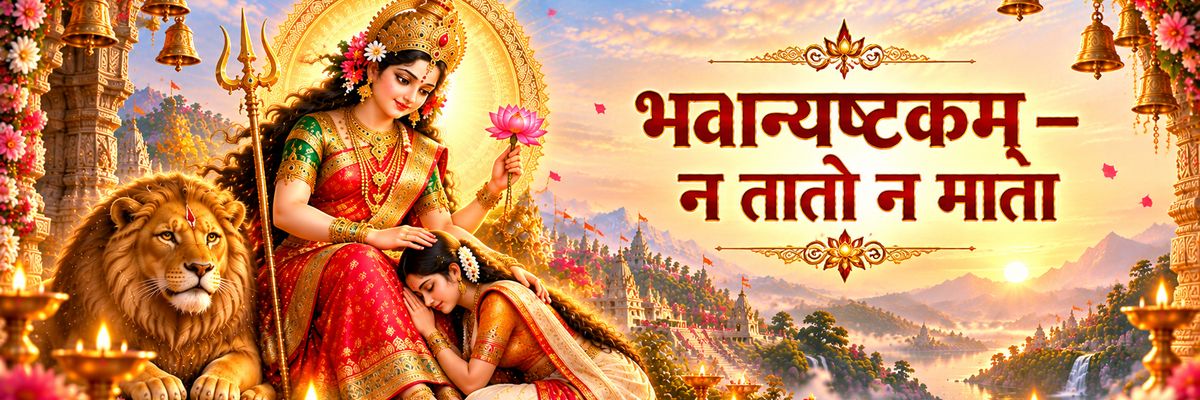
Most stotras praise the deity. The Bhavani Ashtakam hardly does; instead the devotee empties his hands. Every verse ends with the same refrain — "Gatistvam gatistvam tvameka Bhavani", "You are my refuge, you are my refuge, you alone, Bhavani" — and everything before it is a list of what he does not have. Bhavani, "the giver of existence", is Parvati-Durga, consort of Bhava (Shiva); the hymn is attributed to Adi Shankaracharya.
What the eight verses confess
- No one: no father, mother, relative or benefactor; no son, daughter, servant or husband; no wife, no learning, no livelihood.
- Lost in samsara: afraid of great sorrow in the endless ocean of birth, fallen, full of desire and greed, intoxicated, bound in the noose of a bad world.
- No practice: "I know no charity, no meditation, no tantra, no hymn or mantra, no puja, no nyasa."
- No merit: "I know no merit, no pilgrimage, no liberation or absorption, no devotion, no vow, Mother."
- No virtue: doer of bad deeds, keeper of bad company, of bad intellect, a bad servant, without good conduct, given to bad behaviour, of bad sight and bad speech — always.
- No other god: "Brahma, Vishnu, Shiva, Indra, the sun, the moon — I know none of them; I take refuge only in you."
- Everywhere: "In quarrel, in grief, in error, in a foreign land, in water, in fire, on a mountain, among enemies, in a forest — protect me always."
- Nothing left: "Orphaned, poor, old and ill, utterly weak and wretched, always dull-tongued, fallen into calamity and ruined — you alone are my refuge, Bhavani."
The power of the hymn is its honesty. It is the prayer of someone who has stopped pretending, and that is why it is sung at hospital bedsides and in times of crisis as often as in temples.
When and how to recite it
- During Navratri, and on Tuesdays and Fridays.
- In any time of fear or helplessness — verse 7 lists every kind of danger.
- Recite slowly; many people sing it to a simple tune with the refrain repeated after each verse. It is often paired with the Devi Aparadha Kshamapana Stotram, Shankara's other great hymn of a child to the Mother.
Frequently asked questions
Who wrote the Bhavani Ashtakam?
It is traditionally attributed to Adi Shankaracharya.
Who is Bhavani?
Parvati, the Divine Mother, consort of Bhava (Shiva) — worshipped as Durga. The famous Tulja Bhavani temple in Maharashtra is dedicated to her.
What does "Gatistvam gatistvam tvameka Bhavani" mean?
"You are my refuge, you are my refuge, you alone, Bhavani."
When should the Bhavani Ashtakam be recited?
In Navratri, on Tuesdays and Fridays, and whenever one feels helpless or afraid.
Why does the hymn list the devotee's faults?
Because it is a hymn of total surrender: the devotee claims no merit at all, and rests everything on the Mother's grace.
Spotted a mistake?
If you find any grammatical, Hindi, English, mantra-text or other mistake on this page, tell us — we will correct it within 24 hours.