Original text
नागेन्द्रहाराय त्रिलोचनाय भस्माङ्गरागाय महेश्वराय । नित्याय शुद्धाय दिगम्बराय तस्मै नकाराय नमः शिवाय ॥ १ ॥ मन्दाकिनि-सलिलचन्दन-चर्चिताय नन्दीश्वर-प्रमथनाथ- महेश्वराय । मन्दारपुष्प-बहुपुष्प-सुपूजिताय तस्मै मकाराय नमः शिवाय ॥ २ ॥ शिवाय गौरीवदनाब्ज-वृन्द-सूर्याय दक्षाध्वरनाशकाय । श्रीनीलकण्ठाय वृषध्वजाय तस्मै शिकाराय नमः शिवाय ॥ ३ ॥ वसिष्ठ-कुम्भोद्भव-गौतमार्यमुनीन्द्र-देवार्चितशेखराय । चन्द्रार्क-वैश्वानरलोचनाय तस्मै वकाराय नमः शिवाय ॥ ४ ॥ यक्षस्वरूपाय जटाधराय पिनाकहस्ताय सनातनाय । दिव्याय देवाय दिगम्बराय तस्मै यकाराय नमः शिवाय ॥ ५ ॥ पंचाक्षरमिदं पुण्यं यः पठेच्छिवसन्निधौ । शिवलोकमवाप्नोति शिवेन सह मोदते ॥ ॥ इति श्रीमच्छंकराचार्यविरचितं शिवपञ्चाक्षरस्तोत्रं समाप्तम् ॥
Transliteration
Nagendraharaya trilochanaya bhasmangaragaya maheshvaraya Nityaya shuddhaya digambaraya tasmai nakaraya namah shivaya ||1|| Mandakini salila chandana charchitaya nandishvara pramathanatha maheshvaraya Mandara pushpa bahupushpa supujitaya tasmai makaraya namah shivaya ||2|| Shivaya gauri vadanabja vrinda suryaya dakshadhvara nashakaya Shri nilakanthaya vrishadhvajaya tasmai shikaraya namah shivaya ||3|| Vasishtha kumbhodbhava gautamarya munindra devarchita shekharaya Chandrarka vaishvanara lochanaya tasmai vakaraya namah shivaya ||4|| Yakshasvarupaya jatadharaya pinakahastaya sanatanaya Divyaya devaya digambaraya tasmai yakaraya namah shivaya ||5|| Panchaksharamidam punyam yah pathechchhivasannidhau Shivalokamavapnoti shivena saha modate ||
A stotra built from a mantra
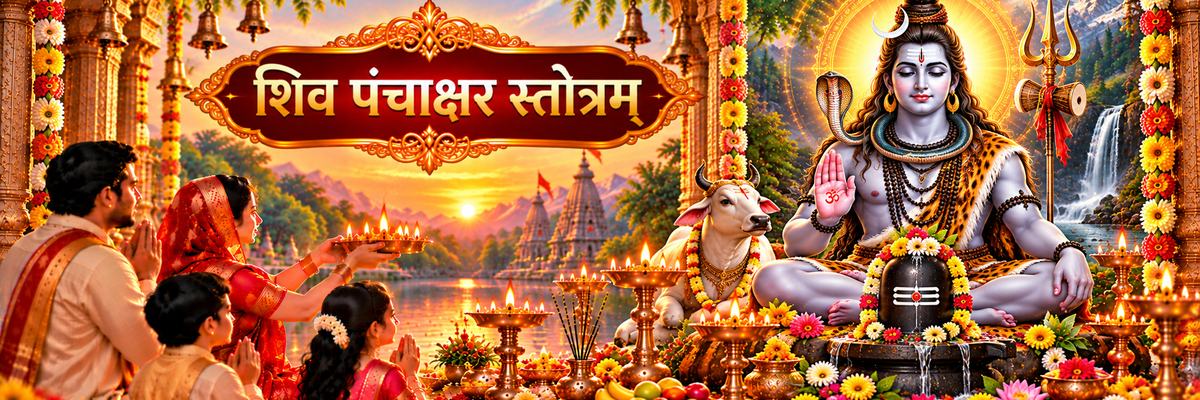
Namah Shivaya, "salutation to Shiva", is the panchakshara, the five-syllable mantra. It first appears in the Shri Rudram of the Yajurveda (namah shivaya cha shivataraya cha) and is central to Shaiva worship everywhere. This stotra, which its colophon ascribes to Adi Shankaracharya, turns the mantra into a poem with a clever design. There are five verses, one for each syllable, and each begins with its syllable and ends by saluting Shiva as that syllable:
- Na: Nagendraharaya… tasmai na-karaya namah Shivaya
- Ma: Mandakini… tasmai ma-karaya
- Shi: Shivaya Gauri… tasmai shi-karaya
- Va: Vasishtha… tasmai va-karaya
- Ya: Yakshasvarupaya… tasmai ya-karaya
Reciting the stotra is thus a slow, savoured way of saying the mantra once.
What each verse shows
- Na: the king of serpents as his necklace, three eyes, ash as his body-paint, eternal, pure, sky-clad (digambara).
- Ma: bathed in the water of the Mandakini (the heavenly Ganga) and anointed with sandal, lord of Nandi and of the pramatha attendants, worshipped with mandara and many other flowers.
- Shi: the auspicious one, the sun that opens the lotus of Gauri's face, destroyer of Daksha's sacrifice, the blue-throated one whose banner bears the bull.
- Va: the one whose crown is worshipped by the great sages Vasishtha, Agastya ("born from a pot") and Gautama and by the gods, whose three eyes are the moon, the sun and fire.
- Ya: the one who took the form of a yaksha, wears matted locks, holds the Pinaka bow, and is eternal, divine and sky-clad.
The yaksha in the last verse is often linked to the Kena Upanishad story in which Brahman appears before the proud gods as a mysterious yaksha and humbles them, though the stotra itself does not say so.
The syllables and the elements
Some teachers map the five syllables to the five elements: na to earth, ma to water, shi to fire, va to air and ya to space. That makes the mantra a salutation to Shiva present in all of creation. This is a later interpretive tradition, not something the stotra states, but it explains why the panchakshara is so often chanted while offering water, flowers and lamps, the elements themselves, at the linga.
When and how to chant it
Because it is short and regular, this is often the first Sanskrit stotra children learn. It is chanted in daily puja, on Mondays, through Shravan, on Pradosh and on Mahashivratri, and it fits naturally during jalabhishek, one verse for each pour of water. The closing verse promises that whoever recites it in Shiva's presence (Shiva sannidhau, before a linga or in a temple) reaches Shiva's world and rejoices with him. Many people follow it with 108 repetitions of Om Namah Shivaya, the mantra the stotra unpacks.
Spotted a mistake?
If you find any grammatical, Hindi, English, mantra-text or other mistake on this page, tell us — we will correct it within 24 hours.