
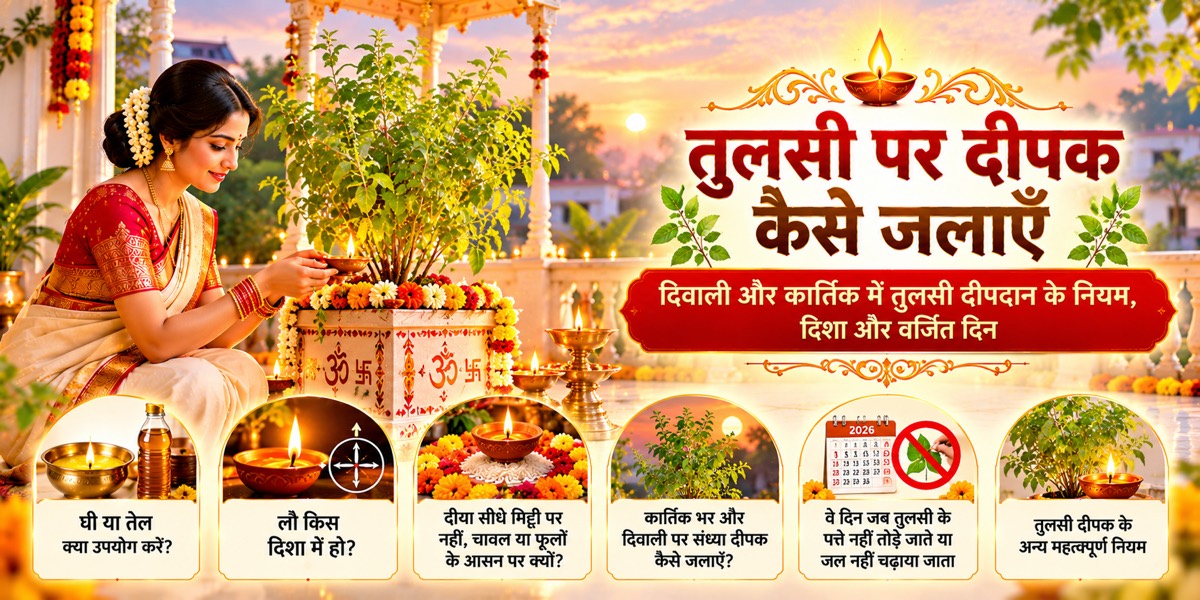
Why the Tulsi lamp matters so much in this season
Tulsi (holy basil) is worshipped in most Hindu homes as Tulsi Mata, the beloved of Vishnu, and the plant in the courtyard or on the balcony is treated as a small shrine. Lighting a lamp at her base every evening is a daily practice in many homes, but in the month of Kartik, which runs through Diwali and ends with Dev Uthani Ekadashi and Kartik Purnima, it becomes a vrat in itself. Kartik is Vishnu's month, and deepdaan (offering lamps) is its central act: lamps to the Tulsi, to the rivers, to the sky (akash deep) and at temples. The month closes with Tulsi Vivah, the marriage of Tulsi to Shaligram, on Dev Uthani Ekadashi, Friday 20 November 2026.
So the Tulsi lamp on Diwali is not a separate ritual. It is one evening in a month of evenings, and on Diwali it is one of the three core lamps of the house, with the mandir and the main gate.
How to light the Tulsi lamp
Ghee or oil
Ghee is preferred. Tulsi is treated as a goddess, and the lamp at her base is a puja lamp, so the same rule as the mandir applies. If ghee is not possible, sesame oil is the usual alternative; mustard oil is better kept for the threshold.
The lamp and the wick
Use a small clay diya with a long wick (lambi bati) resting on the spout. A long wick gives a steady, directed flame, and the spout lets you choose the direction.
Which way the flame should face
The most common guidance is to turn the flame towards the east, the direction of the rising sun, associated with health and long life, or towards the north, the direction of Kuber and of wealth. Families tend to explain the east-facing lamp as one for the health and long life of the family, and the north-facing lamp as one for prosperity. Whichever you choose, the flame should never face south for the Tulsi: south is Yama's direction, kept for the Yama Deepam on Dhanteras night.
The asan: never directly on the soil
Do not set the diya straight onto the soil of the pot, and do not balance it on the rim. Make a small asan (seat) for it first: a little heap of whole, unbroken rice (akshat), or a few flower petals, or a small leaf, on a flat spot at the base of the plant. Then place the diya on it. There are three reasons, and families give all of them:
- A lamp offered to a deity is always given a seat, the same way an idol is not placed on a bare floor.
- Oil and ghee that soak into the soil harm the roots; a Tulsi that sits under a dripping lamp every evening for a month often yellows.
- A diya on the rim tips over or scorches the stems. A flat asan at the base is steady.
Order on Diwali evening
- At dusk, before or right after the Lakshmi Puja, offer a little water at the base of the Tulsi only if it is not a no-water day for your family (Diwali 2026 is a Sunday and Amavasya; see below).
- Make the rice or petal asan, place the diya and light it from the mandir lamp.
- Apply a little roli or haldi to the pot, offer a flower, and do parikrama (going round the plant), three or seven times, or bow if there is no space to walk round.
- Many families sing the Tulsi aarti, Tulsi Maharani Namo Namo.
The restriction calendar for 2026
Household tradition sets aside certain days when Tulsi is rested. The two customs to keep apart are plucking leaves and watering. The plucking restriction is the stronger and more widely held one; the watering restriction is followed by many families but not all.
Days when leaves are not plucked
- Sundays
- Ekadashi and Dwadashi
- Amavasya and Purnima
- Sankranti, and during an eclipse
- After sunset, on any day
Days when many families don't water Tulsi
- Sundays
- Ekadashi. The popular explanation is that Tulsi herself keeps the Ekadashi fast for Vishnu, so she is not given water that day.
Dates in this Diwali window
| Date (2026) | Day | Plucking | Watering (in families that rest her) |
|---|---|---|---|
| Thu 22 Oct | Papankusha Ekadashi | No | No |
| Sun 25 Oct, 1 Nov | Sundays | No | No |
| Thu 5 Nov | Rama Ekadashi | No | No |
| Sun 8 Nov | Diwali: Sunday and Amavasya | No | No |
| Sun 15 Nov | Sunday | No | No |
| Fri 20 Nov | Dev Uthani Ekadashi | No | No; Tulsi Vivah evening or next day |
Diwali 2026 is a double restriction day, both Sunday and Amavasya. If you need Tulsi leaves for a Vishnu or Krishna bhog that evening, pluck them on Saturday 7 November before sunset and keep them in water; Tulsi leaves do not go stale overnight in the way other offerings do. The lamp itself is lit as usual; the restrictions are about touching the plant, not about worshipping her.
Don't disturb the soil in Kartik
Many families avoid repotting, cutting back or digging around the Tulsi during Kartik, and especially on the restriction days. If the plant needs repotting, do it before Kartik begins or after Kartik Purnima. Pinch off dry manjari (seed spikes) gently on an ordinary day, and leave fallen leaves in the pot rather than sweeping them away.
Other things to keep in mind
- Tulsi is not offered to Ganesh. On Diwali the Lakshmi Puja includes Ganesh; keep Tulsi leaves off his plate. Tulsi is also not offered to Shiva.
- Don't chew Tulsi leaves. They are swallowed, or taken with charanamrit; chewing is traditionally avoided.
- A dried Tulsi plant is not thrown away. Its wood can be used for a mala, or the plant is put into flowing water or buried in clean soil, and a new plant is brought in on an auspicious day; many families wait for Dev Uthani Ekadashi.
- Women traditionally do not touch Tulsi during menstruation in many homes; another family member lights the lamp. This is a household custom that families follow to different degrees.
Frequently asked questions
Which direction should the Tulsi diya face?
East or north. East is associated with health and long life, north with prosperity. Avoid south, which is kept for the Yama lamp.
Should the Tulsi lamp be ghee or oil?
Ghee is preferred because it is a puja lamp. Sesame oil is the usual alternative.
Can I place the diya directly on the soil of the Tulsi pot?
It is better not to. Put a small seat of whole rice or flower petals first. The oil harms the roots, and a lamp to a deity is always given an asan.
Can I water Tulsi on Diwali 2026?
Diwali falls on Sunday 8 November, which is also Amavasya. Families that rest Tulsi on Sundays don't water her that day. Lighting the lamp is fine.
I need Tulsi leaves for bhog on Diwali. When should I pluck them?
On Saturday 7 November, before sunset. Keep them in a little water. Don't pluck on Diwali itself, which is both Sunday and Amavasya.
Why isn't Tulsi watered on Ekadashi?
The popular belief is that Tulsi herself fasts on Ekadashi for Vishnu. Not every family follows this, but the no-plucking rule on Ekadashi is very widely kept.
Should I light the Tulsi lamp every day of Kartik?
That is the tradition, from the start of Kartik through Kartik Purnima. If you cannot do every day, light it at least on Diwali, on the Ekadashis and on Dev Uthani Ekadashi, 20 November.
Was this article helpful?
Spotted a mistake?
If you find any grammatical, Hindi, English, mantra-text or other mistake on this page, tell us — we will correct it within 24 hours.