
The short answer
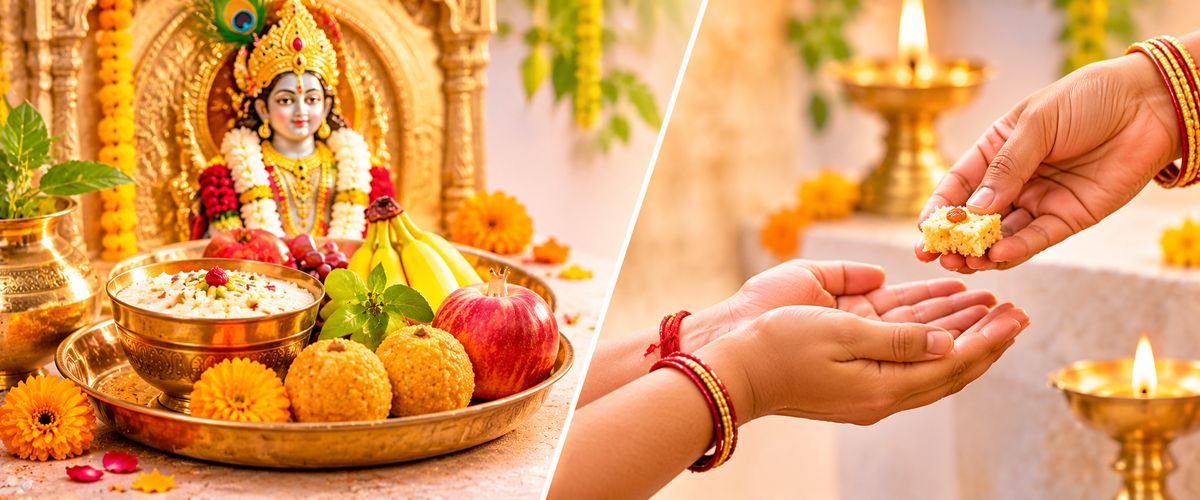
Bhog and prasad are the same food at two different moments. Before it is offered, food placed before the deity is bhog (or naivedya). After it has been offered and accepted, the same food is prasad. Nothing is added to it in between; what changes is whose it is. Bhog is what we give. Prasad is what comes back.
What the words mean
- Bhog (भोग) comes from the root bhuj, to eat or enjoy. It is food prepared for the deity's enjoyment. The word is used most in North Indian homes and in Vaishnava temples, where the day is divided by bhogs: mangala bhog, rajbhog, shayan bhog.
- Naivedya (नैवेद्य) is the formal term in the puja sequence. In the five-step panchopachara puja it is the fifth offering, after sandal paste, flowers, incense and the lamp. When a priest says "naivedyam samarpayami", the bhog is being offered.
- Prasad (प्रसाद) means grace, favour, clarity. The offered food is called prasad because it now carries the deity's grace and is received as a gift, not eaten as an ordinary meal.
- Mahaprasad is used for the prasad of a few great temples, above all Puri. There, food cooked in earthen pots in the temple kitchen is offered to Jagannath and then to Goddess Bimala, and only then is it called Mahaprasad. It is eaten together by people of every caste at the Ananda Bazaar.
What the Gita says about offering food
The verse quoted most for this is Bhagavad Gita 9.26:
पत्रं पुष्पं फलं तोयं यो मे भक्त्या प्रयच्छति ।
तदहं भक्त्युपहृतमश्नामि प्रयतात्मनः ॥
"Whoever offers me a leaf, a flower, a fruit or water with devotion, that offering of love from a pure heart I accept." The list is deliberately humble. A leaf and water qualify; what decides it is bhakti, devotion.
Gita 3.13 explains why we eat only after offering:
यज्ञशिष्टाशिनः सन्तो मुच्यन्ते सर्वकिल्बिषैः ।
भुञ्जते ते त्वघं पापा ये पचन्त्यात्मकारणात् ॥
"The good, who eat what remains of the offering, are freed from all faults; but those who cook only for themselves eat sin." This is the root of the household habit of offering a little of every meal before anyone eats, and of the Brahmarpanam bhojan mantra said before meals.
How to offer bhog at home
- Cook after bathing, in a clean kitchen, with clean hands. In many homes the bhog portion is cooked or served in separate vessels kept for puja.
- Don't taste it. The first taste belongs to the deity. If salt needs checking, judge by smell and experience, or offer it as it is.
- Take out the bhog first, before anyone is served, on a clean plate or leaf. A small portion of each dish is enough.
- Add tulsi for Vishnu, Krishna and Ram. A tulsi leaf on the bhog is essential in Vaishnava practice.
- Place it before the deity with water beside it. Sprinkle a little water around the plate.
- Offer it in words. A simple "Please accept this", the deity's name mantra, or the formal "naivedyam samarpayami" all serve.
- Wait a few minutes. Many families close their eyes or draw a curtain for the length of a short prayer.
- Take it back as prasad. Mix the offered portion back into the rest of the food so that the whole meal becomes prasad, and serve.
What is commonly offered to whom
These are widespread customs, not rules; every region adds its own.
| Deity | Commonly offered | Note |
|---|---|---|
| Krishna, Vishnu, Ram | Makhan-mishri, kheer, panchamrit, fruit, any sattvik food | Always with tulsi. No onion or garlic in Vaishnava bhog. |
| Ganesh | Modak, besan or motichoor laddu, durva grass alongside | Tulsi is traditionally not offered to Ganesh. |
| Shiva | Fruit, milk, bhang in some places, sweets placed before the linga | In many traditions, what is offered directly onto the Shivling (nirmalya) is not eaten, while food placed in front is shared as prasad. |
| Hanuman | Boondi or besan laddu, gur-chana, jalebi on Tuesdays in many places | |
| Lakshmi | Kheer, white sweets, makhane, batasha, kheel | Kheel-batasha is the classic Diwali offering. |
| Durga | Halwa, puri and kala chana on Ashtami and Navami | Also served to the kanyas in kanya pujan. |
| Surya | Jaggery, wheat, and on Chhath thekua and seasonal fruit | See our Chhath samagri list. |
Cleanliness customs most families keep
- Nothing jootha (already tasted or eaten from) is offered.
- Stale food and yesterday's leftovers are not offered; cook fresh, or offer fruit.
- Many homes keep onion, garlic, meat and eggs out of the kitchen on puja days, and always out of Vaishnava bhog.
- The bhog plate is not set on the floor; use a small chowki, a stand or the altar itself.
- Bought sweets are offered before the box is opened and eaten from, not after.
Shakta and some regional traditions offer things Vaishnava homes would not, including fish and meat in some Bengal and Assam temples. In each case the household follows its own sampradaya.
How to receive prasad
Accept it with the right hand, or with both hands cupped, and touch it to your forehead before eating. Don't refuse it, drop it or throw it away. If it's more than you can eat, share it, and give what is left to a cow or another animal, or put it in a plant pot. If you are fasting and the prasad doesn't fit your fast, take it and keep it to eat once the fast is broken, rather than declining it.
Frequently asked questions
What is the difference between bhog and prasad?
Bhog is food offered to the deity; prasad is the same food after it has been offered, received back as the deity's grace. Same food, two moments: before offering and after.
Can homemade everyday food be offered as bhog?
Yes, and many families do this daily: a small plate of whatever has been cooked, offered before anyone eats. It should be fresh, untasted and, for Vaishnava deities, without onion or garlic.
Can I offer only fruit or only water?
Yes. The Gita (9.26) names a leaf, a flower, a fruit and water as acceptable when offered with devotion. Fruit is the most common bhog on fasting days and when cooking isn't possible.
Can I offer sweets bought from a shop?
Yes. Offer them before the box is opened and eaten from. Many families still add one small thing they made themselves, even just a little kheer or mishri.
How long should bhog be kept before the deity?
A few minutes, about the length of a short prayer, is the usual home practice. Temples follow their own timetables. Don't leave cooked food before the deity for hours, where it can spoil.
Why is tulsi not offered to Ganesh?
A popular Puranic legend tells of a curse between Tulsi and Ganesh, after which tulsi is kept away from his worship. Durva grass takes its place.
What should be done with leftover prasad?
Share it, eat it within a reasonable time, and give what remains to animals or put it in a plant pot. It should never go into the dustbin.
Was this article helpful?
Spotted a mistake?
If you find any grammatical, Hindi, English, mantra-text or other mistake on this page, tell us — we will correct it within 24 hours.