
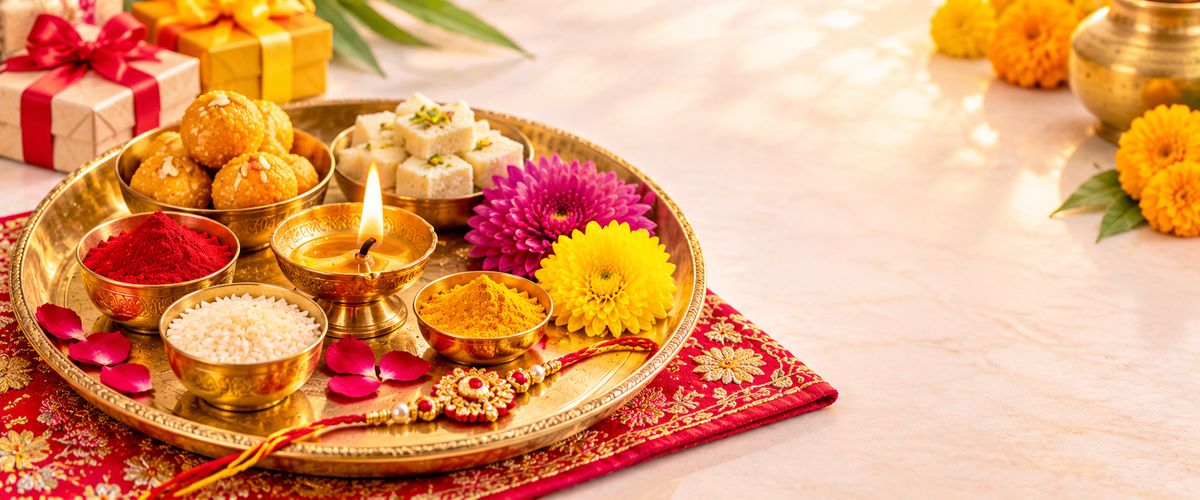
Bhai Dooj 2026 and the thali at a glance
- Bhai Dooj: Wednesday, 11 November 2026 (Kartik Shukla Dwitiya, also called Yama Dwitiya)
- Tilak time (aparahna): 1:10 pm to 3:20 pm, New Delhi
- The five things every thali needs: roli or kumkum, akshat, a lamp, something sweet, and a little water
- Everything else (kalava, coconut, paan, flowers, batasha) depends on your family's custom
For the timing, the brother's seating direction and the Yama–Yamuna story, see our Bhai Dooj muhurat and katha guide. This article is only about the thali: what goes on it and why.
The core items and what each one means
| Item | How much | Why it is there |
|---|---|---|
| Roli or kumkum | A small katori | The tilak itself. Roli is turmeric treated with lime, which turns it red. Red on the forehead marks the brother as protected and honoured. |
| Akshat (unbroken rice) | A small katori, a few spoons | "Akshat" means unbroken, unharmed. The grains pressed onto the tilak carry the wish that his life stays whole. Pick out broken grains. |
| Diya | One lamp, ghee with a cotton wick | For the aarti. Light is offered to a guest you honour as you would a deity. |
| Sweets | A few pieces | The sister puts a sweet in his mouth after the aarti: a wish that his year is sweet. Any home-made or bought mithai is fine. |
| Water | A small lota beside the thali | To sprinkle for purification and to offer him a sip after the sweet. |
| Kalava (mauli) | One length of red-yellow thread | Tied on his right wrist in many North Indian homes as a protective thread. Not universal. |
| Dry coconut (gola) | One, whole | Given to the brother in much of Uttar Pradesh, Haryana and Delhi as a token of prosperity. Many families skip it. |
| Paan and supari | One leaf, one betel nut | The traditional offering of respect to an honoured guest. |
| Flowers | A handful | For the small puja to Ganesh, Yama and Yamuna before the tilak, and to shower on the brother. |
If you can manage only the first five rows, the tilak is complete. The rest add to it but are not required by any rule.
Items some families add
- Chandan (sandalwood paste): used instead of roli in Bengal's Bhai Phonta, and alongside it elsewhere.
- Batasha or mishri: a simple sweet that many homes put in the brother's mouth instead of mithai.
- A small swastik or rangoli on the thali: drawn with roli before arranging the items.
- Haldi-coloured rice (peele chawal): some families colour the akshat with turmeric for auspiciousness.
- Bajri (dry gram) and the rengni thorn: in parts of Bihar, sisters first "curse" the brother and then prick their own tongue with a rengni thorn in atonement, and the brother swallows a few grains of bajri. This belongs to the morning's Godhan rite there, not to the tilak thali everywhere.
- A gift for the sister: the brother brings it; it is not kept on her thali.
Regional thalis
- North India (UP, Delhi, Haryana, Rajasthan): roli, akshat, kalava, ghee diya, mithai, gola, paan-supari.
- Bengal (Bhai Phonta): the phonta is made of chandan, kajal and curd, applied with the little finger. The thali also holds dhaan-durba (paddy and durva grass), placed on the brother's head as a blessing, and a lamp. Conch shells and ululation accompany it.
- Maharashtra, Goa, Karnataka (Bhau Beej): the thali is mainly for the aukshan, the aarti of the brother, with a lamp, kumkum, akshat and a sweet; the brother sits in a square drawn on the floor.
- Nepal and Darjeeling (Bhai Tika): a tika of seven colours on a base of rice and curd, and a garland of makhamali (globe amaranth) flowers. In many homes the sister also cracks a walnut at the door.
None of these is more correct than the others. Follow the custom of your mother's or grandmother's home, and if nobody remembers, the North Indian basics are a safe default.
How to prepare the thali, in order
- Clean the thali. Brass, copper, silver or steel all work. Avoid plastic and anything chipped. Wipe it dry.
- Draw a small swastik in the centre with wet roli, if your family does this.
- Place the diya at the front edge (the side facing your brother), so you can lift it for the aarti without reaching over the other items.
- Put roli and akshat in two small katoris on your right side, the hand you will apply the tilak with.
- Add kalava, flowers and paan-supari on the left.
- Sweets go at the back, on a small plate or leaf if the thali is crowded.
- Keep the lota of water and the gola beside the thali, not on it. A full lota makes the thali hard to lift.
- Light the diya only when you begin, inside the tilak window of 1:10 to 3:20 pm, not hours earlier.
Lay a clean asan or small chowki for the brother before he sits. If you are making a meal for him afterwards, as Yamuna did for Yama, have it ready so the tilak and the meal follow each other.
What to avoid
- Broken rice as akshat. The word itself means unbroken.
- Synthetic sindoor or chemical kumkum on sensitive skin. Pure roli or chandan is gentler.
- A thali used for non-veg serving in homes that keep puja vessels separate.
- Black thread or black items on the thali in most North Indian homes. (Bengal's kajal in the phonta is the known exception.)
After the tilak
Do not throw the leftover akshat and roli in the bin. Put them in a plant pot or in the puja area to be used again. Leftover flowers go to a plant or flowing water. The gola is kept by the brother and, in many homes, broken and eaten later as prasad. The diya is left to burn out by itself.
Frequently asked questions
What are the essential items in a Bhai Dooj thali?
Roli or kumkum, akshat (unbroken rice), a lit lamp, a sweet and a little water. With these five the tilak and aarti are complete. Kalava, gola, paan-supari and flowers are common additions.
Can I use kumkum instead of roli?
Yes. Both are red tilak powders and are used interchangeably in most homes. In Bengal, chandan is the traditional base for the phonta instead.
Is a coconut necessary on Bhai Dooj?
No. The dry coconut (gola) is a strong custom in parts of UP, Haryana and Delhi, but plenty of families never use it. If your family hasn't, there is no need to start.
Can I prepare the thali the night before?
You can clean the thali and keep the dry items ready the night before. Add the flowers and sweets on the day, and light the lamp only at tilak time.
Is the Bhai Dooj thali the same as the Raksha Bandhan thali?
They overlap (roli, akshat, lamp, sweets) but the centre is different. Raksha Bandhan is built around the rakhi; Bhai Dooj around the tilak and the meal, with kalava only in some families.
Which metal is best for the thali?
Brass, copper or silver are traditional; steel is perfectly acceptable. What matters is that it is clean and kept for puja, not that it is expensive.
What if the brother lives far away?
Many sisters prepare the thali anyway, offer the tilak to his photo or to Ganesh with a prayer for him, and send the gola or sweets by post. A video call during the tilak window is common now.
Was this article helpful?
Spotted a mistake?
If you find any grammatical, Hindi, English, mantra-text or other mistake on this page, tell us — we will correct it within 24 hours.