
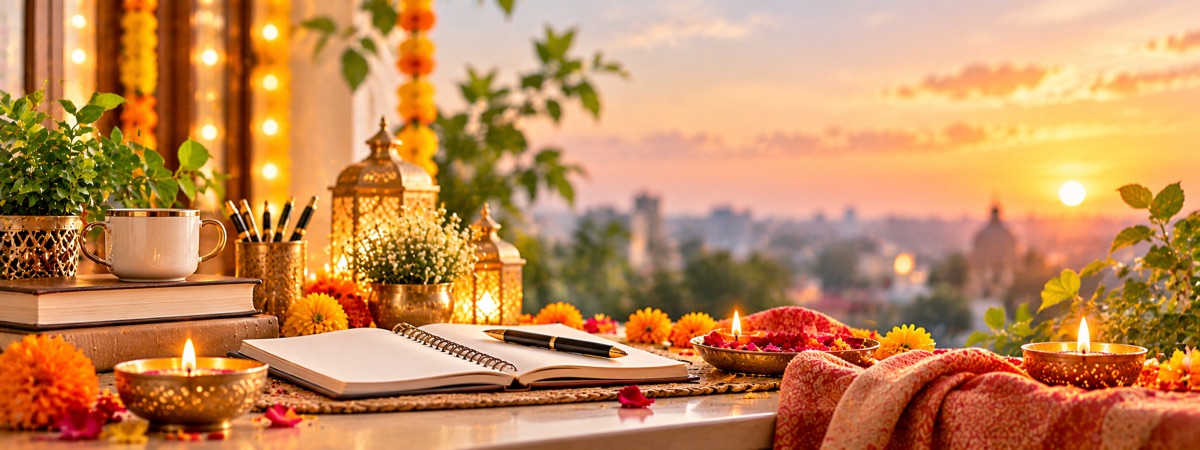
Why Diwali is a good time to take stock
Long before calendars on the wall, Diwali marked the end of one cycle and the start of the next. The harvest was in, the monsoon was over, and traders closed the year's accounts. At Lakshmi Puja on Sunday, 8 November 2026, many business families still perform Chopda Pujan and open new account books with "Shubh" and "Labh" written in them. Two days later, on Tuesday, 10 November, Gujarati families celebrate Bestu Varas, the new year, as Vikram Samvat 2083 begins on Kartik Shukla Pratipada, the same day as Govardhan Puja.
The cleaning that comes before Diwali is part of the same idea: clear out the old so that Lakshmi, prosperity in every sense, has room to enter. It works just as well for the mind as for the house. Here are seven things worth letting go of, and seven worth carrying into the new year.
1. Leave behind: the clutter you've been keeping "just in case". Take along: only what you use and love
Broken appliances, clothes that haven't been worn in two Diwalis, boxes of things kept for a day that never comes. The tradition of clearing the house before Dhanteras is a once-a-year permission to let them go: give usable things to someone who needs them, and discard the rest. A lighter home is easier to keep clean all year. Our guide to Diwali cleaning customs covers the traditional dos and don'ts.
2. Leave behind: grudges. Take along: the relationships worth mending
Diwali visits have always been a way to repair things without having to discuss them: you arrive with sweets, they welcome you in, and the old argument quietly stops mattering. If there is a relative or friend you haven't spoken to this year, a box of sweets and a phone call before Lakshmi Puja is the easiest opening you will get all year. Bhai Dooj on Wednesday, 11 November is another.
3. Leave behind: unpaid dues. Take along: a clean new ledger
The old trader's rule was to settle debts before opening the new books, so the year starts clear. For a household, it can mean paying the small amounts you owe (the friend who covered a bill, the tailor, the shop on credit) and writing a simple budget for the year ahead. Even a single page with income, savings and the few big expenses you know are coming is a real start.
4. Leave behind: the comparison. Take along: gratitude
Festival season brings a flood of other people's new cars, gold and holidays. It's easy to feel behind. Lakshmi Puja is, at heart, an act of thanks for what has come. One practice: after the aarti, before the sweets, have everyone at the puja say one thing they are grateful for from the past year. Children's answers are often the most moving.
5. Leave behind: the habits that drained you. Take along: one daily practice
Choose one habit to drop, such as late-night scrolling, skipping breakfast or the daily argument about the same thing. In its place, choose one small practice to carry into the new year: lighting a diya in the evening, five minutes of puja in the morning, a walk, reading one verse of the Gita a day. Small and daily beats grand and occasional. If you'd like a structure, our five-minute daily panchdev puja is a good start.
6. Leave behind: waste. Take along: a habit of giving
Diwali can produce a mountain of plastic, packaging and leftover food. This year, give the extra sweets to the security staff or a shelter before they go stale, and choose clay diyas, cloth bags and steel boxes over disposables. Daan, giving, is part of Diwali: food, clothes or a donation to someone in need are as much a part of the festival as the lights. Try making it a monthly habit, not a yearly one.
7. Leave behind: last year's disappointments. Take along: one clear intention
Not a list of resolutions, which are usually abandoned by Makar Sankranti, but one sankalp, one intention, for the year of Samvat 2083. Write it down on a slip of paper and keep it in the mandir or with the new account book. Read it again on Diwali next year.
A simple family reflection for Diwali night
After the puja, when the diyas are still burning, sit together for ten minutes and go round the circle with three questions:
- What am I grateful for from this past year?
- What do I want to leave behind?
- What is one thing I want to carry into the new year?
Write the answers in a notebook kept for this purpose. Over the years it becomes a family record unlike any photo album.
Frequently asked questions
Is Diwali the Hindu new year?
For some communities, yes. The Gujarati New Year (Bestu Varas) begins on Kartik Shukla Pratipada, the day after Diwali Amavasya, which in 2026 is Tuesday, 10 November, starting Vikram Samvat 2083. Many North Indian calendars begin the year in Chaitra (March–April) instead, but Diwali is widely treated as the start of the financial year for traders.
What is Chopda Pujan?
Chopda Pujan is the worship of new account books, done on Diwali alongside Lakshmi Puja, especially by Gujarati and Marwari business families. "Shubh" and "Labh" and a swastika are written in the new books before the first entry.
Why are old things thrown out before Diwali?
The house is cleaned and cleared so that Lakshmi can enter a clean, bright home. Practically, it is also the end of the monsoon, a natural time to clear damp, broken and unused items.
What is a sankalp, and how do I make one?
A sankalp is a resolved intention, traditionally spoken before a puja or vrat. For the new year, keep it simple: one specific, positive intention, written down and kept in your mandir.
How can children take part in a Diwali reflection?
Let them answer the same three questions in their own words or draw their answers. Keeping their notes year after year shows them how they've grown.
Is it good to give to charity on Diwali?
Yes. Daan is an essential part of Diwali. Giving food, clothes, sweets or money to those in need, especially the people who work around your home, is considered very auspicious.
Was this article helpful?
Spotted a mistake?
If you find any grammatical, Hindi, English, mantra-text or other mistake on this page, tell us — we will correct it within 24 hours.
Related content
- Deep Clean or Deep Wealth? The Vastu Rules of Pre-Diwali Sweeping, Mopping and the BroomPublished7 min read
- Daily Panchdev Puja Vidhi: The Five Deities of Home Worship and the Right OrderPublished7 min read
- Diwali 2026 Laxmi Puja Vidhi: A Step-by-Step Guide to Welcoming Mahalakshmi at Home and at Your Shop or OfficePublished10 min read
- Bhai Dooj 2026: Auspicious Tilak Timing, Direction, and the Story of Yama and YamunaPublished8 min read