Govardhan Puja 2026 at a glance
- Date: Tuesday, 10 November 2026 (Kartik Shukla Pratipada, the day after Diwali's Amavasya ends)
- Morning puja muhurat: 6:40 am to 8:50 am, New Delhi
- Also called: Annakut, "the mountain of food"
- What is offered: as many dishes as the family can cook, traditionally 56 (chhappan bhog), heaped before a Govardhan made of cow dung or before Krishna's image
Why Govardhan is worshipped with food
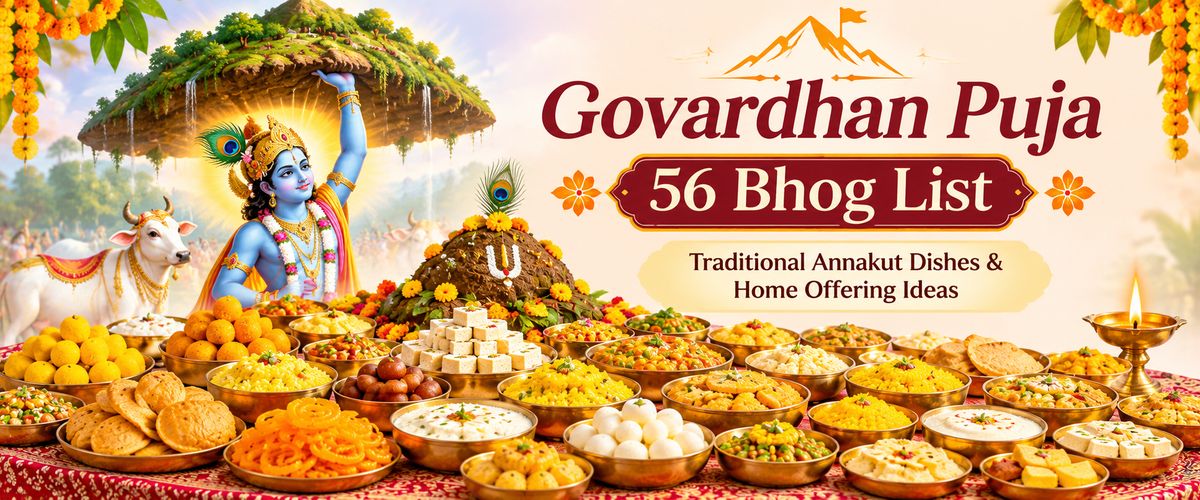
The story is in the tenth book of the Bhagavata Purana (chapters 24 and 25). The people of Vraja were preparing their yearly sacrifice to Indra for the rains. The boy Krishna asked them why: their cattle grazed on Govardhan hill, their water came from its streams, so the hill and the cows deserved the offering. They agreed, cooked a great feast, offered it to Govardhan and fed the cows, brahmins and everyone present. Indra, insulted, sent a storm. Krishna lifted the hill on one finger and sheltered all of Vraja under it for seven days until Indra gave up.
So the food is not decoration. Annakut is the original puja: the feast Vraja cooked for the hill instead of for Indra. That is why the day is about quantity and variety, and why the food is shared out afterwards.
Why 56 dishes?
The number 56 is not in the Bhagavata. The explanation most often given in Vaishnava homes and temples is this: Yashoda fed Krishna eight times a day, once in each prahar. For the seven days he held up Govardhan he ate nothing. When the rain stopped, the people of Vraja made up the missed meals: 7 days × 8 meals = 56 dishes. Some Pushtimarg accounts give other reasons, such as a lotus of 56 petals in Goloka. Treat the number as devotion, not arithmetic. Temples like Shrinathji at Nathdwara offer far more than 56 items at Annakut, and a home that offers five dishes with love has not done less.
The 56 bhog list, by group
There is no single official list; every temple and family has its own. This one is built from dishes commonly made at home in North India for Annakut, with no onion or garlic. Swap any item for a regional favourite.
| Group | Dishes |
|---|---|
| Sweets (12) | 1 Malpua · 2 Jalebi · 3 Besan laddu · 4 Motichoor laddu · 5 Peda · 6 Barfi · 7 Gulab jamun · 8 Suji halwa · 9 Moong dal halwa · 10 Mohanthal · 11 Ghevar · 12 Shakarpara |
| Milk and dairy (9) | 13 Makhan-mishri · 14 Kheer · 15 Rabdi · 16 Shrikhand · 17 Basundi · 18 Dahi · 19 Chaach or lassi · 20 Khurchan · 21 Malai |
| Rice and dal (8) | 22 Plain rice (bhaat) · 23 Kadhi · 24 Khichdi · 25 Meetha kesari bhaat · 26 Sattvik pulao · 27 Arhar dal · 28 Moong dal · 29 Bajre ki khichdi |
| Breads (7) | 30 Puri · 31 Kachori · 32 Paratha · 33 Phulka · 34 Bedmi puri · 35 Missi roti · 36 Thepla |
| Vegetables (11) | 37 Annakut ki sabzi (mixed vegetables) · 38 Aloo sabzi · 39 Kaddu (pumpkin) · 40 Arbi · 41 Gobhi · 42 Bhindi · 43 Chole · 44 Paneer sabzi · 45 Saag · 46 Sem (flat beans) · 47 Shakarkand (sweet potato) |
| Snacks, sides and the finish (9) | 48 Mathri · 49 Namak pare · 50 Pakode · 51 Papad · 52 Chutney · 53 Achar · 54 Raita · 55 Seasonal fruits · 56 Paan beeda with elaichi |
Makhan-mishri is the one dish almost every list includes, because it is Krishna's own favourite in the Vraja stories. Paan comes last, as it does at the end of any formal meal.
The Annakut sabzi and kadhi-chawal
In many North Indian homes the heart of the day is not the sweets but two humble dishes. Annakut ki sabzi is a single pot of every vegetable in season (pumpkin, radish, sweet potato, cauliflower, beans, brinjal, spinach, potato and more) cooked together without onion or garlic. It stands for the whole harvest offered at once. Kadhi-chawal is the other: rice heaped like a hill, with kadhi poured around it. At Nathdwara, a great mound of rice is the centre of the Annakut, and once darshan is over the rice is famously carried off by villagers from the surrounding area, an old right of theirs.
Smaller menus for home
Most families do not cook 56 dishes, and nothing says they must. Choose a number that you can cook well and offer on time.
- 5 dishes: makhan-mishri, kheer, puri, Annakut sabzi, seasonal fruit.
- 11 dishes: the five above, plus kadhi, rice, besan laddu, moong dal, raita and paan.
- 21 dishes: the eleven, plus peda, malpua, dahi, kachori, aloo sabzi, chole, mathri, papad, chutney and achar.
Families that buy sweets usually cook at least the kheer, puri and sabzi at home, so that something on the plate is made with their own hands.
How to offer the bhog
- Cook after bathing, in a clean kitchen. Don't taste anything while cooking: the first taste is Krishna's.
- Make the Govardhan in the courtyard or on a clean board with cow dung (or, in flats, a small hill of flour, rice or a picture), with Krishna as Giridhari on top or beside it, and small figures of cows.
- Arrange the dishes in front, sweets and makhan-mishri nearest, the rice heaped in the middle if you have kadhi-chawal.
- Put a tulsi leaf on the dishes, or at least on the main ones. A bhog to Krishna is considered incomplete without tulsi.
- Offer with water sprinkled around the plates, a prayer, and a few minutes' pause, then do the aarti (the Giriraj Chalisa is often recited).
- Do the parikrama of the Govardhan, usually seven times, many families with a lota of water poured as a line around it.
- Feed the cows a portion, if you can, and then share the prasad with family, neighbours and anyone who visits.
Frequently asked questions
When is Govardhan Puja in 2026?
Tuesday, 10 November 2026, on Kartik Shukla Pratipada. The morning muhurat in New Delhi is 6:40 to 8:50 am. Diwali's Amavasya ends at 12:31 pm on 9 November, which is why Govardhan falls on the 10th this year and not the day right after Lakshmi Puja.
Do I have to offer exactly 56 dishes?
No. 56 is the traditional ideal. Five, eleven or twenty-one dishes offered with care are entirely acceptable, and what matters more is that the food is fresh, sattvik and offered before anyone eats.
Why are onion and garlic left out?
Bhog to Krishna is sattvik in Vaishnava practice, and onion and garlic are classed as tamasic or rajasic. Most temples and households keep them out of all dishes for the day.
Can I offer sweets bought from a shop?
Yes, many families do, especially for elaborate sweets like ghevar. Try to cook at least a few dishes yourself, and offer the bought sweets before opening and eating from the box.
Are Annakut and Govardhan Puja the same?
They are the same day and the same festival. Govardhan Puja names the worship of the hill; Annakut names the heap of food offered to it. Gujarati homes also celebrate the day as Bestu Varas, their new year.
What is the Annakut sabzi?
A single dish of many seasonal vegetables cooked together, without onion or garlic. It represents the whole harvest offered at once and is one of the most important dishes of the day in North Indian homes.
What should be done with the bhog afterwards?
It becomes prasad and is meant to be shared: family, neighbours, helpers, cows. Don't throw any away. Leftovers can be eaten over the next day or given to animals.
Was this article helpful?
Spotted a mistake?
If you find any grammatical, Hindi, English, mantra-text or other mistake on this page, tell us — we will correct it within 24 hours.