
Thekua and Chhath 2026
- Nahay Khay: Friday, 13 November
- Kharna: Saturday, 14 November
- Sandhya Arghya: Sunday, 15 November (sunset 5:28 pm, New Delhi)
- Usha Arghya and parana: Monday, 16 November (sunrise 6:44 am, New Delhi)
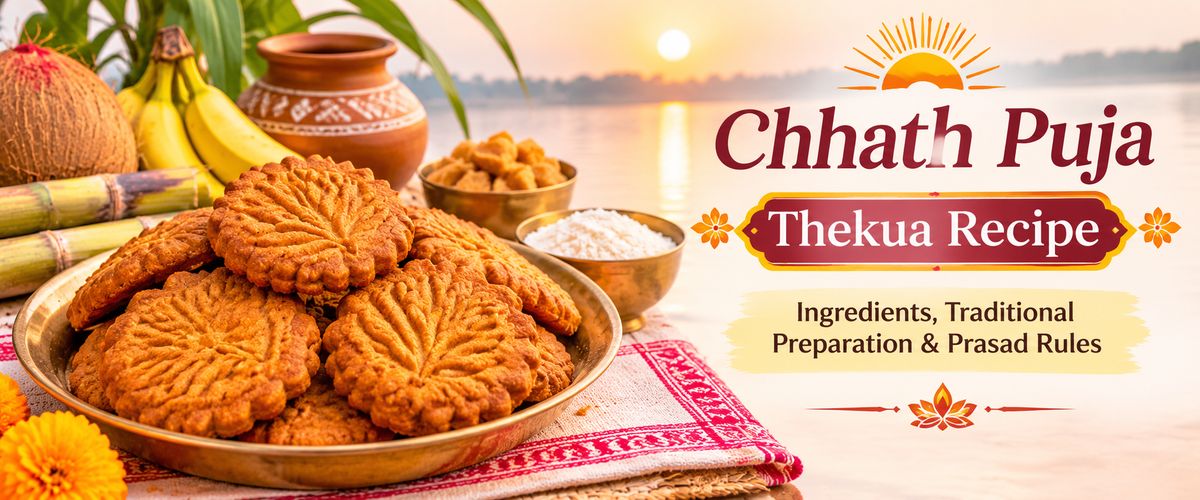
Thekua (called khajuria or thokwa in some areas) is the one prasad every Chhath soop carries. It is a hard, crisp biscuit of wheat flour, jaggery and ghee, pressed on a carved wooden mould and deep-fried. Most families fry it on the morning of the third day, before the evening arghya, though some make it on the night after Kharna. Because the soop sits on the ghat through the evening and again before dawn, thekua had to be something that would not spoil: that is why it is dry, sweet and fried slowly until hard.
This article keeps two things apart: the recipe, which is cooking advice, and the prasad rules, which are family and regional custom. Follow your own household's custom where it differs.
Ingredients (about 30 thekua)
| Ingredient | Quantity | Note |
|---|---|---|
| Wheat flour (atta) | 500 g (about 4 cups) | Slightly coarse atta gives the best crunch. Some families add 2–3 tbsp suji for extra crispness. |
| Jaggery (gur) | 250 g | 200 g for mildly sweet, 300 g for very sweet. Use the darkest, cleanest gur you can find. |
| Water | About 120 ml (½ cup) | Only to melt the jaggery. |
| Ghee for the dough (moyan) | 75 g (about 5 tbsp) | This decides the texture. See the test below. |
| Dry coconut, grated | 3 tbsp | Optional but traditional in many homes. |
| Green cardamom powder | 1 tsp | From 8–10 pods. |
| Fennel seeds (saunf) | 1 tbsp | Optional; common in Bhojpur and Mithila homes. |
| Ghee for frying | Enough for 2 inches in the kadhai | Many families use only ghee for prasad; others use refined oil. Follow your custom. |
Method
- Melt the jaggery. Break the gur and warm it with the water on low heat, stirring until just dissolved. Don't boil it into a syrup. Strain through a clean cloth or fine sieve to remove grit, and let it cool until lukewarm.
- Rub the ghee into the flour. Mix the atta, coconut, cardamom and saunf, add the ghee and rub it in with your fingertips for 3–4 minutes. The test: squeeze a handful in your fist. It should hold the shape of your fingers and break cleanly when nudged. If it crumbles to powder, add a spoon more ghee.
- Knead a stiff dough with the jaggery water only. Add it a little at a time. Stop as soon as the dough comes together; it should be much firmer than roti dough, about like puri dough or stiffer. Do not add plain water.
- Rest it. Cover for 15 minutes so the flour absorbs the liquid.
- Shape. Make balls of about 35–40 g (a large lemon). Press each one flat onto the saancha (the wooden mould) about 1 cm thick, so the pattern prints clearly, and lift it off. With no mould, press with your palm and mark lines with a fork, or press on the back of a clean sieve.
- Heat the ghee to medium-low. About 150–160 °C. Test with a pinch of dough: it should rise slowly with fine bubbles, not shoot up sizzling.
- Fry slowly. Slide in 4–6 at a time and leave them untouched for the first minute. Fry 8–10 minutes in all, turning once or twice, until deep golden-brown on both sides. The bubbling slows down when the inside is cooked.
- Drain and cool completely on a clean plate or rack. Thekua is a little soft when hot and turns crisp as it cools.
Common mistakes
- Hard as stone: too little moyan, or kneaded with plain water. Do the fist test before kneading.
- Breaks in the ghee or soaks up oil: too much moyan, or dough too soft. Add a spoon of atta and knead again.
- Dark outside, raw inside: ghee too hot. Lower the flame; thekua should take at least 8 minutes.
- Pattern disappears: dough too soft, or pressed too thin. Keep it stiff and about 1 cm thick.
- Turns soft after a day: stored while still warm. Let it cool fully before closing the box.
Storage
In an airtight steel or glass container, completely cooled, thekua stays good for 10–15 days, which is why families send it to relatives far from home after Chhath. Don't refrigerate it; it absorbs moisture.
Prasad rules many families follow
These are customs, not cooking advice, and they vary by family and region.
- The wheat is prepared in advance. In many homes the wheat is washed, dried on a clean sheet in the sun and guarded so that birds don't peck at it and no one steps over it, then ground at a cleaned chakki or at home.
- A clean kitchen and vessels. The kitchen is washed, and often new or specially kept vessels are used. Many families still fry thekua on a clay chulha fuelled with mango wood.
- Made after bathing, by the vrati or by family members keeping the same purity, in clean clothes.
- No onion, garlic or non-vegetarian food in the home for the four days.
- No salt in the prasad.
- No tasting. Nothing is eaten before it is offered to Chhathi Maiya and Surya. Children are kept from picking at it.
- Only clean hands touch it, never hands that have touched food being eaten.
For everything else that goes into the soop with the thekua, see our Chhath vrat katha and how to offer Surya arghya.
Frequently asked questions
Can I use sugar instead of jaggery for thekua?
Yes, sugar thekua is made in many homes and comes out paler and crisper. For Chhath prasad most families prefer gur, which is the older tradition and seen as purer.
Ghee or oil, which should I fry thekua in?
Either works for the recipe. Many families insist on ghee for prasad; many others use refined oil. Follow what your household does.
How many days before Chhath can thekua be made?
For the arghya it is made fresh, usually on the morning of Sandhya Arghya (15 November 2026) or the night before. Batches made just to eat or send to relatives can be made earlier, as they keep 10–15 days.
What can I use if I don't have a thekua saancha?
Press the dough with your palm and draw lines with a fork, or press it on the back of a clean sieve or a new comb kept only for this. The pattern is traditional, not a ritual requirement.
Why does my thekua turn very hard?
Almost always too little ghee in the dough, or plain water used for kneading. Rub in enough ghee that a fistful of flour holds its shape before you add the jaggery water.
Can someone who isn't fasting make the thekua?
In most families, yes: relatives help the vrati with the prasad, provided they bathe first, keep the kitchen rules and don't taste anything before the offering.
Is thekua only made for Chhath?
No. It is eaten as a tea-time sweet across Bihar, Jharkhand and eastern UP all year. But the Chhath thekua is made with the stricter purity rules above.
Was this article helpful?
Spotted a mistake?
If you find any grammatical, Hindi, English, mantra-text or other mistake on this page, tell us — we will correct it within 24 hours.