
Chhath 2026: when you need what
- Nahay Khay, Friday 13 November: have the lamps, ghee, puja items and the vrati's clothes ready
- Kharna, Saturday 14 November: buy the soop, daura, sugarcane and most of the fruit; the kheer and roti prasad is made in the evening
- Sandhya Arghya, Sunday 15 November: thekua is fried in the morning, the soop is filled in the afternoon; sunset 5:28 pm (New Delhi)
- Usha Arghya, Monday 16 November: the same soop goes back to the ghat before dawn; sunrise 6:44 am (New Delhi)
Check sunset and sunrise for your own city: the arghya is timed to the sun, not the clock.
Baskets and vessels
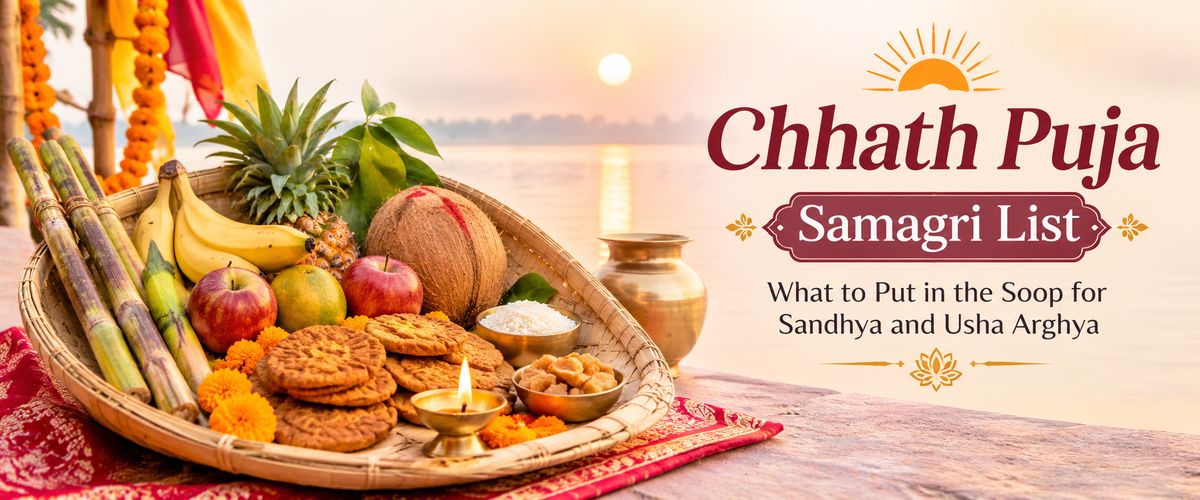
- Bamboo soop (sup): the winnowing tray the offerings are arranged on and lifted to the sun. Most homes keep at least one per vrati; many keep more, often by a vow (for instance one for each child).
- Daura or dauri: the large bamboo basket that carries all the soops and prasad to the ghat, traditionally on the head of a man of the family.
- Brass or copper soop: some families use a metal soop alongside or instead of bamboo. Either is accepted.
- A lota (brass or copper): for the arghya of water and raw milk.
- A clean cloth (often yellow or new) to cover the daura on the way to the ghat.
What goes in the soop
The soop holds what the land gives in early winter. The list is long, but its logic is simple: seasonal, whole, and as close to the field as possible.
| Group | Items | Notes |
|---|---|---|
| Found in nearly every soop | Thekua · banana · coconut · sugarcane pieces · sweet potato (shakarkand) · green ginger plant · green turmeric plant · big lemon (gagal or dabh nimbu) | Ginger and turmeric are offered as whole plants with leaves. Coconut is usually the kind with water, often still in its husk. |
| Common seasonal produce | Water chestnut (singhara) · suthni · radish with leaves · amla · custard apple (sharifa) · orange | Suthni is a small tuber sold in markets only around Chhath in Bihar and eastern UP. |
| Home-made prasad | Thekua · kasar or ladua (rice-flour and jaggery laddu) | See our thekua recipe. Prasad is made without salt. |
| Puja items in the soop | Earthen diya with ghee · sindoor · a few flowers · akshat · paan and supari | The lamp is lit just before the arghya. |
| Optional, by region or custom | Apple · pomegranate · pear · makhana · dry fruits · a lemon instead of gagal | Market fruits are added in towns. They are not required. |
Banana is often a whole bunch kept in the daura, with a few fingers in each soop. Sugarcane stands both in the soop (as pieces) and whole at the ghat or in the Kosi.
Lamps and puja items
- Earthen diyas, several (one for each soop, plus extra for the ghat and Kosi)
- Ghee and cotton wicks, a matchbox kept dry
- Dhoop or agarbatti
- Orange sindoor: married women apply it from the nose tip up to the parting, a mark particular to Chhath
- Roli or chandan, akshat, flowers (marigold is common)
- Raw cow's milk and clean water (or Ganga jal) for the arghya
The vrati's clothes
The vrati wears new or freshly washed clothes, traditionally unstitched: a saree for women (many choose yellow or other bright cotton) and a dhoti for men. They stand in the water in these for the arghya, so a dry change for afterwards is needed, along with a shawl for the dawn arghya in mid-November.
The Kosi (where it is vowed)
Families that have taken a vow (mannat) fill a Kosi on the night of Sandhya Arghya in the courtyard, and many again at the ghat before dawn. For it you need:
- 5 or 7 whole sugarcanes, tied together at the top to form a canopy
- A clay elephant (mitti ka hathi) and earthen kalash or pots, filled with prasad and fruit
- Many diyas, lit in and around it
- A yellow or red cloth tied at the top of the canes, in many homes
Kosi is not part of every family's Chhath. If no one in your home has a vow, you don't need it.
What stays the same and what changes at dawn
- The same soop and daura go to both arghyas. They are brought home after the evening arghya and kept clean overnight.
- Fresh diyas and ghee are used at dawn; the evening lamps are left to burn out.
- Flowers are replaced if they have wilted.
- For the parana: after the Usha Arghya the vrati breaks the 36-hour fast, usually with a little prasad (thekua, fruit) and water or sherbet. Keep these ready separately so the soop's offerings are not disturbed. Some families begin with ginger and jaggery.
- Prasad to distribute: the thekua and fruit from the soop are shared at the ghat and at home after the dawn arghya.
Shopping checklist by day
Save or print this list.
- By Nahay Khay (13 Nov): earthen diyas · ghee · cotton wicks · dhoop · sindoor · roli or chandan · akshat · vrati's new clothes and a shawl · jaggery and wheat for thekua · rice and jaggery for kasar · a lota
- On Kharna (14 Nov): bamboo soop(s) · daura · sugarcane · banana bunch · coconuts · sweet potato · ginger and turmeric plants · gagal lemon · singhara · suthni · radish · amla · seasonal fruit · paan and supari · cloth to cover the daura
- On Sandhya Arghya morning (15 Nov): flowers · raw milk · fry the thekua · fill the soops in the afternoon
- Before dawn (16 Nov): fresh flowers · milk for the arghya · water or sherbet and prasad for the parana
Frequently asked questions
How many soops are needed for Chhath?
At least one for each vrati. Many families keep more, often one per child or by a specific vow, and the number is a family tradition rather than a fixed rule.
Can I use a brass soop instead of bamboo?
Yes. Bamboo is the older and more common choice, but metal soops are used in many homes, sometimes together with bamboo ones.
Are all these fruits necessary?
No. Thekua, banana, coconut, sugarcane and a few seasonal roots and fruits make a complete soop. Everything else depends on what is available and on your family's custom.
Why are ginger and turmeric offered as whole plants?
Chhath offers the harvest as it comes from the field: whole, fresh and unprocessed. Green ginger and turmeric with their leaves are part of that idea.
Is the arghya given with milk or water?
Both. The vrati holds the soop while family members pour water and raw milk from a lota over its edge, towards the sun. Some families pour only water.
Is the same samagri used for both arghyas?
Yes, the same soop and offerings go back to the ghat at dawn. Only the diyas, ghee and any wilted flowers are replaced.
What is done with the soop after Chhath?
The prasad and fruit are distributed. Many families keep the bamboo soop for household use or for the next year; once it is worn out, it is placed in flowing water or a clean place, not thrown in the bin.
Was this article helpful?
Spotted a mistake?
If you find any grammatical, Hindi, English, mantra-text or other mistake on this page, tell us — we will correct it within 24 hours.