
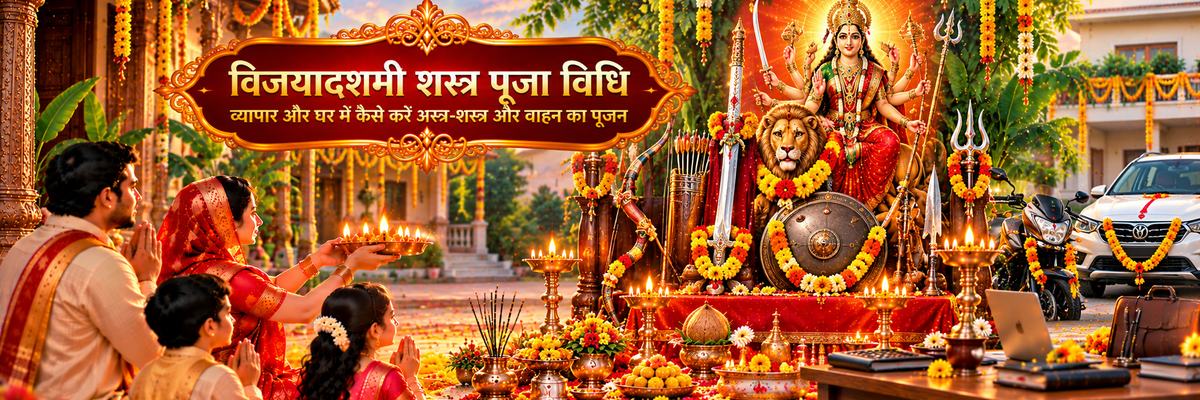
Shastra puja 2026: the date and the muhurat
- Vijayadashami (Dussehra): Tuesday, 20 October 2026
- Dashami tithi: from 12:50 pm on 20 October to 2:11 pm on 21 October
- Vijay muhurat: 1:59 pm to 2:45 pm, the best window for shastra puja
- Aparahna kaal: 1:14 pm to 3:30 pm, the wider afternoon window if you miss the Vijay muhurat
These timings are for New Delhi. They move with local sunrise and sunset, so check your own city's panchang if you are cutting it close. The Vijay muhurat is the eleventh of the day's fifteen muhurtas, which is why it always lands in the early afternoon. Many Rajput and military families also follow the older reading of the verse below and do the puja at dusk, when the first stars appear. Both customs are followed; what matters is that the puja happens on Dashami.
The verse that gives the Vijay muhurat its name, recited by many families at the start of the puja:
आश्विनस्य सिते पक्षे दशम्यां तारकोदये।
स कालो विजयो ज्ञेयः सर्वकार्यार्थसिद्धये॥
Ashvinasya site pakshe dashamyam tarakodaye, sa kalo vijayo jneyah sarvakaryarthasiddhaye.
Meaning: On the Dashami of the bright fortnight of Ashwin, at the rising of the stars, that time should be known as Vijaya (victory). It brings success in every undertaking.
If your family does the Navami puja and havan first, finish those by 9:40 am on 20 October, as set out in our Shardiya Navratri 2026 calendar.
Why weapons are worshipped on this day
Three stories meet on Vijayadashami, and in each of them victory comes through a weapon.
- The Devi's battle. In the Devi Mahatmya, the gods each give the goddess a weapon from their own: Shiva's trident, Vishnu's discus, Indra's thunderbolt and many more. She fights Mahishasura with them and wins on the tenth day. Worshipping weapons on Dashami honours the arms that won that battle.
- The Pandavas' weapons in the Shami tree. During their year in disguise, the Pandavas hid their weapons in a Shami tree. Arjuna took them back down to win his first battle on his return. That story and the Shami puja that grew out of it are told in full in our Shami and Aparajita puja guide.
- Shri Ram's march on Lanka. Tradition holds that Ram worshipped the goddess Aparajita and the Shami tree before setting out, and won on this day.
There is also a practical history. The monsoon closed roads and rivers, so kings began their campaigns after it ended, on Dashami. Before marching, armies cleaned, repaired and worshipped their arms, and the king crossed the boundary of his territory in the rite called seemollanghan. Police lines and army units across India still hold shastra puja on Dussehra.
The deeper idea reaches well beyond soldiers. A shastra is anything a person depends on to do their work and protect their family. For a farmer it is the plough and the tractor, for a trader the weighing scale and the cash box, for a craftsman their tools, for a writer the pen, and for a driver the vehicle. Shastra puja is a day of thanks to those tools, and a prayer that they serve well and safely through the coming year.
Navami or Dashami? Regional customs
- North and central India, Rajasthan: shastra puja on Dashami, usually in the Vijay muhurat, along with Aparajita and Shami puja.
- Karnataka, Tamil Nadu, Kerala, Andhra Pradesh and Telangana: Ayudha Puja falls on Mahanavami, the day before (19 October 2026). Tools, vehicles, machines, books and instruments are cleaned and decorated and rest for the day. They are taken up again on Vijayadashami, which is also when children begin their schooling (Vidyarambham). The royal Ayudha Puja of the Mysuru Dasara is held on Navami.
- Maharashtra: after the puja and seemollanghan, people exchange leaves of the apta tree as "gold" with the greeting sona ghya, sona sarkha raha ("take gold, and stay as precious as gold").
- Eastern India: factories and workshops mostly worship their machines on Vishwakarma Puja in September instead. Dashami there is the day of Durga visarjan.
Follow your family's or your trade's custom. If you have none, Dashami in the Vijay muhurat is the safe default.
What you will need
- A clean red or yellow cloth to lay the weapons and tools on
- A picture or murti of Maa Durga, and of Shri Ram if you like, plus a Ganesh image or a betel nut to stand for him
- Gangajal or clean water in a lota, and a few mango or betel leaves for sprinkling
- Roli or kumkum, haldi, akshat (unbroken rice) and sandalwood paste
- Kalava (red sacred thread)
- Flowers and garlands: marigold, and blue Aparajita flowers if you can find them
- A ghee lamp, incense and camphor for the aarti
- Sweets or jaggery for naivedya, and a coconut
- Shami leaves, if you will also do the Shami puja
Shastra puja at home, step by step
- Prepare the day before. Clean, oil and repair everything that will be worshipped: swords and khukris, licensed firearms, kitchen knives, sickles, tools. Traditionally weapons are not sharpened or used on the puja day itself.
- Set up the place. After bathing, choose a clean spot facing east or north. Lay out the cloth and place the Devi's picture at the head of it. Arrange the weapons and tools neatly in front of her, never pointing at a person and never stacked one on top of another.
- Ganesh first. Every puja begins with Ganesh. Offer a flower and akshat and say "Om Gan Ganapataye Namah".
- Sankalpa. Take water, akshat and a flower in your right hand. Say your name and gotra and state your purpose in your own words: that you are worshipping these weapons and tools for your family's protection, health and success in your work over the coming year. Then let the water fall to the ground.
- Purify. Sprinkle a little Gangajal over the weapons and tools with a mango leaf.
- Tilak and kalava. Apply a tilak of roli and haldi to each item. On a blade, put it on the flat side, never the edge. Tie a few turns of kalava around a handle, butt or grip.
- Flowers and akshat. Offer flowers and akshat to the Devi first and then to the weapons, reciting "Om Aparajitayai Namah" or the Vijay verse above.
- Dhoop, deep and naivedya. Show incense and the lamp to the Devi and the weapons, and offer sweets and the coconut.
- Prayer to the Devi. Recite three times the line from the Devi Mahatmya that honours her as power itself:
या देवी सर्वभूतेषु शक्तिरूपेण संस्थिता।
Meaning: To the goddess who dwells in all beings as power: salutations to her, salutations, salutations again and again.
नमस्तस्यै नमस्तस्यै नमस्तस्यै नमो नमः॥
Ya devi sarvabhuteshu shaktirupena samsthita, namastasyai namastasyai namastasyai namo namah. - Aarti. Do the aarti of Maa Durga (Jai Ambe Gauri) with camphor. Many families also sing a Ram aarti.
- Forgiveness and blessing. Fold your hands and ask pardon for any mistake in the puja. Touch the weapons to your forehead and share the prasad.
- Shami and Aparajita puja. In the same afternoon window, go on to the Aparajita and Shami puja, set out step by step in our Shami and Aparajita guide.
Leave the weapons and tools where they are until the next morning, or at least until evening, before putting them away.
At your shop, office or factory
For a business, the "weapons" are whatever earns the living. Common choices:
- Shop: the weighing scale (taraju), measuring tape, the cash box or galla, the shop keys, and the counter itself
- Office: computers and laptops, the printer, the company seal and stamp, and the main ledger or account register
- Workshop or factory: machines, lathes, generators, tool kits, sewing machines and delivery vehicles
- Farm: the plough, tractor, pump set, sickles and spades
- Clean the premises the day before, as you would for Diwali. Service the machines and switch them off for the puja.
- Draw a swastika with roli on each machine or on the cash box, with Shubh and Labh on either side.
- Follow the same order as at home: Ganesh, sankalpa (in the name of the business), tilak, kalava, flowers, incense, the lamp, naivedya and aarti. A small Durga or Vishwakarma picture is placed at the head.
- Include the staff. The people who run the machines should stand for the puja and each offer a flower. Sharing prasad, sweets or a gift with workers on this day is an old and much-valued custom.
- Start something new. Dussehra is an abujh muhurat, a day that needs no separate muhurat. It is good for opening a shop, starting a new line of work or signing a contract. After the puja, many traders make the year's first sale or a token transaction.
Don't confuse this with the account-book (bahi-khata) puja. In most of North and West India the new books are worshipped with Lakshmi-Ganesh on Diwali. On Dussehra the ledger is honoured as a tool, but the new books usually wait for Diwali.
Vahan puja: worshipping your car, bike or tractor
- Wash the vehicle inside and out before the puja.
- Swastika: draw a swastika with roli or haldi paste on the bonnet, the front of the tank or the windscreen, with Shubh and Labh on either side. Many people also put a tilak on the number plate.
- Kalava and garland: tie kalava on the steering wheel or handlebar and hang a marigold garland on the front.
- Prayer: say a Ganesh prayer, since Ganesh is Vighnaharta and on the road an obstacle means an accident. Then do a short aarti with the lamp in front of the vehicle.
- Coconut: break a coconut in front of the vehicle and share it as prasad.
- Folk customs: placing a lemon under each wheel to be crushed as the vehicle moves off, and hanging a lemon-and-green-chilli string against nazar (the evil eye), are popular folk customs rather than scriptural rules. Follow them if your family does.
- First drive: make the first drive after the puja to a temple if you can.
Dussehra is also one of the most popular days to buy a new vehicle. For that, see our vahan kharid muhurat guide.
Safety and cautions
- Licensed firearms must be unloaded and their ammunition kept separately during the puja. Point them at a wall, never at anyone, and keep children away.
- Never fire in celebration. Celebratory gunfire is a criminal offence under the Arms Act and injures and kills people every festival season. The puja is an act of reverence, not a display.
- Only legally held weapons. The puja is not a reason to bring out a weapon you are not licensed to keep.
- Machines switched off. Make sure power tools and machinery are switched off and unplugged before applying tilak or tying kalava.
- Lamp safety. Keep the lamp and camphor away from fuel tanks, oily rags and anything flammable on a workshop floor.
- Avoid Rahu Kaal. On a Tuesday it falls in the late afternoon, roughly 3 to 4:30 pm in Delhi. The Vijay muhurat ends before it, so it is easy to avoid.
- Respect the tools. Don't step over weapons, tools or books on the puja day. That is a lapse even on ordinary days.
Frequently asked questions
What is the best time for shastra puja on Dussehra 2026?
The Vijay muhurat on Tuesday 20 October, 1:59 pm to 2:45 pm in New Delhi. If you miss it, the aparahna window from 1:14 pm to 3:30 pm still works. Families who follow the dusk tradition do it at sunset. Adjust for your own city using a local panchang.
Is shastra puja done on Navami or Dashami?
Both, depending on region. North and central India worship weapons on Dashami. South India's Ayudha Puja is on Mahanavami (19 October 2026), and the tools are taken up again on Vijayadashami. Follow your family's custom.
We don't keep any weapons at home. Can we still do shastra puja?
Yes. Worship whatever your livelihood depends on: a pen and books, a laptop, kitchen knives, tools, a sewing machine or your vehicle. The puja is about gratitude to the tools that sustain the family, not about owning arms.
Can women perform shastra puja?
Yes. Nothing in the household rite restricts who performs it, and the day itself celebrates the goddess's victory with the weapons she was given. In many families the women of the house lead the puja.
Can we use our tools or vehicle on the day of the puja?
A vehicle can be driven after its puja; many people make the first drive to a temple. For weapons and work tools, the common custom is to let them rest after the puja and take them up the next morning. In South India, tools rest for the whole of Ayudha Puja day.
What is the difference between shastra puja and Vishwakarma Puja?
Vishwakarma Puja, usually on 17 September, honours Vishwakarma, the divine architect and patron of craftsmen and machines. It is the main machine-and-tool festival in eastern India. Shastra puja on Dussehra honours the Devi's victory and the weapons and tools that protect and sustain a family. Some businesses mark both.
Which mantra should I recite during shastra puja?
Begin with "Om Gan Ganapataye Namah". The verse Ashvinasya site pakshe dashamyam tarakodaye names the day's Vijay muhurat, and Ya devi sarvabhuteshu shaktirupena samsthita salutes the Devi as power. "Om Aparajitayai Namah" invokes the undefeated goddess. A sincere prayer in your own words is also enough.
Related content
- Maa Durga
- How to Worship the Shami Tree on Dussehra: Vidhi, Mantra and SignificancePublished8 min read
- Dussehra (Vijayadashami)
- Shardiya Navratri 2026: Kalash Sthapana Muhurat and Day-by-Day Puja DatesPublished4 min read
- Vahan Kharid Muhurat: Buying a Car, Bike or Vehicle
- Abujh Muhurat: Days So Auspicious They Need No Calculation