
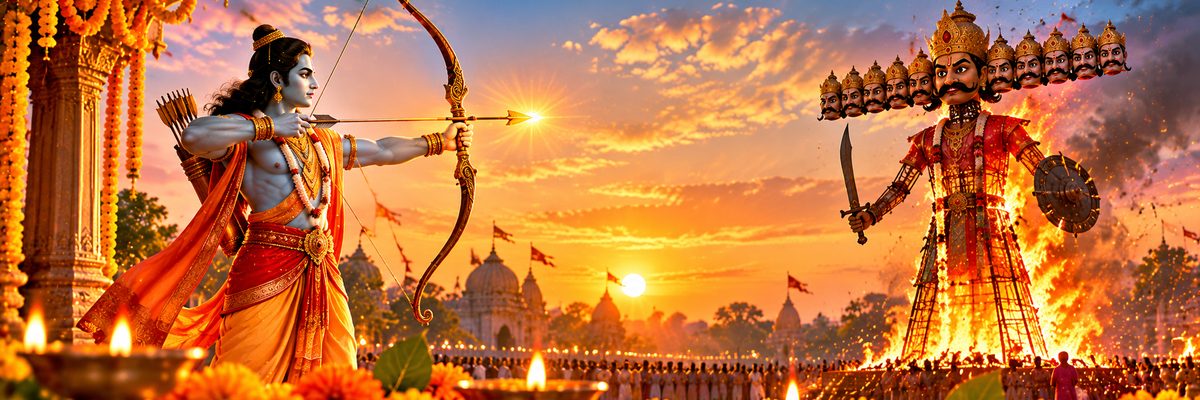
Vijayadashami falls on Tuesday, 20 October 2026. The big public moments of the day are Ravan Dahan in the north and Durga visarjan in the east. Inside homes, though, a quieter set of customs has been handed down: small things done on this one day in the belief that a day of victory is a good day to start the year's luck afresh. Below are the five that come up most often, with where each comes from and how to do it properly.
One honest word first. These are upay, traditional practices, not guarantees. What they reliably do is turn the day's meaning, the win of dharma over adharma, into something you actually do with your own hands. Most of them also have a plain, practical good in them: a cleaner house, money given to someone who needs it, an evening spent in prayer. That is a large part of why they have lasted.
1. Look for the Neelkanth bird on Dussehra 2026
The Neelkanth is the Indian roller (Coracias benghalensis), a myna-sized bird with a brownish breast that looks dull when it sits on a wire. When it takes off, its wings flash a vivid, electric blue. In much of North India, catching sight of one on Dussehra is held to be one of the most auspicious things that can happen that day.
Why this bird, and why this day? Two strands of belief meet in it:
- Shiva's name. Neelkanth, "blue-throated," is a name of Shiva, who drank the halahala poison at the churning of the ocean and held it in his throat. The bird's blue is read as a sign of him, so seeing it is treated like a darshan of Shiva.
- Shri Ram's march on Lanka. A widespread folk belief says Ram saw a Neelkanth before he set out against Ravana, and took it as an omen of victory. Since Dussehra marks that victory, sighting the same bird on the same day is taken as a sign that your own undertakings will succeed.
In villages of Uttar Pradesh and Bihar, people who spot one often say a short folk rhyme, which has several local versions. A common one runs: "Neelkanth tum neele rahiyo, doodh-bhaat ka bhojan kariyo, hamri baat Ram se kahiyo", meaning "Neelkanth, stay blue, eat milk and rice, and carry my words to Ram." The bird is treated as a messenger who will take your wish to God.
How to do it: go out in the morning or around sunset, when rollers are most active. Look along open fields, roadside wires, and the edges of farmland. Many families make it a small outing for the children. If you see one, fold your hands, say the rhyme or simply your wish, and let the bird be.
The caution that matters most. Every year before Dussehra, bird-catchers trap rollers, tie or glue their wings, and carry them through towns so people can pay to "see the Neelkanth." This is cruelty, and it is illegal: the Indian roller is a protected species under India's Wildlife (Protection) Act, 1972, and catching, caging or selling one is a punishable offence. It is also the state bird of Karnataka, Telangana, Andhra Pradesh, Odisha and Bihar. A caged bird gives you no darshan. The belief is about meeting the bird freely, as Ram is said to have done. If you see a trapped roller being shown for money, don't pay; report it to the forest department or the police. If you don't spot one at all, that is not a bad omen. Bow to Shiva in your mind instead.
2. Give in secret (gupt daan) on Vijayadashami 2026
Charity on festival days is old practice, but there is a particular tradition of giving on Vijayadashami without anyone knowing. You leave money in a temple hundi without counting it in front of others, pay a child's fees without telling the family it was you, or quietly hand over a bag of grain.
Why secret? The clearest reason comes from the Bhagavad Gita (17.20), which describes the purest kind of giving:
दातव्यमिति यद्दानं दीयतेऽनुपकारिणे।
देशे काले च पात्रे च तद्दानं सात्त्विकं स्मृतम्॥
Datavyam iti yad danam diyate 'nupakarine, deshe kale cha patre cha tad danam sattvikam smritam.
Meaning: A gift given because giving is right, to someone who can do nothing for you in return, at the proper place and time and to a worthy person, is called sattvic.
The verse does not mention secrecy directly, but secrecy is how families have kept to it. A gift nobody knows about earns you no praise and puts no one in your debt. The only thing left in it is the giving. On the day Ravana is burned, a figure of pride above all, giving without wanting credit is a fitting small act against the same pride in yourself.
What to give: food grains, clothes, blankets ahead of winter, books or school fees, or money to a temple, gaushala or a family you know is struggling. Grain and cloth are the most traditional. Choose what the person actually needs over what feels ritually impressive.
How to do it: give after your morning puja or during the afternoon Vijay muhurat. Don't announce it, don't post it, and don't bring it up later. If someone has to know, such as a temple office needing a name for a receipt, that's fine. Secrecy is a means, not a rule to stress over.
3. Shami leaves in the tijori this Dussehra 2026
The Shami tree is worshipped on Dussehra across North and West India. In the Mahabharata, the Pandavas hid their weapons in a Shami tree during their year in disguise, and Arjuna took them down again to win his first battle on his return. Our Shami and Aparajita puja guide has the full vidhi and mantra.
The custom that makes this an upay comes after the puja. A few leaves are brought home, tied in a red or yellow cloth, and kept in the tijori, cash box or almirah where money and jewellery are kept. They stay there until next Dussehra, as a prayer that the household's wealth stays protected the way the Pandavas' weapons were. In Maharashtra the related custom uses the leaves of the apta tree, which people exchange with each other as "gold" (sona) on Dasara. It recalls the story of Kautsa, for whom Kubera is said to have rained gold onto a tree near King Raghu's city.
How to do it: pick leaves only after you have worshipped the tree, and take just a few. If there is no Shami near you, many temples have one, and nurseries sell small plants that do well in a pot. Last year's leaves go into a river, a plant pot or under a tree. They are not thrown in the bin.
4. Clear the house of negative energy before Diwali 2026
Dussehra sits between Navratri and Diwali, and that position explains a lot about this upay. The kalash of Navratri is taken down, and the house begins preparing for Lakshmi's arrival twenty days later. Traditionally, this is when the year's accumulated clutter, and the heaviness people feel it brings, gets cleared out. The usual methods are all simple:
- Clean first, especially the entrance and the northeast corner. Throw out broken utensils, stopped clocks, cracked mirrors and things kept "just in case." Many families start the big Diwali cleaning on Dussehra itself.
- A fresh toran at the main door. Mango or ashoka leaves strung on a thread, with marigolds if you have them. Fresh leaves at the threshold are an old sign of welcome to the auspicious, and the old toran from Navratri can be taken down now.
- Dhoop through every room. In the evening, carry guggul, loban or a camphor flame on a small plate through each room, ending at the puja place. Open the windows first so the smoke carries out.
- Sprinkle Gangajal. A few drops in each corner with a mango leaf or a tulsi sprig, saying the name of your deity. Gangajal mixed into ordinary water is fine.
- A lamp at the door at dusk. A ghee or mustard-oil diya on the right side of the main entrance as evening falls, which is when Ravan Dahan happens across the country. It marks the light coming in as the effigy of adharma burns outside.
Some North Indian families also bring home a small piece of the burnt wood from the Ravan Dahan grounds and keep it as protection against harm. It is a real and fairly common regional custom. If you follow it, wait until the fire is fully out and the crowd has cleared. Effigies are packed with firecrackers that can go off late.
5. An evening with Ram and Hanuman
Dussehra is first of all Ram's victory, so the simplest upay of the day is to give its evening to him. After returning from Ravan Dahan, or in place of going, light a lamp at home and recite one of these:
- Sundarkand, the part of the Ramcharitmanas where Hanuman crosses to Lanka and finds Sita. Many families read it on Tuesdays anyway, and in 2026 Dussehra falls on a Tuesday. A full reading takes about one and a half to two hours.
- The Ram Raksha Stotra, traditionally recited for protection of home and family.
- The Hanuman Chalisa, if time is short, once or seven times, followed by the Hanuman aarti.
This is also a natural day to start a habit you mean to keep. Vijayadashami counts as an abujh muhurat, a day auspicious enough that no separate muhurat is needed, so a daily path, a vow of giving or a new study begun today is said to begin under the sign of victory.
Dussehra 2026: a simple order for the day
- Morning: bath, home puja, then a walk to look for the Neelkanth.
- Before noon: clean the entrance and put up the fresh toran.
- Afternoon (Vijay muhurat, 1:59–2:45 pm in New Delhi): Shami and Aparajita puja, shastra puja, and the gupt daan.
- Dusk: a lamp at the main door, then dhoop and Gangajal through the house.
- Evening: Ravan Dahan, then Sundarkand or the Hanuman Chalisa at home.
Timings vary with local sunrise. Check your own city's panchang if you are cutting it close.
Frequently asked questions
Is it bad luck if I don't see a Neelkanth on Dussehra?
No. Seeing the bird is considered auspicious, but not seeing one carries no bad omen in any tradition. Rollers are getting harder to spot near cities. Remember Shiva, whose name the bird carries, and go ahead with the rest of the day.
Can I pay to see a caged Neelkanth?
Please don't. The Indian roller is protected under the Wildlife (Protection) Act, 1972, so trapping and showing it for money is a crime, and the birds are often badly injured. Every payment keeps the trade going. The belief is about meeting the bird freely, so a caged one doesn't count for it anyway.
What is the best time for gupt daan on Vijayadashami?
Any time during daylight on Dashami works. Many families give right after the morning puja or during the afternoon Vijay muhurat. What matters more than the hour is that the gift is useful to the person receiving it and that you don't seek credit for it.
Where should Shami leaves be kept, and for how long?
Wrap them in a red or yellow cloth and keep them in the tijori, cash box or the place where you keep money and jewellery. Leave them there for a year and replace them next Dussehra. Put the old leaves into a river, a plant pot or the soil under a tree.
Can these upay be done by women, or by people living away from home?
Yes. None of these practices is limited by gender, and none needs a priest. If you live alone or in a hostel, a lamp, a few minutes of the Hanuman Chalisa and one quiet act of giving carry the full meaning of the day.
Do the upay work if I do them on the day after Dussehra?
The tradition ties them to Dashami tithi. In 2026 that tithi runs from 20 October afternoon into 21 October afternoon, so the next morning still falls within it. Cleaning, giving and prayer are good on any day, though. Doing them a day late is better than not doing them at all.
Is bringing home wood from Ravan Dahan really a tradition?
Yes, in parts of North India people bring home a small piece of the burnt wood and keep it as protection against harm. It is a regional folk custom, not a scriptural rule, so skip it if your family doesn't follow it. If you do, wait until the fire is completely out.
Related content
- How to Worship the Shami Tree on Dussehra: Vidhi, Mantra and SignificancePublished8 min read
- Vijayadashami Shastra Puja Vidhi: How to Worship Weapons, Tools and Vehicles at Home and at WorkPublished11 min read
- Dussehra (Vijayadashami)
- The Story of Dussehra: Rama, Durga, the Shami Tree and Raghu's Gold
- Shri Ram Raksha Stotra