
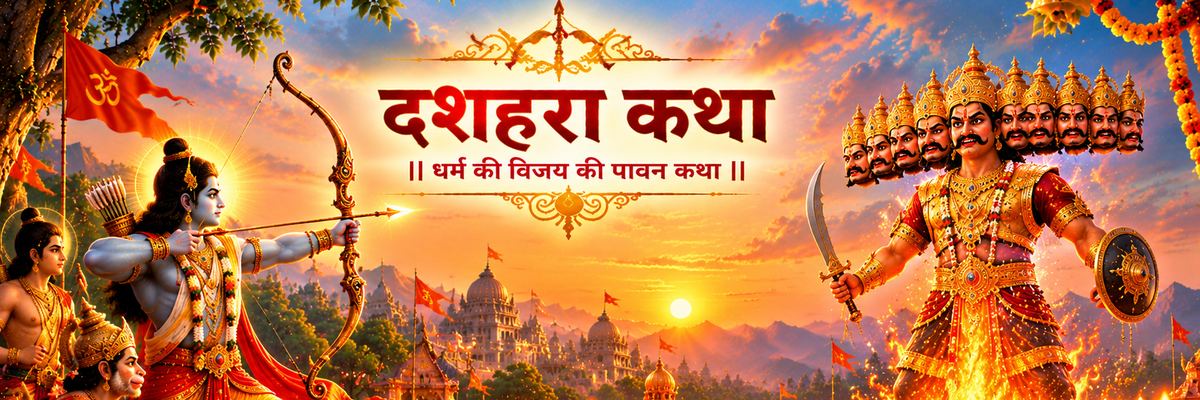
One festival, several stories
Dussehra, or Vijayadashami, falls on the tenth day of the bright half of Ashwin, and it isn't tied to a single story. In North India it is the day of Rama's victory over Ravana. In Bengal and the east it closes Durga Puja, and the story behind it is the goddess's victory over Mahishasura. Maharashtra and Karnataka add the Pandavas' weapons hidden in a shami tree, and Maharashtra also tells of the gold that rained on King Raghu's treasury. Each story comes from a different text, and those texts don't agree on dates. Below, each story is told as its source tells it, with notes on where the popular versions differ.
Rama and Ravana: the last battle
The war in Lanka is told in the Yuddha Kanda of Valmiki's Ramayana. By its final stage Ravana had lost Kumbhakarna, Indrajit and most of his army, and came out to face Rama himself. Rama was fighting on foot against a king in a chariot, and the gods thought the fight unequal. So Indra sent his own chariot, driven by his charioteer Matali, along with armour, arrows and a spear (sarga 102).
As Rama stood exhausted before the decisive duel, the sage Agastya, who had come with the gods to watch, approached him and taught him the Aditya Hridayam, a hymn to the sun. By it, Agastya said, he could conquer every enemy in battle (sarga 105).
Then came the strangest part of the fight. Every time Rama cut off one of Ravana's heads, another rose in its place. Valmiki says a hundred heads were cut off this way and still there was no sign of Ravana dying. The duel went on in the sky, on the ground and on the mountain, for seven days and nights without a moment's rest (sarga 107).
In the end it was Matali who reminded Rama of the weapon he had not used: the arrow made by Brahma, which the sage Agastya had given him. Rama consecrated it with mantras and released it. It struck Ravana in the chest, tore through his heart, went into the earth, and then returned silently to Rama's quiver. The bow fell from Ravana's hand, and he fell dead from his chariot (sarga 108).
The version most people know: the pool of nectar
Many people grow up hearing that Ravana couldn't die because he held amrit, the nectar of immortality, in his navel. That detail comes from Tulsidas's Ramcharitmanas (Lanka Kand), not from Valmiki. As Rama's arrows kept cutting off heads and arms that grew back, Vibhishana told him the secret:
नाभिकुंड पियूष बस याकें। नाथ जिअत रावनु बल ताकें॥
"There is nectar in the pool of his navel. On its strength, Lord, Ravana lives."
Rama drew his bow back to his ear and released thirty-one arrows:
खैंचि सरासन श्रवन लगि छाड़े सर एकतीस।
रघुनायक सायक चले मानहुँ काल फनीस॥ (दोहा 102)
One arrow dried up the nectar in the navel, and the other thirty struck his heads and arms (ten heads and twenty arms make thirty). Tulsidas adds that Ravana's radiance then entered Rama's mouth, and that Shiva and Brahma rejoiced to see it. The Ramlilas of North India mostly follow the Ramcharitmanas, which is why this version, rather than Valmiki's Brahma-arrow, is the one most people know.
"Hostilities end with death"
What happens next in Valmiki is told much less often. Vibhishana had left his brother to join Rama, and now he mourned him. At first he refused to perform Ravana's funeral rites, calling him an enemy in the guise of a brother. Rama would not accept that. Ravana had been unrighteous, he said, but he had also been brilliant, strong and brave, a warrior whom even Indra could not defeat. Then he said:
मरणान्तानि वैराणि निर्वृत्तं नः प्रयोजनम्।
maraṇāntāni vairāṇi nirvṛttaṁ naḥ prayojanam
"Hostilities end with death. Our purpose has been accomplished." (Yuddha Kanda 111.102; verse numbers vary between editions.) Ravana was now as much his as Vibhishana's, Rama said, and he should receive his rites. Vibhishana performed them, and was afterwards consecrated king of Lanka with sea water (sarga 112). It's worth remembering when the effigies burn. The Ramayana's own hero refused to go on hating Ravana once the war was over.
Rama's worship of the goddess before the war
The link between Rama's story and Navratri comes from two later texts. In the Devi Bhagavata Purana (Book 3, chapter 30), the sage Narada finds Rama grieving for Sita and tells him how Ravana can be killed: in this very month of Ashwin, keep the nine-night vow of the goddess, with fasting, japa and homa. Narada offers to be his priest. Rama sets up an altar on a hilltop and fasts for nine days. On the night of the eighth day the goddess appears on her lion. She tells Rama he is a part of Narayana, born to destroy Ravana, and promises him victory. On the tenth day Rama performs the Vijaya puja, the worship for victory, and only then sets out for the sea, builds the bridge and kills Ravana. So in this telling, the tenth day is the day Rama sets out with the goddess's blessing, not the day Ravana dies.
Bengal tells it through the 15th-century Krittivasi Ramayana, where the worship is called Akal Bodhan, the untimely awakening of the goddess, because Rama invoked her in autumn instead of in spring. Rama was to offer her 108 blue lotuses, and the goddess hid one to test him. Rama, who is called lotus-eyed, picked up an arrow to take out one of his own eyes and complete the count, and she appeared and stopped him. Bengal's Durga Puja is held in autumn because of this story, and 108 lotuses are still offered in it.
Durga and Mahishasura
The story Bengal celebrates on this day comes from the Devi Mahatmya (chapters 81 to 93 of the Markandeya Purana), which is recited all through Navratri. The buffalo demon Mahishasura had driven the gods out of heaven. Their anger poured out of them as light, and the light gathered into a single goddess, who was armed with weapons given by each of the gods.
The third chapter tells of her fight with Mahishasura himself, who kept changing shape. When she bound him with her noose, he left his buffalo form and became a lion. As she moved to cut off its head, he became a man with a sword. When she pierced the man with arrows, he became a huge elephant and dragged at her lion with his trunk, and she cut the trunk off. Then he became a buffalo again and shook the three worlds. Chandika drank a divine drink, laughed with reddened eyes, and told him to roar while he could, because the gods would soon be roaring at his death. She leapt onto him, pressed down his neck with her foot and struck him with her spear. Trapped under her foot, he had only half emerged from the buffalo's mouth in his true form when she cut off his head with her great sword.
The text itself doesn't say the battle lasted nine days. The idea that the goddess fought through the nine nights and won on the tenth is how the festival maps onto the story. In Bengal, Dashami is Bijoya: the goddess, who came home to her parents for the puja, leaves again for Kailash, and her idol is immersed. Married women smear each other with sindoor in sindoor khela, and people visit their elders and share sweets.
The Pandavas and the shami tree
The Mahabharata's Virata Parva supplies another Dussehra custom. The Pandavas had to spend the thirteenth year of their exile in disguise. If they were discovered, they would have to spend twelve more years in the forest. Before entering King Virata's city they had to hide their weapons, above all Arjuna's Gandiva bow, which anyone would recognise. Arjuna chose a huge shami tree beside a cremation ground, near a peak that was hard to reach. The weapons were tied in its branches, in places where the boughs would not break and the rain would not reach. Then the Pandavas hung a corpse on the tree, so that the smell would keep people away. When shepherds asked about it, they said it was their 180-year-old mother, hung there according to the custom of their forefathers (section 5).
At the end of the year the Kauravas raided Virata's cattle. Arjuna, who had spent the year disguised as Brihannala, a dance teacher of the third gender, became charioteer to the frightened young prince Uttara. He drove to the shami tree, had Uttara bring down the weapons, and with the Gandiva drove back Bhishma, Drona, Karna and the whole Kaurava army. The Mahabharata gives no calendar date for this. Tradition places the recovery of the weapons on Vijayadashami, though. This is why the shami tree is worshipped on Dussehra, why weapons and tools are worshipped at this time (Ayudha Puja, which in the south usually falls on the ninth day), and why kings once marked the day by ceremonially crossing their borders (Simollanghan).
Raghu, Kautsa and the rain of gold
The last story is Kalidasa's, from the fifth canto of the Raghuvamsha, and it is about Rama's great-grandfather Raghu. Raghu had just finished the Vishvajit sacrifice, in which a king gives away everything he owns. Then Kautsa, a young student of the sage Varatantu, came to him. Kautsa had finished his studies and needed to pay his teacher's fee. Raghu had so little left that he welcomed his guest with water in a clay vessel, and seeing this, Kautsa was ready to leave without asking. Raghu pressed him, and Kautsa explained. His teacher had at first said that Kautsa's years of devoted service were payment enough. But Kautsa kept insisting, and in irritation the teacher named a fee: fourteen crore coins, one crore for each of the fourteen branches of learning he had taught (5.20–21).
Raghu would not let it be said that a scholar had left his door empty-handed. He asked Kautsa to stay two or three days and decided to take the money from Kubera, the god of wealth. That night he slept in his chariot with weapons loaded on it, ready to march on Kailash at dawn as if Kubera were just another neighbouring king. In the morning his astonished treasury officers reported that a shower of gold had fallen from the sky into the middle of the treasury (5.29). Raghu gave all of it to Kautsa, and Kautsa would take only what his teacher was owed. Kalidasa says the people of Saketa (Ayodhya) praised them both: the student who wanted no more than his teacher's fee, and the king who gave more than was asked. Kautsa blessed Raghu with a son as worthy as himself, and that son was Aja, Rama's grandfather.
In Maharashtra the story is told with a different ending. There, the gold fell on the leaves of shami and apta trees, and it fell on Vijayadashami. That is why people there exchange apta leaves as "sona" (gold) on Dussehra, saying "sona ghya, sonyasarkha raha" ("take gold, and stay as good as gold"). The Raghuvamsha itself says only that the gold fell into the treasury.
Why the effigies burn
The burning of effigies of Ravana, Kumbhakarna and Meghnad isn't found in any of these texts. It grew out of the Ramlila, the Ramayana staged as folk theatre in the days before Dussehra (at Ramnagar in Varanasi it runs for about a month). Whichever story a family tells, the stories share one shape: a victory won with patience and the help of the divine, followed by a new beginning. That is why Vijayadashami is also a day for starting new things, such as learning (Vidyarambha), new work and journeys. For the dates, rituals and regional customs of the festival itself, see Dussehra.