
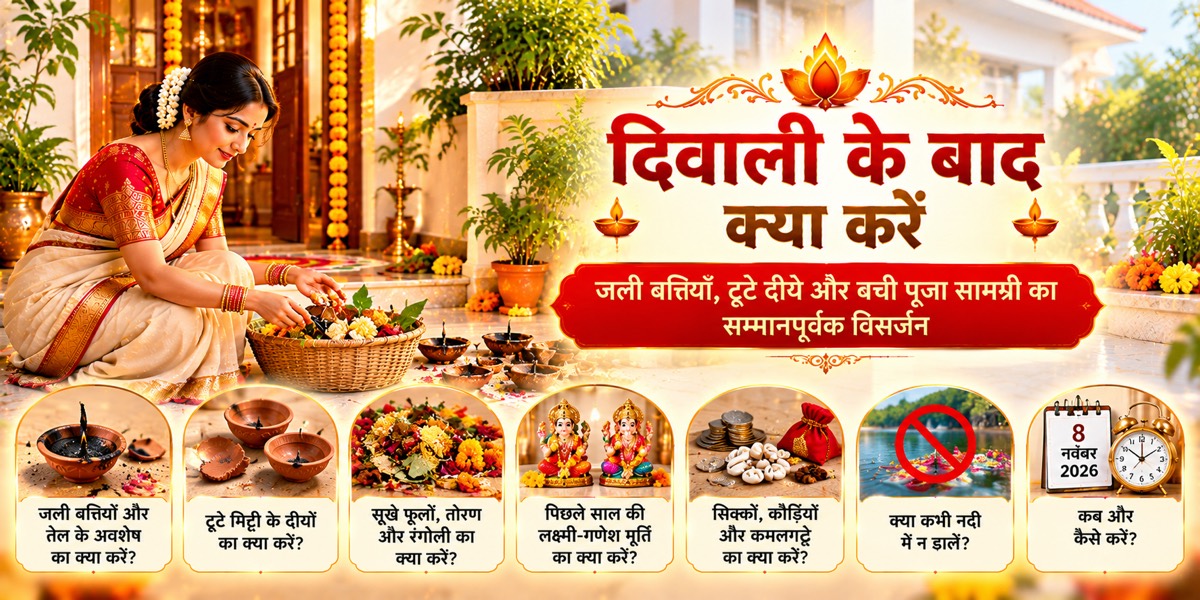
Why the cleanup has rules too
Everything used in a puja has been offered, and something offered is not ordinary rubbish. Tossing a burnt wick or a garland into the household bin, where it mixes with food waste and is stepped on, is seen as avamanana, disrespect, to what was a part of the worship. At the same time, the old answer of "put it in the river" no longer works for most of what a modern Diwali leaves behind: oil, foil, synthetic colour, plastic and glitter. The guidance below keeps the respect and drops the pollution. In short: keep what is meant to be kept, return to the soil what came from it, and keep everything else out of the water.
When to clear up
- Not on Diwali night. Lakshmi Puja is on Sunday 8 November 2026, and most families don't sweep or clear anything that night.
- The household diyas can be collected from the morning of Monday 9 November. Many homes keep lighting a few lamps each evening through Govardhan Puja (10 November) and Bhai Dooj (11 November), and clear up after that.
- The puja chowki (the Lakshmi-Ganesh setup) is usually left in place until the next morning at least, and in many homes until Bhai Dooj. The main ghee lamp is allowed to burn out on its own.
- Diyas and wicks needed again for Dev Uthani Ekadashi (20 November) and Kartik Purnima can be cleaned and set aside.
Burnt wicks (kali bati)
The blackened wicks from the Lakshmi Puja lamp and the household diyas are the most common leftover, and the one people are most unsure about.
- Pull them out of the lamps once they are cold and collect them in a small paper bag or a box kept for puja leftovers. Don't throw them into the kitchen bin.
- Bury them in soil: in a garden bed, the base of a tree, or a large plant pot (not the Tulsi). A cotton wick is organic and breaks down; the oil left in it is a small amount and the soil absorbs it.
- Alternatively, burn them in the next havan or with the dried flowers in a small fire, and put the ash in the soil.
Some families collect the soot (kajal) from the Diwali night lamp by holding a brass plate over the flame, and apply it as a tilak or behind a child's ear for protection. Doctors advise against putting home-made kajal in the eyes, especially children's; use it, if at all, as a mark on the skin.
Oil residue and ash
- Leftover oil in diyas: wipe it out with an old cloth or newspaper and dispose of it with dry waste. Never pour it into a drain, a river or a pond: a film of oil suffocates water life, and a few hundred diyas' worth from one street is a real pollutant.
- Ash from the havan, agarbatti and dhoop: mix into plant pots or garden soil. It is rich in potash and is the oldest fertiliser there is.
- Don't put ash or wicks into the Tulsi pot; Tulsi is kept clean of other offerings' remains.
Clay diyas: whole and broken (khandit)
Whole diyas
An unchipped clay diya can be reused. Soak it in warm water with a little dishwashing liquid, scrub off the oil, rinse, and dry it in the sun for a day. Store it wrapped in newspaper for Dev Uthani Ekadashi, Kartik Purnima or next Diwali. Many families also give clean, whole diyas to the potter or to a temple that uses them.
Chipped or broken diyas
A khandit (broken or chipped) lamp is not used in puja; this is one of the clearest rules about puja vessels, the same rule that applies to a chipped idol. But a broken diya is still fired earth, and it goes back to the earth:
- Break it further into small pieces, wrap them in paper, and crush them. The terracotta fragments go at the bottom of plant pots for drainage, or into a garden bed.
- Or place the pieces under a peepal or banyan tree, or at a temple's collection point, if one is nearby.
- Don't throw broken diyas into water; they don't dissolve, and they are hazardous for bathers and animals.
Flowers, garlands, torans and leaves
- Separate flowers and leaves from strings, wires, foil and plastic. Only the organic part is composted.
- Compost them. A simple pot or bin compost with a layer of soil on top works; in two months the Diwali garlands are fertiliser. Many cities and temples now run nirmalya collection, where puja flowers are composted or made into incense.
- Marigold is worth a second life: the dry flower heads are full of seeds. Crumble a few into a pot and you will have marigolds for next Diwali.
- Mango and ashoka leaf torans go the same way once dry, in the compost or under a tree.
What about flowing water?
Offering puja flowers to flowing water is an old custom. Today many rivers and lakes are already overloaded, and several municipalities fine immersion outside designated spots. If you follow the custom, offer only a handful of natural flowers and leaves, with no string, thread, plastic, foil, oil or synthetic colour, at a designated ghat or immersion tank. For everything else, the soil is the respectful choice. Returning an offering to the earth is as old and as complete as returning it to the water.
Rangoli
- Rangoli made of rice flour, turmeric, kumkum or flower petals can be left for birds and ants, which is part of its original purpose, and then swept into a garden bed.
- Synthetic rangoli colours and glitter are dry waste. Sweep them up, don't wash them into a drain.
- Sweep rangoli away on the morning after Diwali or after Bhai Dooj, never on Diwali night.
What to keep from the Lakshmi Puja
| Item | What families do |
|---|---|
| Silver or gold coin worshipped in the puja | Keep it in the safe or puja box, wrapped in red cloth; worship it again next Diwali |
| Cowries, gomti chakra, kamalgatta | Tie in red cloth with a little akshat and keep in the safe or cash box for the year |
| Whole coriander from Dhanteras | Keep a few seeds in the safe; sow the rest in a pot |
| Akshat, roli | Unused akshat goes back into the household rice; used akshat to birds or the soil |
| Khil-batashe, sweets, fruit | Prasad: eat and share; never throw away |
| New account books (bahi-khata) | Begin using from the next working day |
| Kalash water | Sprinkle around the house and pour the rest into plants (not the Tulsi if it is a no-water day) |
| Kalash coconut | Break and share as prasad, usually the next day |
Last year's Lakshmi-Ganesh idol
Many families bring a new clay Lakshmi-Ganesh every Diwali and retire the previous year's. Metal and marble idols are kept and worshipped every year; it is the clay ones that are let go.
- After the new idols are installed and the Diwali puja is done, offer the old ones a flower and a short prayer of thanks, and ask forgiveness for any lapse in their worship.
- Do visarjan at home: place the idol in a bucket or tub of clean water and let it dissolve over a day or two. Unbaked clay idols melt completely.
- Pour the water and the dissolved clay into the garden or large plant pots.
- Painted or plaster-of-Paris idols don't dissolve and shouldn't go into rivers. Hand them to a temple or municipal immersion tank, and for next year choose an unpainted or natural-colour clay idol.
Frequently asked questions
Can I throw burnt diya wicks in the dustbin?
Better not. Collect them and bury them in garden or pot soil, or burn them with the next havan and put the ash in the soil.
What should I do with broken clay diyas?
Don't use them in puja again. Crush them and use the pieces at the bottom of plant pots or in a garden bed, or leave them under a peepal tree. Don't throw them into water.
Can I put Diwali flowers in the river?
Only a handful of natural flowers, without string or plastic, and only at a designated ghat or immersion tank. Composting is equally respectful and much kinder to the river.
When should I remove the Diwali diyas and puja setup in 2026?
Not on Diwali night (8 November). Collect household diyas from the morning of 9 November, or after Bhai Dooj on 11 November if you keep lighting through the five days.
What do I do with leftover diya oil?
Wipe it out with paper or an old cloth and put it in dry waste. Never pour it into a drain or water body.
What happens to last year's Lakshmi-Ganesh idol?
A clay idol is dissolved at home in a bucket of water after the new one is installed, and the water and clay go into the garden. Metal and marble idols are kept and worshipped every year.
Can clay diyas be reused?
Yes, if they are not chipped. Wash off the oil, dry them in the sun, and keep them for Dev Uthani Ekadashi on 20 November, Kartik Purnima or next Diwali.
Was this article helpful?
Spotted a mistake?
If you find any grammatical, Hindi, English, mantra-text or other mistake on this page, tell us — we will correct it within 24 hours.
Related content
- Maa Lakshmi
- Diwali 2026 Laxmi Puja Vidhi: A Step-by-Step Guide to Welcoming Mahalakshmi at Home and at Your Shop or OfficePublished10 min read
- Bhai Dooj 2026: Auspicious Tilak Timing, Direction, and the Story of Yama and YamunaPublished8 min read
- Dev Uthani Ekadashi 2026: When Does Lord Vishnu Wake? Tulsi Vivah Vidhi and the Return of Auspicious CeremoniesPublished9 min read
- Maa Lakshmi Puja Vidhi: Friday Worship and Diwali Night
- Diwali