
Dev Uthani Ekadashi 2026 at a glance
Dev Uthani Ekadashi, also called Prabodhini, Devutthana or Dev Uthan Ekadashi, falls on the Ekadashi of the bright fortnight of Kartik. It is the day Bhagwan Vishnu is believed to wake from his four-month yogic sleep, which began on Devshayani Ekadashi in Ashadh. In 2026 it falls on Friday, 20 November.
- Ekadashi tithi: 7:15 am on 20 November to 6:31 am on 21 November
- Parana (breaking the fast): 21 November, 1:11 pm to 3:18 pm
- Hari Vasara ends: 12:07 pm on 21 November (don't break the fast before this)
- Gauna Ekadashi (second day): Saturday, 21 November, with parana on 22 November from 6:49 am to 8:56 am
- Tulsi Vivah (Dwadashi): Saturday, 21 November; Dwadashi runs from 6:31 am on 21 November to 4:56 am on 22 November
These timings are for New Delhi. Householders keep the fast on 20 November. The second, gauna day is listed for those who keep the fast for two days or follow that custom; if you are keeping one day, keep the first.
Why Vishnu "sleeps" and "wakes"
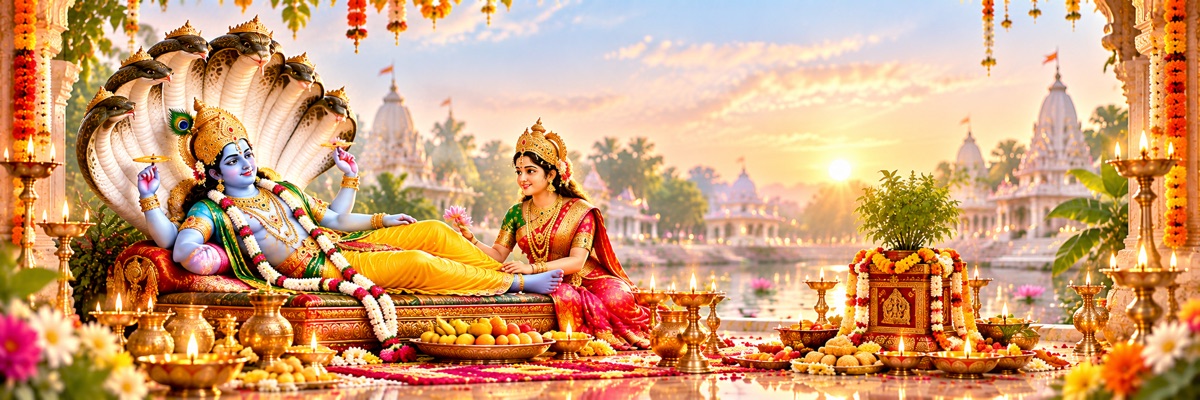
For the four months of Chaturmas, from Devshayani Ekadashi in Ashadh to Prabodhini Ekadashi in Kartik, Vishnu is said to rest in yoga-nidra on the serpent Shesha in the ocean of milk. It is the season of the monsoon, of staying in one place, of vows and of inward practice: sadhus stop wandering, devotees give up certain foods, and big household celebrations are put off. Weddings, griha pravesh, mundan and other sanskaras are traditionally not done in these months.
On Prabodhini Ekadashi, prabodhini meaning "the awakening", the household wakes the Lord, and the season of auspicious ceremonies opens again. That is why this Ekadashi is so closely watched by families planning a wedding.
Waking Lord Vishnu: the traditional mantra and method
The sugarcane mandap
In much of Uttar Pradesh, Bihar, Madhya Pradesh and Rajasthan, the evening begins with a small mandap of sugarcane. Four or five sugarcane stalks are stood up and tied together at the top over the puja place, the tulsi or a chowki, to make a canopy. Sugarcane is newly harvested at this time, and the canopy is both a welcome for the Lord and the wedding mandap for the Tulsi Vivah.
The vidhi
- Morning. Bathe, take the sankalp for the Ekadashi fast, and do your usual Vishnu puja. Our Vishnu puja vidhi has the full method.
- Draw the Lord's feet. In the courtyard or near the puja place, many families draw the footprints of Vishnu with geru (red ochre) or rice paste, leading towards the mandap.
- Set up the mandap of sugarcane, and place under it the image of Vishnu or a Shaligram, and the season's offerings: singhara (water chestnut), shakarkand (sweet potato), amla, ber, sitaphal, new grain and jaggery.
- Cover and wake. In many homes the offerings and the image are covered with a daliya (a bamboo basket or sieve). In the evening, the family gathers, lights lamps, rings bells and blows the conch, and beats a thali, singing the folk songs that begin "Utho dev, baitho dev". Then the cover is lifted: the Lord is awake.
- The prabodhan mantra. While waking him, recite:
उत्तिष्ठ गोविन्द त्यज निद्रां जगत्पते।
त्वयि सुप्ते जगन्नाथ जगत्सुप्तं भवेदिदम्॥
उत्थिते चेष्टते सर्वमुत्तिष्ठोत्तिष्ठ माधव।
"Arise, Govinda, give up sleep, Lord of the world. When you sleep, O Jagannath, the whole world sleeps; when you rise, everything moves. Arise, arise, O Madhava." - Puja and aarti. Offer flowers, tulsi leaves, the seasonal fruit and sweets, and do the aarti with Om Jai Jagdish Hare. Many families also chant Om Namo Narayanaya or read the Vishnu Chalisa.
- Stay awake if you can. Many devotees keep a jagran through the night, singing bhajans, since the Lord has just woken.
The Ekadashi fast
- The fast runs from sunrise on 20 November until the parana on 21 November. Grains, rice and pulses are avoided; fruit, milk, sabudana, singhara, sweet potato and potato are commonly eaten.
- Break the fast on 21 November between 1:11 and 3:18 pm in Delhi, after Hari Vasara ends at 12:07 pm. Breaking it with a tulsi leaf and water, then a sattvik meal, is traditional.
- Pregnant women, the elderly, diabetics and anyone on medication should keep a lighter fast with fruit and milk. Our Ekadashi vrat guide explains the general rules.
Tulsi Vivah: the story of Vrinda
The Puranas tell of Vrinda, a woman of great devotion and virtue, married to the asura king Jalandhar. Her chastity and devotion made her husband invincible, and he used his strength to torment the gods. To end Jalandhar's power, Vishnu took her husband's form and broke her vow; Jalandhar was then killed in battle by Shiva. When Vrinda discovered the deception, she cursed Vishnu to become a stone, which is why he is worshipped as the Shaligram, and gave up her life. From where she died grew the tulsi plant. Moved by her devotion, Vishnu declared that he would always accept tulsi as most dear, that no offering to him would be complete without a tulsi leaf, and that he would marry her every year.
Tellings differ in detail between the Shiva Purana, the Padma Purana and folk versions, but every one ends with the same promise: the marriage of Tulsi and Vishnu (as Shaligram, or as Krishna) is celebrated on the day the Lord wakes, and with it, the season of human weddings opens too.
A simple, authentic Tulsi Vivah at home
Tulsi Vivah can be done on Prabodhini Ekadashi evening itself or on Dwadashi (21 November in 2026), and in many regions on any day up to Kartik Purnima. Many families do it on Ekadashi evening, right after waking the Lord, under the same sugarcane mandap.
What you need
- The tulsi plant in its pot, cleaned, with the pot painted or decorated (many draw a swastik in geru)
- A Shaligram, or a small idol or picture of Vishnu or Krishna, as the groom
- A red chunri, bangles, sindoor, bindi, mehndi and other shringar for Tulsi as the bride
- A yellow cloth for the groom, a sacred thread (janeu) if your family uses one
- Sugarcane stalks for the mandap, a kalash, a lamp, roli, akshat, haldi, flowers and garlands
- Seasonal fruit, sweets, and a small gift or dakshina
Step by step
- Prepare the bride. Clean the tulsi pot, place it on a chowki or under the sugarcane mandap, and dress Tulsi as a bride: the red chunri over the plant, bangles on its branches, sindoor and bindi on the pot.
- Prepare the groom. Bathe the Shaligram or idol in panchamrit and water, dress it in yellow, and place it on a small platform on Tulsi's right side.
- Ganesh puja and kalash. Begin, as always, with Ganesh, and set up the kalash.
- Sankalp. The host couple (often the parents of the house, acting as Tulsi's parents) take the sankalp to perform the marriage.
- Worship both. Offer haldi, roli, akshat, flowers and garlands to Tulsi and the Lord. Many families recite the eight names of Tulsi: Vrinda, Vrindavani, Vishwapujita, Vishwapavani, Pushpasara, Nandini, Tulsi and Krishnajivani.
- Kanyadaan. The host couple "give away" Tulsi, placing her hand, a sprig, in the Lord's with water and akshat. Tie a gathbandhan, a knot of cloth or kalava, between the two.
- Phere. Holding the Shaligram or idol, a member of the family walks around the tulsi seven times while the others sing wedding songs (mangal geet).
- Aarti and prasad. Do the aarti with Tulsi Maharani Namo Namo and Om Jai Jagdish Hare, and share the prasad and the seasonal fruit. Many families also read the Tulsi Chalisa.
Afterwards, the chunri and shringar are given to a married woman or a priest's family, and the Shaligram returns to its usual place.
Auspicious ceremonies begin again
With the Lord awake, weddings, engagements, griha pravesh, mundan and naming ceremonies can be planned again. Two things are worth knowing:
- Prabodhini Ekadashi is itself treated as an abujh muhurat in many regions, a day so auspicious that a wedding can be held without looking for a separate muhurat. Our abujh muhurat guide lists the others.
- "Weddings resume" doesn't mean every date after it works. Each wedding still needs a muhurat that suits the couple's charts, and planetary factors such as the setting of Venus or Jupiter, and Kharmas in mid-December, close the window again. See our vivah muhurat page before fixing a date.
Prabodhini Ekadashi also begins Bhishma Panchak, the five days to Kartik Purnima, and is the day of the great Kartiki Ekadashi pilgrimage to Vitthal at Pandharpur in Maharashtra.
Frequently asked questions
When is Dev Uthani Ekadashi in 2026?
Friday, 20 November 2026. Ekadashi tithi runs from 7:15 am on 20 November to 6:31 am on 21 November.
When should the Dev Uthani Ekadashi fast be broken?
On 21 November, between 1:11 pm and 3:18 pm in Delhi, after Hari Vasara ends at 12:07 pm.
When is Tulsi Vivah in 2026?
Drik Panchang lists Tulsi Vivah on Saturday, 21 November (Dwadashi). Many families also do it on Ekadashi evening, 20 November, right after waking the Lord, and in many regions it can be done on any day up to Kartik Purnima.
Can Tulsi Vivah be done without a Shaligram?
Yes. A small idol or picture of Vishnu or Krishna is commonly used as the groom. A Shaligram is traditional, but not required.
Can weddings be held on Dev Uthani Ekadashi itself?
In many regions, yes. The day is treated as an abujh muhurat. Still, check with your family priest, as some communities prefer to wait for a muhurat matched to the couple's charts.
Is it wrong to pluck tulsi leaves on Ekadashi?
Yes, by tradition tulsi leaves are not plucked on Ekadashi, or on Sundays and after sunset. Pick the leaves you need for the puja the day before.
Who should keep the Gauna Ekadashi on 21 November?
The gauna (second) day is for those who keep a two-day fast or whose tradition follows it. Householders usually keep only the first day, 20 November.
Why is sugarcane used on Dev Uthani Ekadashi?
It is freshly harvested at this time of year, it is sweet like the occasion, and the stalks make a natural mandap for waking the Lord and for the Tulsi Vivah under it. Many families cut and eat the first sugarcane of the season only after this day.
Was this article helpful?
Spotted a mistake?
If you find any grammatical, Hindi, English, mantra-text or other mistake on this page, tell us — we will correct it within 24 hours.
Related content
- Shri Vishnu
- Vishnu Puja Vidhi: Thursday and Ekadashi Worship at Home
- Ekadashi Vrat
- Om Jai Jagdish Hare
- Tulsi Maharani Namo Namo (Tulsi Aarti)
- Tulsi Chalisa
- Vishnu Chalisa
- Om Namo Narayanaya – Vishnu Ashtakshara Mantra
- Vivah Muhurat: How a Hindu Wedding Date Is Chosen
- Abujh Muhurat: Days So Auspicious They Need No Calculation