
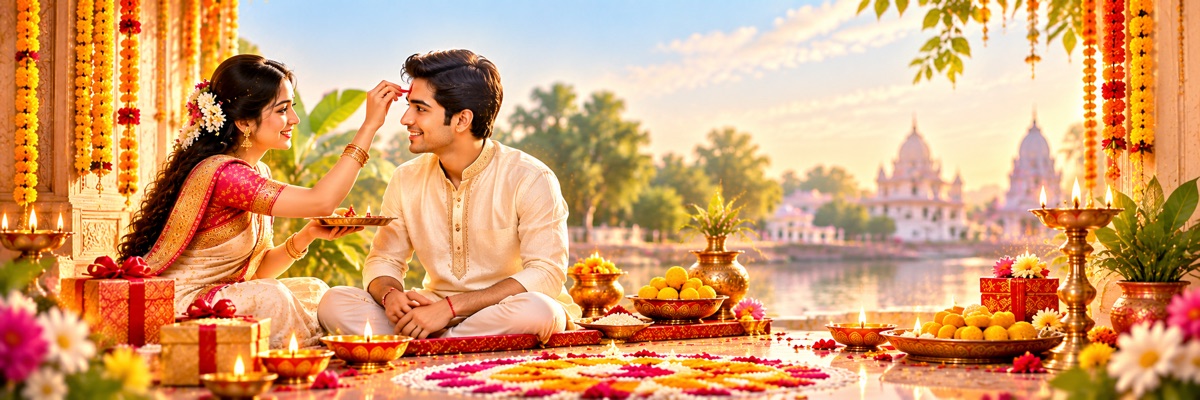
Bhai Dooj 2026 at a glance
Bhai Dooj closes the five days of Diwali. It falls on Dwitiya, the second day of the bright fortnight of Kartik, and is also called Yama Dwitiya and Bhratri Dwitiya. In 2026 it falls on Wednesday, 11 November.
- Bhai Dooj tilak time (aparahna): 1:10 pm to 3:20 pm (2 hours 10 minutes)
- Dwitiya tithi: 2:00 pm on 10 November to 3:53 pm on 11 November
These timings are for New Delhi. Dwitiya begins on the afternoon of 10 November, but the day for Bhai Dooj is the one on which Dwitiya covers the aparahna, the afternoon portion of the day, and in 2026 that is 11 November. So don't be confused by calendars that show Dwitiya starting on the 10th: the tilak is on Wednesday the 11th. The day before, Tuesday 10 November, is Govardhan Puja.
Why the tilak is in the afternoon
The shastras assign Yama Dwitiya's rites to the aparahna, and the story explains it: Yama came to his sister's house for a meal, and the tilak and the meal belong together. Many families still follow the order of the story: the sister applies the tilak, then feeds her brother, and the brother eats at her home that day rather than his own. If the afternoon is impossible for you, do the tilak while Dwitiya lasts (until 3:53 pm in Delhi) rather than skipping it.
Which way should the brother face?
- The brother sits facing north or north-east, the directions most families and priests recommend for receiving a tilak and blessings. East is also accepted in many homes.
- The sister sits or stands facing him, so she faces south or south-west, with the thali in front of her.
- Avoid seating the brother facing south, the direction of Yama, for the tilak itself. The prayer of the day is that Yama stays away from him.
- The brother sits on a clean asan, a low stool (patra) or a mat, not on the bare floor, and covers his head with a handkerchief or cap in many families.
The Bhai Dooj thali
- Roli or kumkum, akshat (unbroken rice), a little water
- Kalava (sacred thread)
- A ghee lamp for the aarti
- Sweets, and in many homes a dry coconut (gola) to give the brother
- Paan and supari, a few flowers
- In some families, dried flowers, batasha or a little sindoor, according to custom
How the sister applies the tilak, step by step
- Morning. Both bathe. Many sisters keep a fast until the tilak, or at least don't eat until it is done. The brother comes to the sister's home, traditionally bringing a gift.
- Prepare the place. In many North Indian homes, the sister draws a small chowk (a square pattern) with rice flour where her brother will sit.
- Worship first. The sister lights the lamp and offers roli and akshat to Ganesh, and in many families to Yamaraj, Yamuna and Chitragupta, before the tilak.
- The tilak. With the ring finger of her right hand, she applies roli or kumkum to the middle of her brother's forehead in an upward stroke, then presses a few grains of akshat onto it. Some sisters put a little water on his palms first.
- Kalava and aarti. She ties kalava on his right wrist, does his aarti with the lamp, and puts sweets in his mouth. She gives him the coconut if her family has that custom.
- Blessings and gifts. The sister prays for his long life; the brother touches her feet if she is elder, or blesses her if she is younger, and gives her a gift.
- The meal. She serves him a meal, and he eats at her home, as Yama did at Yamuna's.
The story of Yama and Yamuna
Yama, the god of death, and Yamuna, the river goddess (also called Yami), were twins, the children of Surya the sun god and his wife Sanjna. Yamuna loved her brother dearly and kept asking him to come to her home for a meal, but Yama, busy with the work of judging the dead, kept putting it off.
At last, on Kartik Shukla Dwitiya, he arrived at her door unannounced. Yamuna was overjoyed. She bathed, welcomed him with a tilak on his forehead and an aarti, and served him a feast with her own hands. Yama was so pleased that he asked her to name any boon. Yamuna asked that every year on this day he would come to her, and that any brother who receives a tilak from his sister and eats at her home on this day should be free from the fear of untimely death. Yama granted it. That is why the day is called Yama Dwitiya, and why the tilak is a prayer for the brother's long life.
A second, popular story links Bhai Dooj to Krishna: after killing the demon Narakasura, Krishna visited his sister Subhadra, who welcomed him with a tilak, flowers and sweets.
The Yamuna snan on Yama Dwitiya
Because of the story, bathing in the Yamuna on this day is considered especially meritorious. The greatest crowds are at Vishram Ghat in Mathura, where brothers and sisters bathe together, often holding hands, and then visit the small temple of Yama and Yamuna nearby. The belief is that a brother and sister who bathe together in the Yamuna on Yama Dwitiya are protected from the fear of Yama. If you cannot go to Mathura, add a few drops of Ganga jal or Yamuna jal to your bath water at home and remember the story.
Chitragupta puja on the same day
Yama Dwitiya is also the day of Chitragupta, Yama's record-keeper, who writes down the deeds of every being. Kayastha families in particular worship Chitragupta with pen and ink (kalam-dawat puja), and many write their accounts or a few lines in his honour. Read the Chitragupt Chalisa if this is your family's tradition.
How India keeps the day
- North India: Bhai Dooj, with roli tilak, kalava and a dry coconut in many homes.
- Maharashtra, Goa and Karnataka: Bhau Beej. The sister draws a square for the brother to sit in, and in many homes he is given basundi-puri or shrikhand.
- West Bengal: Bhai Phonta. The sister applies a phonta (dot) of sandalwood paste, kajal and curd, reciting a rhyme that "puts a thorn at Yama's door".
- Nepal and the Darjeeling hills: Bhai Tika, the last day of Tihar, with a tika of seven colours and a garland of makhamali (globe amaranth) flowers, which stay fresh for a long time.
- Odisha and parts of the South: Bhratri Dwitiya, often with a family meal rather than an elaborate ritual.
If you can't be together
- A sister without a brother, or far from him, can apply the tilak to a cousin or a brother-like friend, or offer it to Krishna or to the moon in his name.
- A brother without a sister can visit a cousin or a friend's home, or offer a tilak at a Yamuna or river ghat.
- Over a video call, many families now do the aarti together, with the sister offering the tilak to her brother's picture and the brother applying it himself.
Frequently asked questions
When is Bhai Dooj in 2026?
Wednesday, 11 November 2026. Dwitiya begins at 2:00 pm on 10 November, but it covers the afternoon of 11 November, so the tilak is on the 11th.
What is the tilak muhurat on Bhai Dooj 2026?
In New Delhi, 1:10 pm to 3:20 pm, the aparahna. If that is not possible, apply the tilak any time before Dwitiya ends at 3:53 pm.
Which direction should the brother face during the tilak?
North or north-east, with the sister facing him. Don't seat him facing south, the direction of Yama.
Should the sister fast on Bhai Dooj?
It is a custom, not a rule. Many sisters don't eat until they have applied the tilak and fed their brother; others don't fast at all. Follow your family's practice.
What gift should a brother give on Bhai Dooj?
There is no rule. Clothes, jewellery, money or something she needs are all traditional. The story's spirit is the brother honouring the sister's love, so a thoughtful gift matters more than an expensive one.
Is Bhai Dooj the same as Raksha Bandhan?
No. Both celebrate brothers and sisters, but on Raksha Bandhan (Shravan Purnima) the sister ties a rakhi and the brother promises protection, while on Bhai Dooj the sister applies a tilak and prays for the brother's long life, and he eats at her home.
Can a married woman go to her brother's home instead?
Traditionally the brother goes to the married sister's home, as Yama went to Yamuna's. But where that's not practical, many families reverse it; the tilak and the prayer are what matter.
What should be done with the coconut given on Bhai Dooj?
It is prasad: the brother breaks and eats it, or shares it at home. Some families keep it in the puja place for a few days before eating it.
Was this article helpful?
Spotted a mistake?
If you find any grammatical, Hindi, English, mantra-text or other mistake on this page, tell us — we will correct it within 24 hours.