
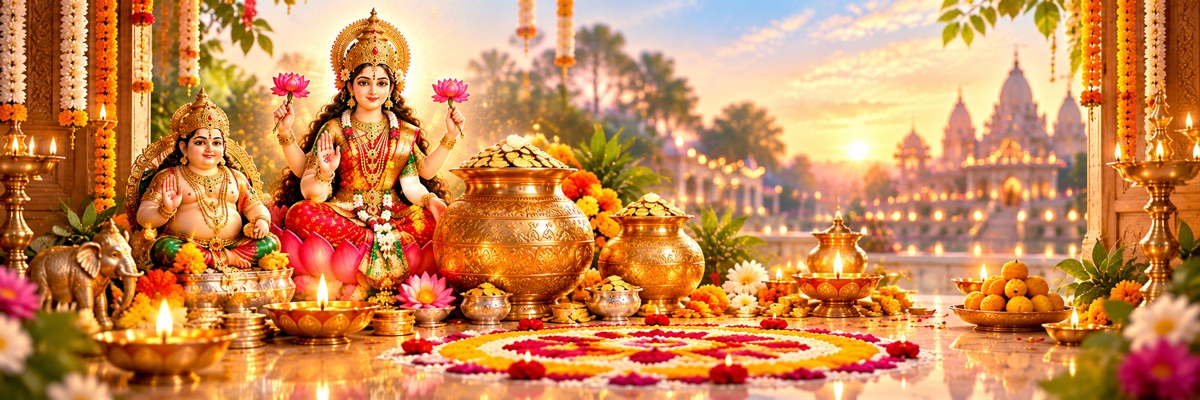
Dhanteras 2026 at a glance
Dhanteras, or Dhantrayodashi, opens the five days of Diwali. It falls on Trayodashi, the thirteenth day of the dark fortnight of Kartik (purnimanta), and in 2026 it is on Friday, 6 November.
- Dhanteras puja muhurat: 6:02 pm to 7:57 pm (Vrishabha kaal, 1 hour 56 minutes)
- Pradosh kaal: 5:33 pm to 8:09 pm
- Yama Deepam (evening sandhya): 5:33 pm to 6:51 pm, same day
- Trayodashi tithi: 10:30 am on 6 November to 10:47 am on 7 November
These timings are for New Delhi. The puja is done in the evening, in Pradosh kaal, and the Vrishabha lagna inside it is preferred because it is a sthir (fixed) lagna: what is brought home in it is believed to stay. For shopping, the Trayodashi window, from late morning on 6 November until the next morning, is the traditional time.
| City | Dhanteras puja muhurat, 6 Nov 2026 |
|---|---|
| New Delhi | 6:02 – 7:57 pm |
| Gurgaon | 6:03 – 7:59 pm |
| Chandigarh | 6:00 – 7:54 pm |
| Jaipur | 6:11 – 8:07 pm |
| Kolkata | 5:28 – 7:26 pm |
| Mumbai | 6:35 – 8:35 pm |
| Pune | 6:32 – 8:31 pm |
| Hyderabad | 6:15 – 8:13 pm |
| Bengaluru | 6:25 – 8:20 pm |
| Chennai | 6:14 – 8:10 pm |
Why buying on Dhanteras matters
Two stories meet on this day. In the churning of the ocean, Bhagwan Dhanvantari, the physician of the gods, rose from the waters holding a pot (kalash) of amrit on this Trayodashi, which is why the day is also Dhanvantari Jayanti, and why the Government of India marks it as National Ayurveda Day. The second is Mahalakshmi and Kuber, worshipped this evening for wealth that comes and stays. Bringing home a new vessel or a little metal on this day is the household way of welcoming both: health first, then prosperity. The dhan in the name is usually read as wealth, but many teachers remind us that the first wealth is health.
What to buy on Dhanteras, and why
Gold and silver
The best-known purchase. Gold stands for Lakshmi, and silver, linked with the moon, for calm and coolness in the home. You do not need jewellery: a single silver coin with Lakshmi-Ganesh on it, which is then placed in the Diwali puja, is the most common choice. Buy within your means. A small coin bought with a clear mind is the custom; a loan for jewellery is not.
Brass, copper and steel vessels
Because Dhanvantari rose with a kalash, a new vessel is the oldest Dhanteras purchase. Brass (peetal), associated with Dhanvantari and with Brihaspati, is the traditional choice, and copper is favoured for water. Families who follow the custom strictly fill the new vessel with something before bringing it in, water, rice, sugar or sweets, so that it never enters the home empty.
A new broom
The broom (jhaadu) is treated as a form of Lakshmi because it sweeps out dirt and, with it, poverty (daridrya). A new broom bought on Dhanteras is used from the next day, kept out of sight, and never stepped over. Many families don't throw the old one out on Dhanteras itself, but retire it a day later.
Whole coriander seeds
Whole coriander (sabut dhaniya) is a quiet but very old Dhanteras purchase. The word dhaniya is close to dhan, and the seed is a symbol of abundance that sprouts and multiplies. See the three coriander customs below.
Salt
In many homes a new packet of salt is the first thing bought on Dhanteras. Salt is believed to absorb negativity, and a pinch of it in the water used to mop the floor on Diwali eve is a common custom. It is also a reminder that the household's basic needs, before luxuries, are blessed by Lakshmi.
Other things families buy
- A Lakshmi-Ganesh idol or picture for the Diwali puja, and new diyas
- Gomti chakra, cowrie shells (kaudi) and batasha for the puja thali
- New account books (bahi-khata) for traders, to be worshipped on Diwali
- Electronics, a vehicle or household goods, if you were already planning to buy them
What not to buy on Dhanteras
- Iron, and sharp or cutting things such as knives, scissors and blades. Iron is linked with Shani, and sharp edges with cutting and quarrels, so tradition keeps them out of a day meant to bring things in. If you need a kitchen knife, buy it another day.
- Glass and fragile items. Glass is associated with Rahu, and a thing that can shatter is considered a poor symbol for wealth that should last.
- Black clothes or black objects, which many families avoid on any auspicious beginning.
- Empty vessels. Fill a new pot before you carry it home, as above.
- Oil and ghee are bought a day earlier by some families, who prefer not to buy them on Dhanteras itself. This is a regional custom, not a rule.
- Things bought on borrowed money. The idea of Dhanteras is wealth that grows, not debt. Many traders also avoid lending money on this day.
Plastic and aluminium are avoided in some homes for the same reasons as glass, but this is a newer belief and varies widely.
Zodiac-wise shopping (rashi anusar)
Astrologers often suggest a purchase for each rashi, based on the planet that rules it. Treat these as suggestions, not obligations: buying anything on the list below for the right reasons is fine, whatever your sign.
| Rashi (ruling planet) | Suggested purchase |
|---|---|
| Mesh / Aries, Vrishchik / Scorpio (Mars) | Copper vessels, gold |
| Vrishabh / Taurus, Tula / Libra (Venus) | Silver, white or bright clothes, perfume |
| Mithun / Gemini, Kanya / Virgo (Mercury) | Books, stationery, a pen; brass or green-coloured items |
| Kark / Cancer (Moon) | Silver coin or silver vessel, rice |
| Simha / Leo (Sun) | Gold, copper |
| Dhanu / Sagittarius, Meen / Pisces (Jupiter) | Gold, brass vessels, turmeric, yellow items |
| Makar / Capricorn, Kumbh / Aquarius (Saturn) | Steel or brass utensils for the kitchen; a blanket or warm clothes to give to someone in need |
Saturn signs are usually advised to give rather than to stock up, so a gift to a worker or a needy family is the traditional Dhanteras act for Capricorn and Aquarius.
Three coriander customs for Dhanteras
These are folk customs passed down in households, not scriptural rules. They are simple, cost almost nothing, and many families keep them every year.
- Offer, then sow. Offer a handful of whole coriander seeds to Lakshmi in the Dhanteras or Diwali puja. The next morning, sow a few in a pot or in the garden. A healthy green crop is taken as a happy sign for the household's prosperity in the year ahead.
- Keep a few in the tijori. Tie some of the worshipped seeds in a small red cloth and keep them in your safe, cash box, cupboard or wallet until next Dhanteras, when you replace them with fresh ones and sow or immerse the old.
- Dhaniya-gud prasad. Offer coriander seeds with jaggery (gud) as naivedya, then share it with the family as prasad. Many families also keep a little at the front door or the puja place through the five days.
Yama Deepam: the lamp for Yamaraj
On Dhanteras evening a lamp is lit outside the home for Yamaraj, the god of death, with a prayer that no one in the family meets an untimely death. A popular katha tells of King Hima's son, who was destined to die on the fourth night of his marriage; his young wife kept him awake all night, piled her jewellery and gold at the door and lit lamps everywhere, and told stories and sang until dawn. Yama came as a serpent, was dazzled by the light, listened to her songs until morning, and left without taking him. The lamp outside the door recalls that night.
How to do it
- Time: after sunset in Pradosh kaal; in Delhi the Yama Deepam sandhya is 5:33 to 6:51 pm on 6 November.
- The lamp: an earthen lamp, or one made of wheat flour dough, with four wicks (chaumukha) facing four directions. Fill it with mustard or sesame oil.
- Place and direction: outside the main door, on the right side as you look out, with the lamp facing south, the direction of Yama. Some families place it near the drain or the rubbish heap outside the house, which is the older custom.
- Prayer: light it and, facing south, say this prayer (from the Yama Deepam tradition):
मृत्युना पाशदण्डाभ्यां कालेन श्यामया सह।
त्रयोदश्यां दीपदानात् सूर्यजः प्रीयतां मम॥
"By this lamp offered on Trayodashi, may the son of Surya (Yama), with death, the noose and the staff, with time and with his consort Shyama, be pleased with me." - Leave the lamp to burn out on its own, and go inside without looking back, as tradition asks.
Some families also light a lamp for Yama on Narak Chaturdashi (Choti Diwali), the next evening.
Dhanteras puja in brief
In the evening muhurat, worship Ganesh first, then Lakshmi, Kuber and Dhanvantari with roli, akshat, flowers, a ghee lamp and sweets. Place the coins, utensils or jewellery you bought in front of the deities; this is when they are "blessed". Close with Om Jai Lakshmi Mata. The full method for Lakshmi worship, which you will use again on Diwali, is in our Lakshmi puja vidhi. Many families also read the Kanakadhara Stotram or chant Om Shreem Mahalakshmyai Namah.
The five days of Diwali 2026
- Friday, 6 November: Dhanteras, Yama Deepam
- Saturday, 7 November: Choti Diwali / Narak Chaturdashi evening
- Sunday, 8 November: Diwali Lakshmi Puja
- Tuesday, 10 November: Govardhan Puja
- Wednesday, 11 November: Bhai Dooj
Read more about the festival as a whole on our Diwali page.
Frequently asked questions
When is Dhanteras in 2026?
Friday, 6 November 2026. Trayodashi tithi runs from 10:30 am on 6 November to 10:47 am on 7 November, and the evening puja is on 6 November.
What is the best time to shop on Dhanteras 2026?
During Trayodashi tithi, from 10:30 am on 6 November. The evening Vrishabha kaal, 6:02 to 7:57 pm in Delhi, is considered the most auspicious, both for the puja and for bringing new things home.
Can I buy steel utensils on Dhanteras?
Yes. Steel kitchen utensils are commonly bought, and many astrologers suggest them for Capricorn and Aquarius. What families avoid is raw iron and sharp tools, not steel vessels. Brass and copper remain the traditional first choice.
Is buying a broom on Dhanteras really auspicious?
Yes, in tradition the broom is a form of Lakshmi that removes poverty. Use it from the next day, keep it out of sight, and never step over it or put it upright.
Which direction should the Yama Deepam face?
South, the direction of Yama. It is placed outside the main door after sunset, usually with four wicks and mustard oil.
What if I can't afford gold or silver?
Buy a brass or steel vessel, a broom, whole coriander or salt. Tradition values the act of welcoming Lakshmi, not the price. Nothing in the festival asks you to spend beyond your means.
Can I buy a car or electronics on Dhanteras?
Yes. Many people book vehicles and appliances for Dhanteras. If you can, take delivery during Trayodashi, and do a small puja of the vehicle with roli, a swastik and a coconut. Our vehicle purchase muhurat guide explains the general rules.
Is Dhanteras the same as Dhanvantari Jayanti?
They fall on the same Trayodashi. Dhanvantari Jayanti remembers the god of medicine, and is observed as National Ayurveda Day; Dhanteras is the household festival of Lakshmi and Kuber on the same day.
Was this article helpful?
Spotted a mistake?
If you find any grammatical, Hindi, English, mantra-text or other mistake on this page, tell us — we will correct it within 24 hours.