
Original text
नाम मंत्र: ॐ देवी शैलपुत्र्यै नमः॥ प्रार्थना (ध्यान श्लोक): वन्दे वाञ्छितलाभाय चन्द्रार्धकृतशेखराम्। वृषारूढां शूलधरां शैलपुत्रीं यशस्विनीम्॥ स्तुति: या देवी सर्वभूतेषु माँ शैलपुत्री रूपेण संस्थिता। नमस्तस्यै नमस्तस्यै नमस्तस्यै नमो नमः॥
Transliteration
Naam mantra: Om devi shailaputryai namah || Prarthana (dhyana shloka): Vande vanchhitalabhaya chandrardhakritashekharam Vrisharudham shuladharam shailaputrim yashasvinim || Stuti: Ya devi sarvabhuteshu man shailaputri rupena sansthita Namastasyai namastasyai namastasyai namo namah ||
Who is Maa Shailputri?
Maa Shailputri is the first of the Navdurga, the nine forms of Maa Durga worshipped on the nine days of Navratri. Her name means "daughter of the mountain" — shaila is mountain, putri daughter. In Shardiya Navratri 2026 she is worshipped on Day 1 (Pratipada), Sunday 11 October.
She is Parvati as the daughter of Himavan, king of the Himalayas. In her previous birth she was Sati, daughter of Daksha Prajapati, who married Shiva against her father's wishes. When Daksha held a great yajna and pointedly excluded Shiva, Sati went uninvited, could not bear the insult to her husband, and gave up her body in the sacrificial fire. She was reborn to Himavan and Mena — which is why, in this first form, she is called Shailputri, and also Hemavati.
Because she begins the cycle, Shailputri is the root of the whole Navratri: she represents the steady, grounded start of the spiritual journey, the way a mountain is the steady base on which everything rests.
Her form
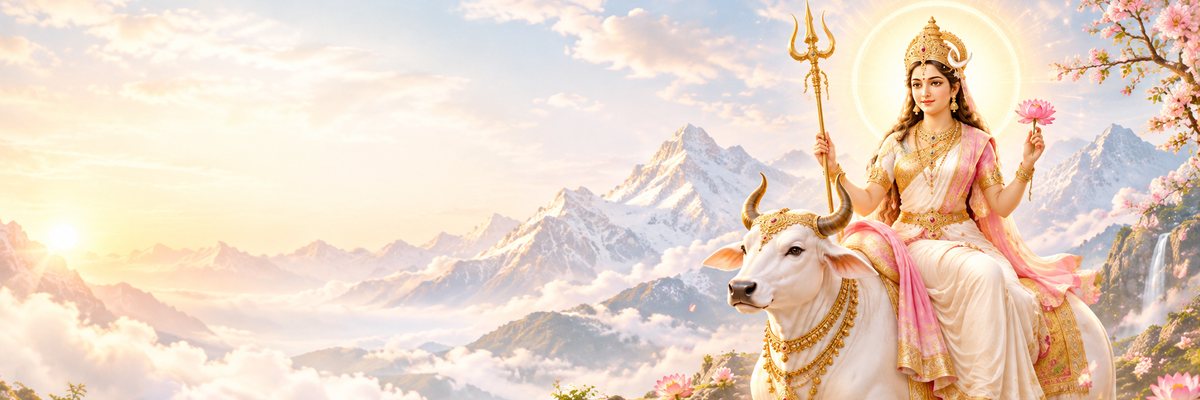
She rides a bull (hence Vrisharudha), holds a trident in her right hand and a lotus in her left, and wears the crescent moon on her head.
Mantras of Maa Shailputri
Naam mantra: ॐ देवी शैलपुत्र्यै नमः॥ — chant 108 times on a mala.
Prarthana (dhyana shloka):
वन्दे वाञ्छितलाभाय चन्द्रार्धकृतशेखराम्।
वृषारूढां शूलधरां शैलपुत्रीं यशस्विनीम्॥
Stuti:
या देवी सर्वभूतेषु माँ शैलपुत्री रूपेण संस्थिता।
नमस्तस्यै नमस्तस्यै नमस्तस्यै नमो नमः॥
The stuti is modelled on the Devi Mahatmya's "Ya Devi sarvabhuteshu" hymn, with her name in place: "To the Devi who dwells in all beings in the form of Maa Shailputri — salutations to her, again and again."
Puja vidhi on Day 1
- Wake early, bathe and wear clean clothes; light the lamp before the kalash and the Devi's image.
- Take a sankalpa for the day's worship (and the Navratri vrat, if you are keeping it).
- Invoke Maa Shailputri with the prarthana shloka above, picturing her form.
- Offer water, roli, akshat, red flowers or a red chunri, dhoop and a ghee lamp.
- Offer the day's bhog: pure cow's ghee — offered, then given away, traditionally for good health.
- Chant the naam mantra 108 times, then the stuti; read the Durga Chalisa or a chapter of the Durga Saptashati if you can.
- Close with the aarti, Jai Ambe Gauri, and distribute the prasad.
Day one also begins with kalash sthapana (ghatasthapana), so Shailputri is worshipped right after the kalash is established.
The nine days
See all nine forms on the Maa Durga page, and dates and muhurat in Shardiya Navratri 2026.
Frequently asked questions
On which day of Navratri is Maa Shailputri worshipped?
On the first day (Pratipada); in Shardiya Navratri 2026 that is Sunday 11 October.
What is the mantra of Maa Shailputri?
The naam mantra is ॐ देवी शैलपुत्र्यै नमः॥, chanted 108 times, along with her prarthana shloka and the "Ya Devi sarvabhuteshu" stuti.
What bhog is offered to Maa Shailputri?
Traditionally pure cow's ghee — offered, then given away, traditionally for good health. Customs vary between families and regions.
Why is Maa Shailputri worshipped on the first day of Navratri?
She is the first of the nine forms — Parvati as the daughter of the Himalaya — and represents the stable beginning of the nine-day journey.
Who was Shailputri in her previous birth?
Sati, daughter of Daksha, who gave up her life in her father's yajna fire and was reborn as Parvati.
Spotted a mistake?
If you find any grammatical, Hindi, English, mantra-text or other mistake on this page, tell us — we will correct it within 24 hours.