
Original text
आरती श्री रामायण जी की । कीरति कलित ललित सिय पी की ॥ गावत ब्रहमादिक मुनि नारद । बाल्मीकि बिग्यान बिसारद ॥ शुक सनकादिक शेष अरु शारद । बरनि पवनसुत कीरति नीकी ॥ ॥ आरती श्री रामायण जी की.. ॥ गावत बेद पुरान अष्टदस । छओं शास्त्र सब ग्रंथन को रस ॥ मुनि जन धन संतान को सरबस । सार अंश सम्मत सब ही की ॥ ॥ आरती श्री रामायण जी की.. ॥ गावत संतत शंभु भवानी । अरु घटसंभव मुनि बिग्यानी ॥ ब्यास आदि कबिबर्ज बखानी । कागभुशुंडि गरुड़ के ही की ॥ ॥ आरती श्री रामायण जी की.. ॥ कलिमल हरनि बिषय रस फीकी । सुभग सिंगार मुक्ति जुबती की ॥ दलनि रोग भव मूरि अमी की । तात मातु सब बिधि तुलसी की ॥ आरती श्री रामायण जी की । कीरति कलित ललित सिय पी की ॥
Transliteration
Aarti Shri Ramayan Ji Ki, Kirati Kalit Lalit Siy Pi Ki. Gavat Brahmadik Muni Narad, Balmiki Bigyan Bisarad. Shuk Sanakadik Shesh Aru Sharad, Barani Pavansut Kirati Neeki. (Refrain) Gavat Bed Puran Ashtadas, Chhaon Shastra Sab Granthan Ko Ras. Muni Jan Dhan Santan Ko Sarbas, Saar Ansh Sammat Sab Hi Ki. (Refrain) Gavat Santat Shambhu Bhavani, Aru Ghatsambhav Muni Bigyani. Byas Aadi Kabibarj Bakhani, Kagbhushundi Garud Ke Hi Ki. (Refrain) Kalimal Harani Bishay Ras Pheeki, Subhag Singar Mukti Jubati Ki. Dalani Rog Bhav Moori Ami Ki, Taat Maatu Sab Bidhi Tulsi Ki. Aarti Shri Ramayan Ji Ki, Kirati Kalit Lalit Siy Pi Ki.
An aarti for a book
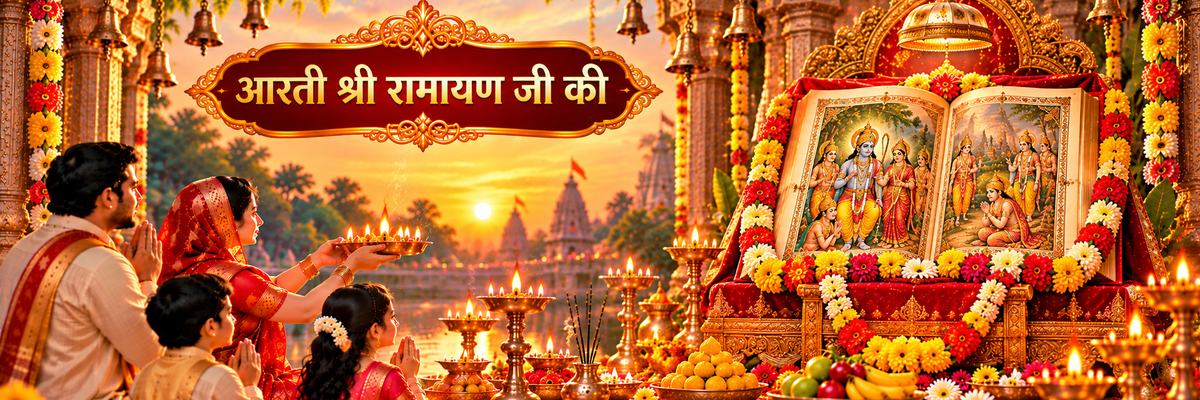
Hindu worship has aartis for gods, goddesses, rivers and plants. This one is for a text. Its refrain says it plainly: aarti Shri Ramayan ji ki, kirati kalit lalit Siy pi ki, "the aarti of the revered Ramayana, graceful with the fame of Sita's beloved." In North Indian homes and temples the Ramayana means above all Goswami Tulsidas's Ramcharitmanas (1574 onward), and the book itself is treated as a living presence. It is wrapped in cloth, placed on a stand, offered flowers and incense, and, when a reading is complete, honoured with its own aarti.
Who sings the Ramayana
The first and third stanzas list everyone who has sung or told Rama's story:
- Brahma and the other gods, the sage Narada, and Valmiki, "expert in knowledge", the first poet, who wrote the Sanskrit Ramayana.
- Shuka, the four Sanaka brothers, Shesha the serpent, and Sharada (Saraswati), all of whom describe the fine fame of Pavansut, Hanuman.
- Shambhu and Bhavani, who sing it constantly. In the Manas, Shiva tells the whole story to Parvati.
- Ghatsambhav, "born of a pot", the sage Agastya, and Vyasa and other great poets.
- Kakbhushundi, the crow-sage, telling it to Garuda. This is another of the Manas's narrators, whose dialogue fills much of its last book.
Anyone who knows the Manas will recognise its structure. Tulsidas presents the poem as a chain of tellings, Shiva to Parvati, Kakbhushundi to Garuda, Yajnavalkya to Bharadwaja, and finally Tulsi to us. The aarti honours the whole chain.
The essence of all scripture
The second stanza makes the book's claim: the Vedas and the eighteen Puranas sing it, it holds the essence (ras) of the six schools of philosophy and of every book, it is the wealth of the sages and the whole treasure of the saints, and its essential teaching has the agreement of all. This is not a rival claim against other scriptures. It is the Manas tradition's view that Rama's name and story gather all of them into one.
The last stanza: Tulsi's voice
The final verse uses images Tulsidas himself liked. The Ramayana washes away the grime of the Kali age and makes the taste of sense-pleasure seem flat. It is the jewellery that adorns the maiden called Liberation. It is the nectar-root that cures the disease of worldly existence. And then the line in which the composer seems to step forward: taat maatu sab bidhi Tulsi ki, "Tulsi's father and mother in every way." Tulsidas, said to have been abandoned as a child, called Rama's story his only parent. Whether he wrote this aarti or a later devotee wrote it in his voice, the line is why it is sung as Tulsidas's own.
When it is sung
It closes almost every reading of the Ramcharitmanas: the twenty-four-hour Akhand Ramayan path, the nine-day Navahna parayan in Navratri, the month-long Masparayan, and the weekly Sundarkand path on Tuesdays and Saturdays. It is also sung on Ram Navami, often followed by Hanuman's aarti, and at the end of Ramlila performances. Families who keep a Manas at home sing it when they close the book after the day's reading.
Spotted a mistake?
If you find any grammatical, Hindi, English, mantra-text or other mistake on this page, tell us — we will correct it within 24 hours.