Original text
अधरं मधुरं वदनं मधुरं नयनं मधुरं हसितं मधुरम् । हृदयं मधुरं गमनं मधुरं मधुराधिपतेरखिलं मधुरम् ॥ १ ॥ वचनं मधुरं चरितं मधुरं वसनं मधुरं वलितं मधुरम् । चलितं मधुरं भ्रमितं मधुरं मधुराधिपतेरखिलं मधुरम् ॥ २ ॥ वेणुर्मधुरो रेणुर्मधुरः पाणिर्मधुरः पादौ मधुरौ । नृत्यं मधुरं सख्यं मधुरं मधुराधिपतेरखिलं मधुरम् ॥ ३ ॥ गीतं मधुरं पीतं मधुरं भुक्तं मधुरं सुप्तं मधुरम् । रूपं मधुरं तिलकं मधुरं मधुराधिपतेरखिलं मधुरम् ॥ ४ ॥ करणं मधुरं तरणं मधुरं हरणं मधुरं रमणं मधुरम् । वमितं मधुरं शमितं मधुरं मधुराधिपतेरखिलं मधुरम् ॥ ५ ॥ गुञ्जा मधुरा माला मधुरा यमुना मधुरा वीची मधुरा । सलिलं मधुरं कमलं मधुरं मधुराधिपतेरखिलं मधुरम् ॥ ६ ॥ गोपी मधुरा लीला मधुरा युक्तं मधुरं मुक्तं मधुरम् । दृष्टं मधुरं शिष्टं मधुरं मधुराधिपतेरखिलं मधुरम् ॥ ७ ॥ गोपा मधुरा गावो मधुरा यष्टिर्मधुरा सृष्टिर्मधुरा । दलितं मधुरं फलितं मधुरं मधुराधिपतेरखिलं मधुरम् ॥ ८ ॥
Transliteration
Adharam madhuram vadanam madhuram nayanam madhuram hasitam madhuram Hridayam madhuram gamanam madhuram madhuradhipaterakhilam madhuram ||1|| Vachanam madhuram charitam madhuram vasanam madhuram valitam madhuram Chalitam madhuram bhramitam madhuram madhuradhipaterakhilam madhuram ||2|| Venurmadhuro renurmadhurah panirmadhurah padau madhurau Nrityam madhuram sakhyam madhuram madhuradhipaterakhilam madhuram ||3|| Gitam madhuram pitam madhuram bhuktam madhuram suptam madhuram Rupam madhuram tilakam madhuram madhuradhipaterakhilam madhuram ||4|| Karanam madhuram taranam madhuram haranam madhuram ramanam madhuram Vamitam madhuram shamitam madhuram madhuradhipaterakhilam madhuram ||5|| Gunja madhura mala madhura yamuna madhura vichi madhura Salilam madhuram kamalam madhuram madhuradhipaterakhilam madhuram ||6|| Gopi madhura lila madhura yuktam madhuram muktam madhuram Drishtam madhuram shishtam madhuram madhuradhipaterakhilam madhuram ||7|| Gopa madhura gavo madhura yashtirmadhura srishtirmadhura Dalitam madhuram phalitam madhuram madhuradhipaterakhilam madhuram ||8||
A poem made of one word
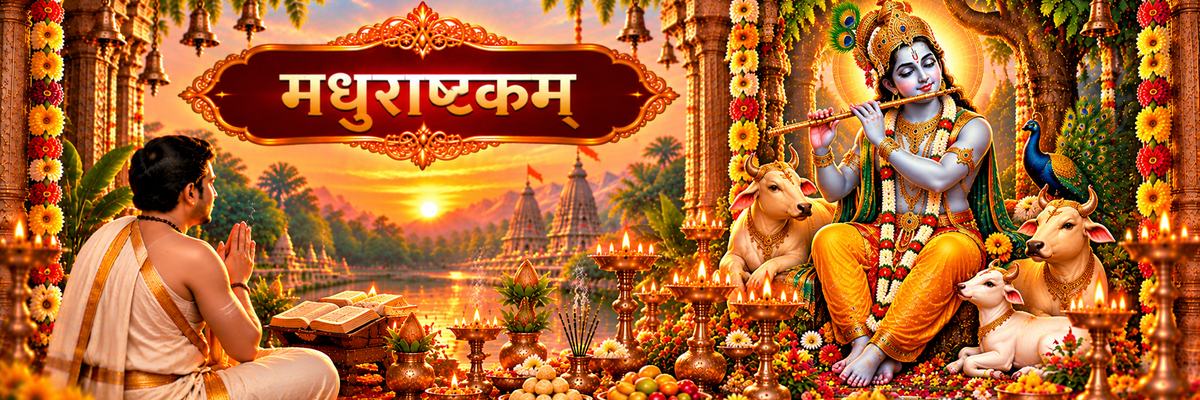
Madhurashtakam is built almost entirely on a single word. Line after line names something about Krishna and calls it madhuram, sweet, and every verse closes with the same refrain: madhuradhipater akhilam madhuram, "everything about the Lord of sweetness is sweet". The refrain carries a quiet double meaning: Madhura is also an old Sanskrit name for Mathura, so Madhuradhipati can be heard as the Lord of Mathura too.
It was composed by Shri Vallabhacharya (1479–1531), founder of the Pushti Marga, the "path of grace", whose followers worship Krishna above all as the child and young cowherd of Braj, in the form of Shrinathji at Nathdwara. Madhurashtakam is that devotion in miniature: no philosophy, no petition, just delight.
What is sweet
The list moves outward from Krishna's body to his whole world:
- His person (verses 1–2): lips, face, eyes, smile, heart, gait, words, deeds, clothes, the graceful bend of his body (valitam), his movements and his wandering.
- His play (3–5): his flute, and the dust (renu) raised as he walks home with the cows, his hands, his feet, his dance, his friendship, his songs, how he eats and sleeps, his form, his tilak, what he does, how he "steals" (haranam, both butter and hearts) and how he plays.
- His world (6–8): the gunja-berry necklace, the garland, the Yamuna and its ripples, its water and lotuses, the gopis, the lila, the cowherd boys, the cows, his herding stick, and finally all of creation (srishtir madhura).
Some words carry two readings. Pitam in verse 4 can mean "what he drinks" or his famous "yellow" garment. That openness is part of the poem's charm: whichever way you hear it, it is sweet.
Why it is so loved
Madhurashtakam is easy to learn: the vocabulary is simple and the rhythm is regular, so even children who know no Sanskrit pick it up quickly. Musically it lends itself to everything from a lullaby tempo to a fast kirtan, and countless recordings exist. Theologically it says something very Braj: Krishna is not to be feared, petitioned or analysed, only enjoyed. Even the things that touch him become sweet: the dust, the stick, the cows, the river.
When it is sung
It is sung on Janmashtami and during Krishna's daily worship in Pushti Marga homes and havelis, at Radhashtami, in the month of Kartik, and as a simple evening song before a small Krishna or Laddu Gopal shrine. Many people sing it while offering bhog, since so many of its sweet things are about food, feeding and play. There is no phala verse asking for anything in return, which suits a hymn written purely for the pleasure of praising him.
Spotted a mistake?
If you find any grammatical, Hindi, English, mantra-text or other mistake on this page, tell us — we will correct it within 24 hours.