
Original text
श्रीमत्पयोनिधिनिकेतन चक्रपाणे भोगीन्द्रभोगमणिरञ्जितपुण्यमूर्ते । योगीश शाश्वत शरण्य भवाब्धिपोत लक्ष्मीनृसिंह मम देहि करावलम्बम् ॥१॥ ब्रह्मेन्द्ररुद्रमरुदर्ककिरीटकोटि- सङ्घट्टिताङ्घ्रिकमलामलकान्तिकान्त । लक्ष्मीलसत्कुचसरोरुहराजहंस लक्ष्मीनृसिंह मम देहि करावलम्बम् ॥२॥ संसारघोरगहने चरतो मुरारे मारोग्रभीकरमृगप्रवरार्दितस्य । आर्तस्य मत्सरनिदाघनिपीडितस्य लक्ष्मीनृसिंह मम देहि करावलम्बम् ॥३॥ संसारकूपमतिघोरमगाधमूलं सम्प्राप्य दुःखशतसर्पसमाकुलस्य । दीनस्य देव कृपणापदमागतस्य लक्ष्मीनृसिंह मम देहि करावलम्बम् ॥४॥ संसारसागरविशालकरालकाल- नक्रग्रहग्रसननिग्रहविग्रहस्य । व्यग्रस्य रागरसनोर्मिनिपीडितस्य लक्ष्मीनृसिंह मम देहि करावलम्बम् ॥५॥ संसारवृक्षमघबीजमनन्तकर्म- शाखाशतं करणपत्रमनङ्गपुष्पम् । आरुह्य दुःखफलितं पततो दयालो लक्ष्मीनृसिंह मम देहि करावलम्बम् ॥६॥ संसारसर्पघनवक्त्रभयोग्रतीव्र- दंष्ट्राकरालविषदग्धविनष्टमूर्तेः । नागारिवाहन सुधाब्धिनिवास शौरे लक्ष्मीनृसिंह मम देहि करावलम्बम् ॥७॥ संसारदावदहनातुरभीकरोरु- ज्वालावलीभिरतिदग्धतनूरुहस्य । त्वत्पादपद्मसरसीशरणागतस्य लक्ष्मीनृसिंह मम देहि करावलम्बम् ॥८॥ संसारजालपतितस्य जगन्निवास सर्वेन्द्रियार्तवडिशार्थझषोपमस्य । प्रोत्खण्डितप्रचुरतालुकमस्तकस्य लक्ष्मीनृसिंह मम देहि करावलम्बम् ॥९॥ संसारभीकरकरीन्द्रकराभिघात- निष्पिष्टमर्मवपुषः सकलार्तिनाश । प्राणप्रयाणभवभीतिसमाकुलस्य लक्ष्मीनृसिंह मम देहि करावलम्बम् ॥१०॥ अन्धस्य मे हृतविवेकमहाधनस्य चोरैः प्रभो बलिभिरिन्द्रियनामधेयैः । मोहान्धकूपकुहरे विनिपातितस्य लक्ष्मीनृसिंह मम देहि करावलम्बम् ॥११॥ लक्ष्मीपते कमलनाभ सुरेश विष्णो वैकुण्ठ कृष्ण मधुसूदन पुष्कराक्ष । ब्रह्मण्य केशव जनार्दन वासुदेव देवेश देहि कृपणस्य करावलम्बम् ॥१२॥ यन्माययोर्जितवपुःप्रचुरप्रवाह- मग्नार्थमत्र निवहोरुकरावलम्बम् । लक्ष्मीनृसिंहचरणाब्जमधुव्रतेन स्तोत्रं कृतं सुखकरं भुवि शङ्करेण ॥१३॥
Transliteration
Shrimatpayonidhiniketana chakrapane bhogindrabhogamaniranjitapunyamurte yogisha shashvata sharanya bhavabdhipota lakshminrisimha mama dehi karavalambam (1) Brahmendrarudramarudarkakiritakoti- sanghattitanghrikamalamalakantikanta lakshmilasatkuchasaroruharajahamsa lakshminrisimha mama dehi karavalambam (2) Samsaraghoragahane charato murare marograbhikaramrigapravararditasya artasya matsaranidaghanipiditasya lakshminrisimha mama dehi karavalambam (3) Samsarakupamatighoramagadhamulam samprapya duhkhashatasarpasamakulasya dinasya deva kripanapadamagatasya lakshminrisimha mama dehi karavalambam (4) Samsarasagaravishalakaralakala- nakragrahagrasananigrahavigrahasya vyagrasya ragarasanorminipiditasya lakshminrisimha mama dehi karavalambam (5) Samsaravrikshamaghabijamanantakarma- shakhashatam karanapatramanangapushpam aruhya duhkhaphalitam patato dayalo lakshminrisimha mama dehi karavalambam (6) Samsarasarpaghanavaktrabhayogratiivra- damshtrakaralavishadagdhavinashtamurteh nagarivahana sudhabdhinivasa shaure lakshminrisimha mama dehi karavalambam (7) Samsaradavadahanaturabhikaroru- jvalavalibhiratidagdhatanuruhasya tvatpadapadmasarasisharanagatasya lakshminrisimha mama dehi karavalambam (8) Samsarajalapatitasya jagannivasa sarvendriyartavadisharthajhashopamasya protkhanditaprachuratalukamastakasya lakshminrisimha mama dehi karavalambam (9) Samsarabhikarakarindrakarabhighata- nishpishtamarmavapushah sakalartinasha pranaprayanabhavabhitisamakulasya lakshminrisimha mama dehi karavalambam (10) Andhasya me hritavivekamahadhanasya chauraih prabho balibhirindriyanamadheyaih mohandhakupakuhare vinipatitasya lakshminrisimha mama dehi karavalambam (11) Lakshmipate kamalanabha suresha vishno vaikuntha krishna madhusudana pushkaraksha brahmanya keshava janardana vasudeva devesha dehi kripanasya karavalambam (12) Yanmayayorjitavapuhprachurapravaha- magnarthamatra nivahorukaravalambam lakshminrisimhacharanabjamadhuvratena stotram kritam sukhakaram bhuvi shankarena (13)
"Give me your hand"
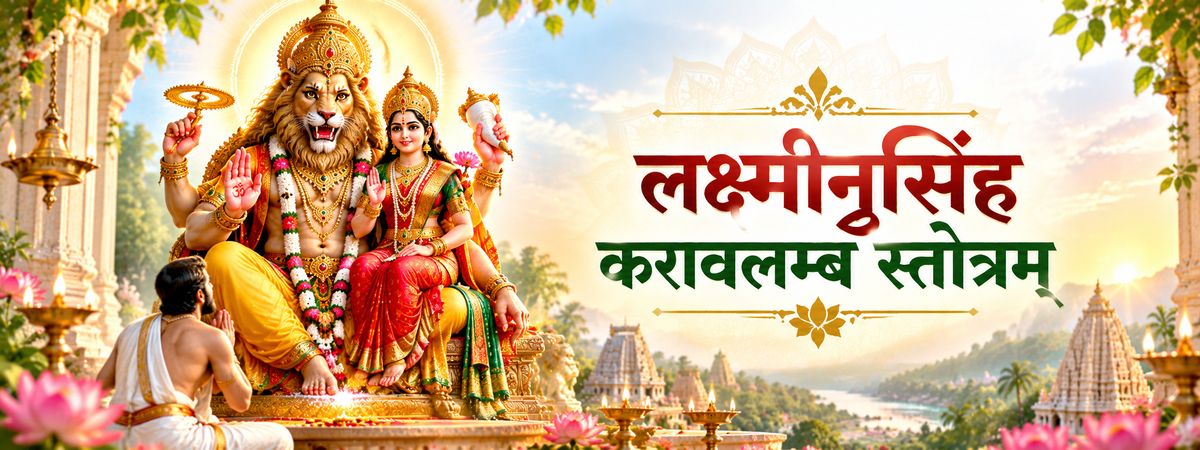
Karavalamba means the support of a hand, the hand you hold out to someone who is falling or drowning. Every verse of this stotra ends with Lakshmi-Nrisimha mama dehi karavalambam, "Lakshmi-Narasimha, give me your hand." It is one of the most direct and emotional hymns in the Sanskrit devotional tradition: no philosophy, no request for wealth, just a person in trouble calling out for help. The closing verse says it was made by Shankara, a bee at the lotus feet of Lakshmi-Narasimha, and tradition attributes it to Adi Shankaracharya.
The legend behind it
A well-known story says Shankara composed it in a moment of real danger. In the most common telling, a Kapalika who wanted to sacrifice him was about to strike when Shankara's disciple Padmapada, a devotee of Narasimha, was seized by the Lord's fury and killed the attacker, and Shankara sang this hymn in gratitude and surrender. Other versions place it elsewhere, but all agree it came from a moment when only divine help would do.
Samsara in seven pictures
After two verses praising the Lord who lies on the ocean of milk, on the jewelled hood of the serpent king, with his feet touched by the crowns of Brahma, Indra and Rudra, the stotra turns to samsara, worldly existence, and paints it again and again:
- A dark forest (3), where I wander hunted by the fierce beast of desire, scorched by the summer heat of envy.
- A bottomless well (4), full of a hundred snakes of sorrow.
- A vast ocean (5), where the crocodile of time seizes me and the waves of attachment toss me.
- A tree (6), whose seed is sin, whose branches are endless karma, whose leaves are the senses and whose flowers are desire; I climbed it and its fruit was suffering, and now I am falling.
- A serpent (7), whose poisoned fangs have burned my body, so Narasimha is called as the one who rides Garuda, the enemy of snakes.
- A forest fire (8) that has scorched every hair of my body.
- A fisherman's net (9), where I am like a fish caught on the hook of the senses, and an elephant (10) whose trunk has crushed me.
Verse 11 names the thieves: the senses, strong robbers who have stolen my great wealth of discernment and pushed me, blind, into the well of delusion. Verse 12 drops the imagery altogether and simply piles up names, Lakshmipati, Kamalanabha, Vishnu, Vaikuntha, Krishna, Madhusudana, Keshava, Janardana, Vasudeva, asking the Lord of gods to give his hand to a helpless man.
When to recite it
It is recited on Narasimha Jayanti (Vaishakha Shukla Chaturdashi), on Saturdays and at dusk, the hour of his appearance, and especially in times of fear, illness, debt or legal trouble. Many recite it daily during a hard period of life. Pair it with the Ugram Viram mantra and the aarti Om Jai Narsingh Hare.
A note on the text
This stotra survives in several versions of different lengths; some editions have more verses, and a few lines vary. The thirteen-verse text given here follows the source it was checked against, ending with Shankara's signature verse.
Frequently asked questions
Who wrote the Karavalamba Stotram?
It is attributed to Adi Shankaracharya, and the final verse names Shankara as its author. Some scholars think a later Shankaracharya of the same lineage may have composed it, but it is universally known as Shankara's.
What does "karavalambam" mean?
The support of a hand: kara is hand and avalamba is support. The refrain asks the Lord to hold out his hand.
Why is it addressed to Lakshmi-Narasimha and not Ugra Narasimha?
The hymn is a plea for mercy, so it calls on the calm form with Lakshmi on his lap, the Narasimha who has been pacified and is ready to rescue.
When is the best time to recite it?
At sunset, on Saturdays and on Narasimha Jayanti. In a crisis, any time you can sit quietly for ten minutes is right.
Can it be recited for protection from enemies or illness?
Yes, that is how many people use it, though the hymn itself asks mainly for rescue from samsara: from desire, envy, fear and the pull of the senses.
Why do different books have different numbers of verses?
The text was handed down in many lines of transmission and gathered extra verses along the way. The core verses with the "karavalambam" refrain are common to all versions.
Spotted a mistake?
If you find any grammatical, Hindi, English, mantra-text or other mistake on this page, tell us — we will correct it within 24 hours.