
Bhagwan Narasimha
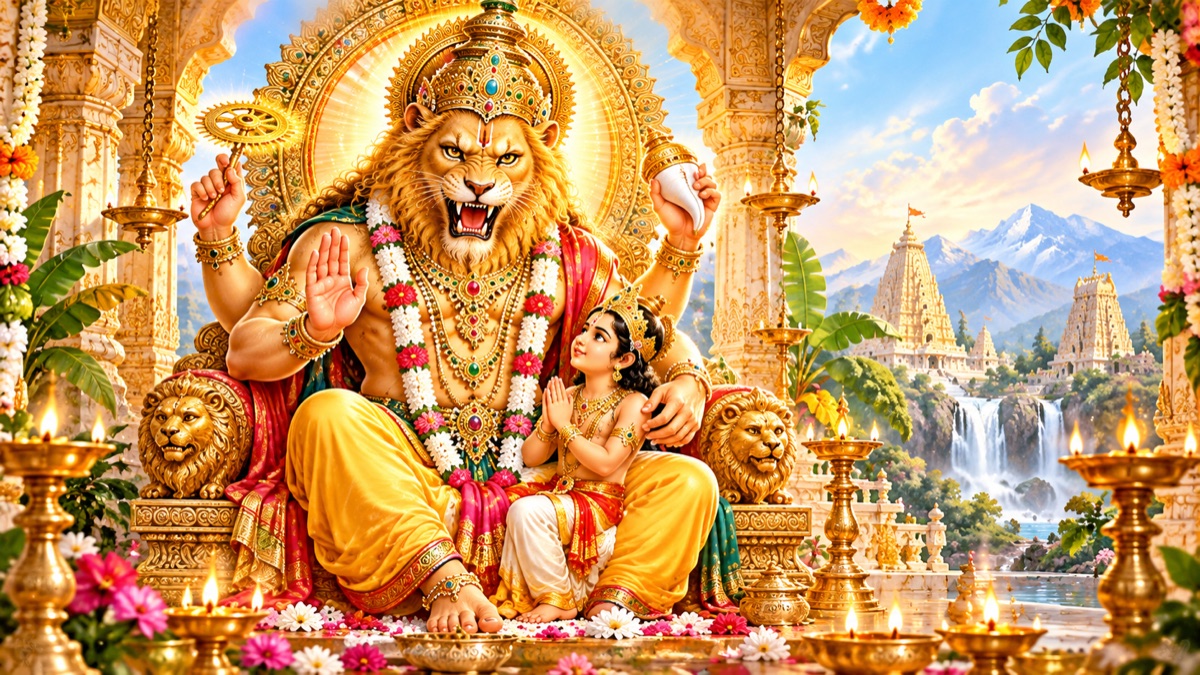
Vishnu's fourth avatar, half man and half lion, who burst from a pillar at dusk to save the child Prahlad: the protector who answers when every door is shut.
The avatar that slips through a loophole
Narasimha (nara, man; simha, lion) is the fourth of Vishnu's ten avatars, and his story is built like a riddle. The demon king Hiranyakashipu, whose brother Hiranyaksha had been killed by Vishnu as Varaha, did fierce tapasya and won a boon from Brahma that seemed to make him unkillable. He could not be killed by man or beast, by day or by night, inside a house or outside it, on the ground or in the sky, by any weapon, by anything living or lifeless. Then he set out to wipe out the worship of Vishnu.
Prahlad and the pillar
His own son Prahlad refused. The boy kept chanting Vishnu's name through every attempt to kill him: thrown from a cliff, trampled by elephants, poisoned, and burned in the lap of his aunt Holika, who was protected by a boon and burned instead (the story behind Holika Dahan). At last the king pointed to a pillar of his hall and asked whether Prahlad's Vishnu was in that too. When Prahlad said yes, he struck it, and Vishnu burst out as Narasimha. Every condition of the boon was answered. He was neither man nor beast. It was twilight, neither day nor night. He dragged the king to the threshold, neither inside nor out, laid him across his lap, neither ground nor sky, and tore him apart with his claws, which are not weapons. Our Prahlad story tells the full account.
Fierce form, gentle form
His anger was so great afterwards that even the gods were afraid to approach him. It was the child Prahlad who calmed him with a hymn, and Lakshmi who sat on his lap. That is why he is worshipped in two moods. Ugra Narasimha is the fierce form, with a lion's face, wild mane and the demon across his knees, prayed to for protection from danger, enemies and fear; the mantra Ugram Viram Mahavishnum addresses him this way. Lakshmi-Narasimha is the peaceful form with the goddess on his left knee, prayed to for grace and refuge, and it is this form that Adi Shankaracharya's Karavalamba Stotram addresses.
Where he is worshipped
Narasimha is especially dear to South India and to Vaishnava traditions everywhere. Ahobilam in Andhra Pradesh, in the Nallamala hills, has nine Narasimha shrines and is held to be where the avatar appeared. Simhachalam near Visakhapatnam worships Varaha-Narasimha covered in sandalwood paste, which is removed for a single day, Chandanotsavam on Akshaya Tritiya. Yadadri (Yadagirigutta) in Telangana and Mangalagiri, where the deity is offered jaggery water (panakam), are other great shrines. In ISKCON temples his prayers are sung every day for protection.
Narasimha Jayanti
His appearance day is Vaishakha Shukla Chaturdashi, the date the opening doha of the Narasimha Chalisa itself gives. Devotees fast through the day and worship him at sandhya, the twilight hour of his appearance, then break the fast the next morning. Many also remember him on Saturdays and in times of danger or illness. At home, a lamp, panakam or jaggery, tulsi, and his chalisa and aarti Om Jai Narsingh Hare make a full puja.
Mantra
Stotra
Chalisa
Aarti
Puja Vidhi
Spotted a mistake?
If you find any grammatical, Hindi, English, mantra-text or other mistake on this page, tell us — we will correct it within 24 hours.