
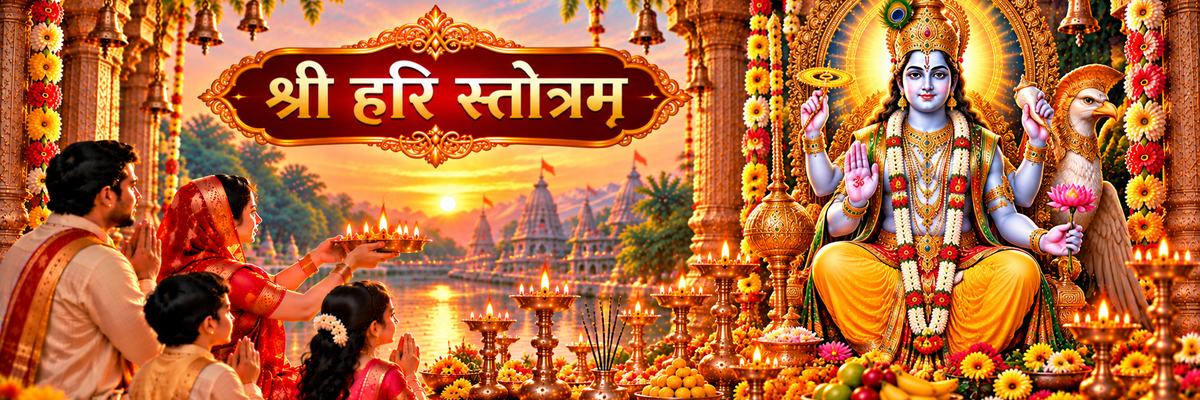
Original text
जगज्जालपालं चलत्कण्ठमालं शरच्चन्द्रभालं महादैत्यकालम् । नभोनीलकायं दुरावारमायं सुपद्मासहायं भजेऽहं भजेऽहम् ॥ १ ॥ सदाम्भोधिवासं गलत्पुष्पहासं जगत्सन्निवासं शतादित्यभासम् । गदाचक्रशस्त्रं लसत्पीतवस्त्रं हसच्चारुवक्त्रं भजेऽहं भजेऽहम् ॥ २ ॥ रमाकण्ठहारं श्रुतिव्रातसारं जलान्तर्विहारं धराभारहारम् । चिदानन्दरूपं मनोज्ञस्वरूपं धृतानेकरूपं भजेऽहं भजेऽहम् ॥ ३ ॥ जराजन्महीनं परानन्दपीनं समाधानलीनं सदैवानवीनम् । जगज्जन्महेतुं सुरानीककेतुं त्रिलोकैकसेतुं भजेऽहं भजेऽहम् ॥ ४ ॥ कृताम्नायगानं खगाधीशयानं विमुक्तेर्निदानं हरारातिमानम् । स्वभक्तानुकूलं जगद्वृक्षमूलं निरस्तार्तशूलं भजेऽहं भजेऽहम् ॥ ५ ॥ समस्तामरेशं द्विरेफाभकेशं जगद्बिम्बलेशं हृदाकाशदेशम् । सदा दिव्यदेहं विमुक्ताखिलेहं सुवैकुण्ठगेहं भजेऽहं भजेऽहम् ॥ ६ ॥ सुरालिबलिष्ठं त्रिलोकीवरिष्ठं गुरूणां गरिष्ठं स्वरूपैकनिष्ठम् । सदा युद्धधीरं महावीरवीरं महाम्भोधितीरं भजेऽहं भजेऽहम् ॥ ७ ॥ रमावामभागं तलानग्रनागं कृताधीनयागं गतारागरागम् । मुनीन्द्रैः सुगीतं सुरैः सम्परीतं गुणौधैरतीतं भजेऽहं भजेऽहम् ॥ ८ ॥ फलश्रुतिः । इदं यस्तु नित्यं समाधाय चित्तं पठेदष्टकं कण्ठहारं मुरारेः । स विष्णोर्विशोकं ध्रुवं याति लोकं जराजन्मशोकं पुनर्विन्दते नो ॥ ९ ॥
Transliteration
Jagajjalapalam chalatkanthamalam Sharachchandrabhalam mahadaityakalam Nabhonilakayam duravaramayam Supadmasahayam bhaje'ham bhaje'ham ||1|| Sadambhodhivasam galatpushpahasam Jagatsannivasam shatadityabhasam Gadachakrashastram lasatpitavastram Hasachcharuvaktram bhaje'ham bhaje'ham ||2|| Ramakanthaharam shrutivratasaram Jalantarviharam dharabharaharam Chidanandarupam manojnasvarupam Dhritanekarupam bhaje'ham bhaje'ham ||3|| Jarajanmahinam paranandapinam Samadhanalinam sadaivanavinam Jagajjanmahetum suranikaketum Trilokaikasetum bhaje'ham bhaje'ham ||4|| Kritamnayaganam khagadhishayanam Vimukternidanam hararatimanam Svabhaktanukulam jagadvrikshamulam Nirastartashulam bhaje'ham bhaje'ham ||5|| Samastamaresham dvirephabhakesham Jagadbimbalesham hridakashadesham Sada divyadeham vimuktakhileham Suvaikunthageham bhaje'ham bhaje'ham ||6|| Suralibalishtham trilokivarishtham Gurunam garishtham svarupaikanishtham Sada yuddhadhiram mahaviraviram Mahambhodhitiram bhaje'ham bhaje'ham ||7|| Ramavamabhagam talanagranagam Kritadhinayagam gataragaragam Munindraih sugitam suraih samparitam Gunaughairatitam bhaje'ham bhaje'ham ||8|| Idam yastu nityam samadhaya chittam Pathedashtakam kanthaharam murareh Sa vishnorvishokam dhruvam yati lokam Jarajanmashokam punarvindate no ||9||
A hymn you can hear the rhythm of
The Shri Hari Stotram, known by its opening word Jagajjalapalam, is credited in its colophon to Swami Brahmananda. It is written in bhujangaprayata, "the serpent's gait", the same swinging metre as Tulsidas's Rudrashtakam: four short-long-long beats to every line. Each verse is four lines of rhyming compound epithets, all ending in -am, and each closes with the doubled refrain bhaje'ham bhaje'ham, "I worship, I worship". That chiming sound is why the hymn has become so popular in recordings and in children's recitation.
A portrait in epithets
There is no story here, only names, one after another, each a small picture of Vishnu:
- Verse 1: guardian of the web of the world (jagaj-jala-palam), with a garland swaying at his throat and a brow like the autumn moon, death to the great demons, sky-blue in body, whose maya cannot be resisted, companion of Lakshmi.
- Verse 2: dwelling always in the ocean, with a smile like falling blossoms, the shelter of the world, bright as a hundred suns, armed with mace and discus, in shining yellow silk, with a lovely laughing face.
- Verse 3: the necklace at Lakshmi's throat (Rama-kantha-haram, a lovely image of her embrace), the essence of all the Vedas, sporting within the waters, removing the burden of the earth, consciousness and bliss, who has taken many forms, a quiet reference to the avatars.
- Verses 4–6: free from old age and birth, full of supreme bliss, absorbed in samadhi, ever new; cause of the world's birth, banner of the gods' army, the one bridge across the three worlds; carried by Garuda, root of the world-tree, remover of the pain of the afflicted; dark-haired like bees, dwelling in the space of the heart, whose home is Vaikuntha.
- Verses 7–8: mightiest among the gods, weightiest of teachers, steadfast in battle; with Lakshmi at his left side, recipient of sacrifices, free from passion, sung by sages, surrounded by gods, beyond all qualities.
A necklace for Murari
The closing verse returns to the image of verse 3. Whoever recites "this octet, a necklace for Murari's throat" (kanthaharam Murareh) every day with a settled mind goes surely to Vishnu's sorrowless world and does not again meet the grief of old age and birth. The poet offers the hymn itself as a garland, the same kind of ornament Vishnu wears in the first verse.
When to recite it
Shri Hari Stotram is recited in daily morning worship of Vishnu or Krishna, especially on Thursdays and Ekadashi, during Kartik and in the Vaishakh month, and before reading the Bhagavad Gita or Vishnu Sahasranama. Its regular rhythm makes it ideal for learning by ear. Many families teach it to children alongside the Achyutashtakam, since together they give a picture of Vishnu as both the cosmic Lord and the beloved of Braj.
Spotted a mistake?
If you find any grammatical, Hindi, English, mantra-text or other mistake on this page, tell us — we will correct it within 24 hours.