
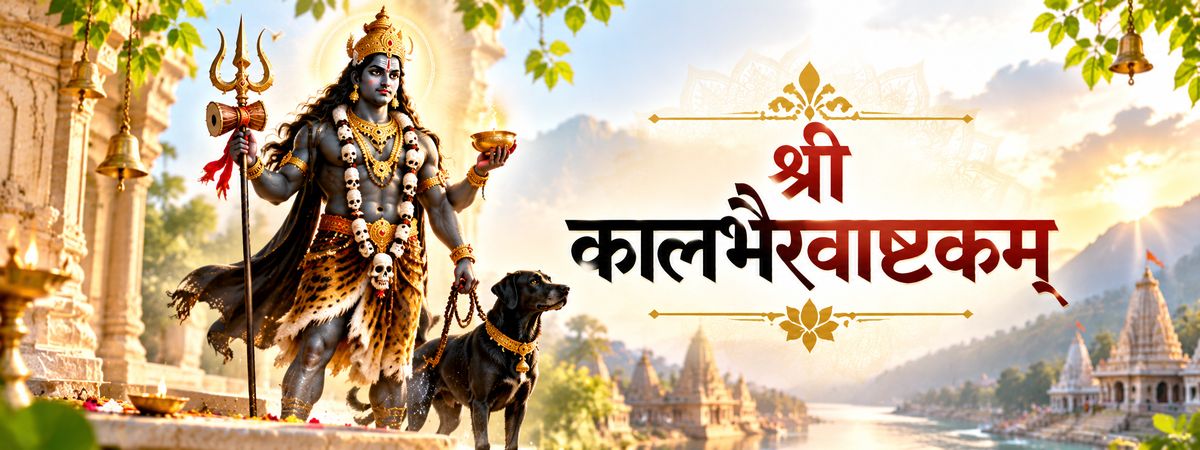
Original text
देवराजसेव्यमानपावनांघ्रिपङ्कजं व्यालयज्ञसूत्रमिन्दुशेखरं कृपाकरम् । नारदादियोगिवृन्दवन्दितं दिगंबरं काशिकापुराधिनाथकालभैरवं भजे ॥१॥ भानुकोटिभास्वरं भवाब्धितारकं परं नीलकण्ठमीप्सितार्थदायकं त्रिलोचनम् । कालकालमंबुजाक्षमक्षशूलमक्षरं काशिकापुराधिनाथकालभैरवं भजे ॥२॥ शूलटङ्कपाशदण्डपाणिमादिकारणं श्यामकायमादिदेवमक्षरं निरामयम् । भीमविक्रमं प्रभुं विचित्रताण्डवप्रियं काशिकापुराधिनाथकालभैरवं भजे ॥३॥ भुक्तिमुक्तिदायकं प्रशस्तचारुविग्रहं भक्तवत्सलं स्थितं समस्तलोकविग्रहम् । विनिक्वणन्मनोज्ञहेमकिङ्किणीलसत्कटिं काशिकापुराधिनाथकालभैरवं भजे ॥४॥ धर्मसेतुपालकं त्वधर्ममार्गनाशकं कर्मपाशमोचकं सुशर्मदायकं विभुम् । स्वर्णवर्णशेषपाशशोभिताङ्गमण्डलं काशिकापुराधिनाथकालभैरवं भजे ॥५॥ रत्नपादुकाप्रभाभिरामपादयुग्मकं नित्यमद्वितीयमिष्टदैवतं निरंजनम् । मृत्युदर्पनाशनं करालदंष्ट्रमोक्षणं काशिकापुराधिनाथकालभैरवं भजे ॥६॥ अट्टहासभिन्नपद्मजाण्डकोशसंततिं दृष्टिपातनष्टपापजालमुग्रशासनम् । अष्टसिद्धिदायकं कपालमालिकाधरं काशिकापुराधिनाथकालभैरवं भजे ॥७॥ भूतसंघनायकं विशालकीर्तिदायकं काशिवासलोकपुण्यपापशोधकं विभुम् । नीतिमार्गकोविदं पुरातनं जगत्पतिं काशिकापुराधिनाथकालभैरवं भजे ॥८॥ ॥ फलश्रुति ॥ कालभैरवाष्टकं पठंति ये मनोहरं ज्ञानमुक्तिसाधनं विचित्रपुण्यवर्धनम् । शोकमोहदैन्यलोभकोपतापनाशनं ते प्रयान्ति कालभैरवांघ्रिसन्निधिं ध्रुवम् ॥९॥ ॥ इति श्रीमच्छङ्कराचार्यविरचितं श्रीकालभैरवाष्टकं सम्पूर्णम् ॥
Transliteration
Devarajasevyamanapavananghripankajam vyalayajnasutramindushekharam kripakaram naradadiyogivrindavanditam digambaram kashikapuradhinathakalabhairavam bhaje (1) Bhanukotibhasvaram bhavabdhitarakam param nilakanthamipsitarthadayakam trilochanam kalakalamambujakshamakshashulamaksharam kashikapuradhinathakalabhairavam bhaje (2) Shulatankapashadandapanimadikaranam shyamakayamadidevamaksharam niramayam bhimavikramam prabhum vichitratandavapriyam kashikapuradhinathakalabhairavam bhaje (3) Bhuktimuktidayakam prashastacharuvigraham bhaktavatsalam sthitam samastalokavigraham vinikvananmanojnahemakinkinilasatkatim kashikapuradhinathakalabhairavam bhaje (4) Dharmasetupalakam tvadharmamarganashakam karmapashamochakam susharmadayakam vibhum svarnavarnasheshapashashobhitangamandalam kashikapuradhinathakalabhairavam bhaje (5) Ratnapadukaprabhabhiramapadayugmakam nityamadvitiyamishtadaivatam niranjanam mrityudarpanashanam karaladamshtramokshanam kashikapuradhinathakalabhairavam bhaje (6) Attahasabhinnapadmajandakoshasantatim drishtipatanashtapapajalamugrashasanam ashtasiddhidayakam kapalamalikadharam kashikapuradhinathakalabhairavam bhaje (7) Bhutasanghanayakam vishalakirtidayakam kashivasalokapunyapapashodhakam vibhum nitimargakovidam puratanam jagatpatim kashikapuradhinathakalabhairavam bhaje (8) Phalashruti: Kalabhairavashtakam pathanti ye manoharam jnanamuktisadhanam vichitrapunyavardhanam shokamohadainyalobhakopatapanashanam te prayanti kalabhairavanghrisannidhim dhruvam (9)
A hymn for the guardian of Kashi
Every verse of this ashtakam ends with the same line: Kashika-puradhinatha Kalabhairavam bhaje, "I worship Kalabhairava, the lord of the city of Kashi." That refrain places the hymn exactly. In Varanasi, Shiva is Vishwanath, the lord of the universe, but it is Kaal Bhairav, his fierce form, who is the city's Kotwal, its guardian, keeping watch over who lives there and settling their karma. The stotra is attributed to Adi Shankaracharya, and it is one of the most widely chanted of his hymns. Its quick, marching metre suits the god it praises.
Who the verses describe
The eight verses build up a full picture of Bhairav. He is gentle and terrifying at once:
- Worshipped by the gods (1). Indra serves his lotus feet; he wears a snake as his sacred thread and the moon on his head; Narada and the yogis bow to him; he is digambara, clothed only by the directions.
- Shiva himself (2). Bright as ten million suns, blue-throated, three-eyed, the one who carries us across the ocean of samsara, and kala-kala, the death of Death.
- Armed and dancing (3). Holding trident, axe, noose and staff, dark-bodied, of terrible valour, fond of the wild tandava dance.
- Kind to devotees (4). Giver of both worldly enjoyment and liberation (bhukti-mukti), with golden bells chiming at his waist.
- The keeper of dharma (5). Protector of the bridge of dharma, destroyer of the paths of adharma, and karma-pasha-mochaka, the one who frees us from the noose of karma.
- The breaker of death's pride (6). His feet shine with jewelled sandals; he destroys mrityu-darpa, the arrogance of death.
- Fierce in judgement (7). His laugh shatters the cosmic egg; one glance of his destroys a net of sins; he wears a garland of skulls and grants the eight siddhis.
- The judge of Kashi (8). Leader of the bhutas, purifier of the merits and sins of all who live in Kashi, wise in the ways of right conduct.
What the phalashruti promises
The ninth verse says that those who read this lovely ashtakam, which leads to knowledge and liberation and increases merit, are freed from grief, delusion, poverty, greed, anger and suffering, and surely reach the presence of Kalabhairava's feet. It is a hymn for overcoming fear, especially the fear of death, which is what "Kaal" Bhairav, lord of time, stands for.
When to recite it
Its special days are Kalashtami, the Ashtami of every waning moon, and Kaal Bhairav Jayanti, the Kalashtami of Margashirsha. Many also recite it on Sundays and Tuesdays, at night, in front of a mustard-oil lamp. Pilgrims to Varanasi often recite it at the Kaal Bhairav temple before their darshan of Vishwanath. Follow it with the Bhairav Chalisa and the Bhairav Aarti, and feed a dog afterwards if you can. Versions differ very slightly in a few words; the text here follows the source it was checked against.
Frequently asked questions
Who wrote the Kalabhairava Ashtakam?
It is attributed to Adi Shankaracharya, and its colophon names him. It is said to have been composed in Kashi, which fits its refrain.
Is it safe to recite at home?
Yes. Although Bhairav is a fierce deity, this ashtakam is a devotional hymn of praise, not a tantric mantra, and needs no initiation.
What is the best time to recite it?
At night on Kalashtami or Kaal Bhairav Jayanti is traditional, but morning or evening recitation on any day is fine.
How many times should I recite it?
Once a day is enough. On Kalashtami some recite it eight or eleven times, or every day for forty days during a difficult period.
Does it help with fear and negativity?
That is its traditional purpose. The phalashruti speaks of freedom from grief, delusion and anger, and Bhairav as lord of time is prayed to for freedom from the fear of death.
Can women recite it?
Yes. There is no restriction on who may recite it.
Spotted a mistake?
If you find any grammatical, Hindi, English, mantra-text or other mistake on this page, tell us — we will correct it within 24 hours.