
Original text
॥ श्री भैरव देव जी आरती ॥ जय भैरव देवा, प्रभु जय भैरव देवा । जय काली और गौरा देवी कृत सेवा ॥ ॥ जय भैरव देवा...॥ तुम्ही पाप उद्धारक दुःख सिन्धु तारक । भक्तों के सुख कारक भीषण वपु धारक ॥ ॥ जय भैरव देवा...॥ वाहन श्वान विराजत कर त्रिशूल धारी । महिमा अमित तुम्हारी जय जय भयहारी ॥ ॥ जय भैरव देवा...॥ तुम बिन देवा सेवा सफल नहीं होवे । चौमुख दीपक दर्शन सबका दुःख खोवे ॥ ॥ जय भैरव देवा...॥ तेल चटकि दधि मिश्रित भाषावलि तेरी । कृपा करिये भैरव, करिये नहीं देरी ॥ ॥ जय भैरव देवा...॥ पाँव घुँघरू बाजत अरु डमरू डमकावत । बटुकनाथ बन बालकजन मन हरषावत ॥ ॥ जय भैरव देवा...॥ बटुकनाथ जी की आरती जो कोई नर गावे । कहे धरणीधर नर मनवांछित फल पावे ॥ ॥ जय भैरव देवा...॥
Transliteration
Jai Bhairav Deva, Prabhu Jai Bhairav Deva Jai Kali aur Gaura Devi krit seva Tumhi pap uddharak dukh sindhu tarak Bhakton ke sukh karak bhishan vapu dharak Vahan shvan virajat kar trishul dhari Mahima amit tumhari jai jai bhayhari Tum bin Deva seva safal nahin hove Chaumukh deepak darshan sabka dukh khove Tel chataki dadhi mishrit bhashavali teri Kripa kariye Bhairav, kariye nahin deri Paanv ghunghroo bajat aru damroo damkavat Batuknath ban balakjan man harshavat Batuknath ji ki aarti jo koi nar gave Kahe Dharanidhar nar manvanchhit phal pave
An aarti for the guardian
This is the aarti most commonly sung to Bhairav in North India, at his temples in Varanasi and Delhi, at the Bhairon Nath shrine on the Vaishno Devi route, and in homes on Kalashtami. It is short and full of concrete images, and it shows the two sides of Bhairav in one song: the fearsome guardian and the playful child, Batuk Nath. The final verse names its poet as Dharanidhar.
What it says
- Served by the goddesses. The opening line hails Bhairav as the one whom Kali and Gaura (Gauri) serve. It reflects his place beside the goddess at every Shakti Peetha, where he guards her shrine.
- Rescuer and terror. He lifts people out of sin, carries them across the ocean of sorrow, gives happiness to devotees, and wears a terrifying body (bhishan vapu). The two belong together: his fierceness is aimed at what harms his devotees.
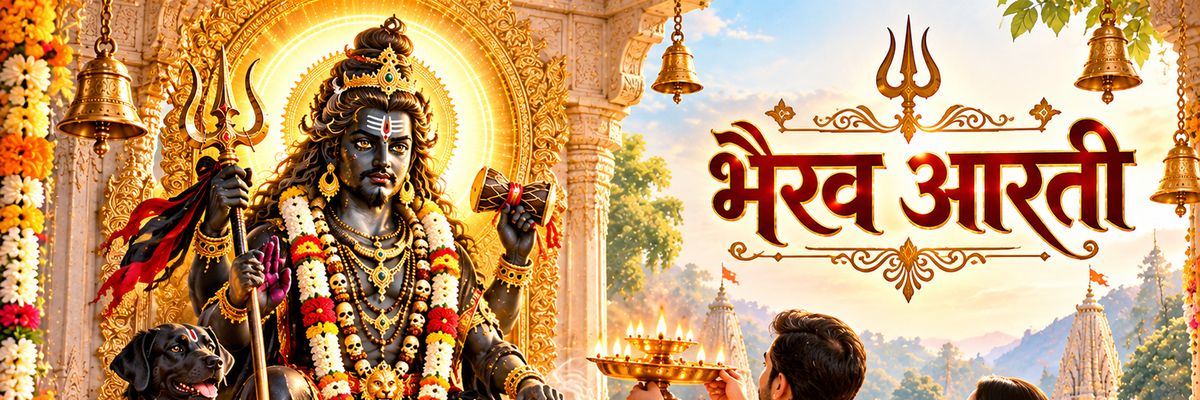
- His dog and trident. Vahan shvan virajat, he rides a dog, and holds a trident in his hand. He is bhayhari, the remover of fear.
- No worship without him. "Without you, Deva, no service bears fruit." Many temples have the custom of visiting Bhairav before or after the main deity so that the pilgrimage is complete, and this line expresses it. The darshan of the chaumukh deepak, the four-wicked lamp lit for him, is said to remove everyone's sorrow.
- His offerings. Oil, and things mixed with curd, are named as his offerings, with a plea: be kind, Bhairav, and do not delay.
- Batuk Nath. The last verses turn to his child form: anklets ringing on his feet and the damru sounding, he becomes Batuk Nath and delights the hearts of children.
How and when to sing it
Sing it at the close of Bhairav puja, after the Bhairav Chalisa or the Kalabhairava Ashtakam. Light a mustard-oil lamp, ideally with four wicks as the aarti itself mentions, and wave it in circles before his image. The usual days are Kalashtami each month, Kaal Bhairav Jayanti in Margashirsha, and Sundays and Tuesdays. Afterwards, offer the prasad (imarti, jalebi, sweet rotis or urad pakoras are common) and give some to a dog.
Frequently asked questions
Who wrote the Bhairav aarti?
The last verse names the poet as Dharanidhar ("kahe Dharanidhar"). Nothing more is reliably known about him.
Is it for Kaal Bhairav or Batuk Bhairav?
Both. It opens with the fierce guardian and closes by calling itself "Batuknath ji ki aarti", so it is sung for either form.
Which lamp should be used?
A mustard-oil lamp is traditional for Bhairav. The aarti itself mentions the four-wicked (chaumukh) lamp.
When is the best day to sing it?
Kalashtami (the Ashtami of the waning moon) and Kaal Bhairav Jayanti. Sundays and Tuesdays are also common.
Can I sing it at home?
Yes. It is a simple devotional aarti and needs no special preparation beyond a lamp and a clean place.
Why is feeding a dog linked to Bhairav's worship?
The dog is his vahana, as the aarti says. Feeding a dog after his puja is treated as feeding Bhairav's own companion.
Spotted a mistake?
If you find any grammatical, Hindi, English, mantra-text or other mistake on this page, tell us — we will correct it within 24 hours.