
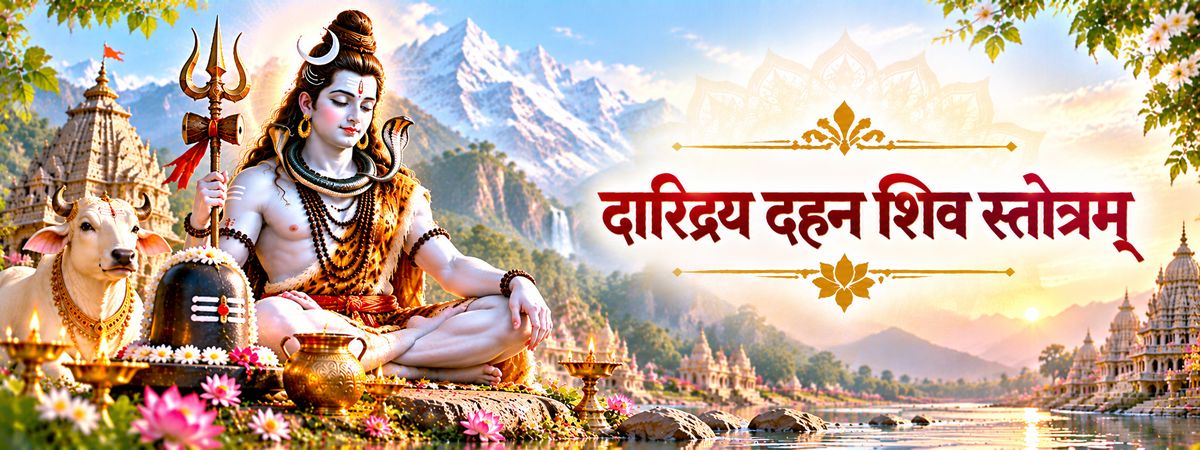
Original text
विश्वेश्वराय नरकार्णव तारणाय कर्णामृताय शशिशेखरधारणाय । कर्पूरकान्तिधवलाय जटाधराय दारिद्र्य दुःखदहनाय नमः शिवाय ॥१॥ गौरीप्रियाय रजनीशकलाधराय कालान्तकाय भुजगाधिपकङ्कणाय । गंगाधराय गजराजविमर्दनाय दारिद्र्य दुःखदहनाय नमः शिवाय ॥२॥ भक्तिप्रियाय भवरोगभयापहाय उग्राय दुर्गभवसागरतारणाय । ज्योतिर्मयाय गुणनामसुनृत्यकाय दारिद्र्य दुःखदहनाय नमः शिवाय ॥३॥ चर्मम्बराय शवभस्मविलेपनाय भालेक्षणाय मणिकुण्डलमण्डिताय । मंझीरपादयुगलाय जटाधराय दारिद्र्य दुःखदहनाय नमः शिवाय ॥४॥ पञ्चाननाय फणिराजविभूषणाय हेमांशुकाय भुवनत्रयमण्डिताय । आनन्दभूमिवरदाय तमोमयाय दारिद्र्य दुःखदहनाय नमः शिवाय ॥५॥ भानुप्रियाय भवसागरतारणाय कालान्तकाय कमलासनपूजिताय । नेत्रत्रयाय शुभलक्षण लक्षिताय दारिद्र्य दुःखदहनाय नमः शिवाय ॥६॥ रामप्रियाय रघुनाथवरप्रदाय नागप्रियाय नरकार्णवतारणाय । पुण्येषु पुण्यभरिताय सुरार्चिताय दारिद्र्य दुःखदहनाय नमः शिवाय ॥७॥ मुक्तेश्वराय फलदाय गणेश्वराय गीतप्रियाय वृषभेश्वरवाहनाय । मातङ्गचर्मवसनाय महेश्वराय दारिद्र्य दुःखदहनाय नमः शिवाय ॥८॥ वसिष्ठेन कृतं स्तोत्रं सर्वरोगनिवारणं । सर्वसंपत्करं शीघ्रं पुत्रपौत्रादिवर्धनम् । त्रिसंध्यं यः पठेन्नित्यं स हि स्वर्गमवाप्नुयात् ॥ ॥ इति वसिष्ठ विरचितं दारिद्र्यदहनशिवस्तोत्रं सम्पूर्णम् ॥
Transliteration
Vishveshvaraya narakarnava taranaya Karnamritaya shashishekharadharanaya | Karpurakantidhavalaya jatadharaya Daridrya duhkhadahanaya namah shivaya ||1|| Gauripriyaya rajanishakaladharaya Kalantakaya bhujagadhipakankanaya | Gangadharaya gajarajavimardanaya Daridrya duhkhadahanaya namah shivaya ||2|| Bhaktipriyaya bhavarogabhayapahaya Ugraya durgabhavasagarataranaya | Jyotirmayaya gunanamasunrityakaya Daridrya duhkhadahanaya namah shivaya ||3|| Charmambaraya shavabhasmavilepanaya Bhalekshanaya manikundalamanditaya | Manjhirapadayugalaya jatadharaya Daridrya duhkhadahanaya namah shivaya ||4|| Panchananaya phanirajavibhushanaya Hemanshukaya bhuvanatrayamanditaya | Anandabhumivaradaya tamomayaya Daridrya duhkhadahanaya namah shivaya ||5|| Bhanupriyaya bhavasagarataranaya Kalantakaya kamalasanapujitaya | Netratrayaya shubhalakshana lakshitaya Daridrya duhkhadahanaya namah shivaya ||6|| Ramapriyaya raghunathavarapradaya Nagapriyaya narakarnavataranaya | Punyeshu punyabharitaya surarchitaya Daridrya duhkhadahanaya namah shivaya ||7|| Mukteshvaraya phaladaya ganeshvaraya Gitapriyaya vrishabheshvaravahanaya | Matangacharmavasanaya maheshvaraya Daridrya duhkhadahanaya namah shivaya ||8|| Vasishthena kritam stotram sarvaroganivaranam | Sarvasampatkaram shighram putrapautradivardhanam | Trisandhyam yah pathennityam sa hi svargamavapnuyat || || iti vasishtha virachitam daridryadahanashivastotram sampurnam ||
A hymn against poverty
Daridrya means poverty, and dahana burning. The phalashruti at the end attributes the hymn to the sage Vasishtha and says it removes all disease, quickly brings every kind of wealth, and increases children and grandchildren. Its refrain, ending every verse, is a play on Shiva's five-syllable mantra: daridrya duhkha dahanaya namah shivaya, "salutations to Shiva, who burns away the sorrow of poverty".
Shiva through his names
- Verse 1: lord of the universe, who carries us across the ocean of hell, nectar to the ears, crowned with the moon, white as camphor, with matted hair.
- Verse 2: beloved of Gauri, bearer of the moon's crescent, ender of death (Kala), wearing the serpent king as a bracelet, bearer of the Ganga, slayer of the elephant demon.
- Verse 3: lover of devotion, remover of the fear of the disease of worldly life, fierce, ferry across the hard ocean of existence, full of light.
- Verse 4: clothed in hide, smeared with ash from the cremation ground, with an eye on his forehead, jewelled earrings, anklets on both feet.
- Verse 5: five-faced, adorned with the king of serpents, in golden garments, ornament of the three worlds.
- Verse 6: beloved of the sun, worshipped by Brahma on the lotus seat, three-eyed, bearing every auspicious mark.
- Verse 7: dear to Rama, giver of boons to Raghunath, lover of serpents, full of merit, worshipped by the gods.
- Verse 8: lord of liberation, giver of fruits, lord of the ganas, lover of music, riding the bull, clothed in elephant hide, Maheshwara.
When to recite it
- On Mondays, Pradosh and in Shravan, after offering water and bilva to the Shivalinga.
- The phalashruti says trisandhyam, at the three junctions of the day (dawn, noon, dusk), for its full fruit.
- At times of debt, loss of livelihood or financial strain, with steady effort alongside the prayer.
Frequently asked questions
Who composed the Daridrya Dahana Stotram?
Its phalashruti says "Vasishthena kritam stotram", the stotra was composed by the sage Vasishtha.
How often should it be recited?
The text recommends three times a day, at dawn, noon and dusk. Many recite it once daily or on Mondays.
Does it only concern money?
No. The phalashruti also promises relief from disease and growth of family; daridrya can mean any lack.
What is the refrain?
"Daridrya duhkha dahanaya namah shivaya", salutations to Shiva who burns the sorrow of poverty.
Which day is best?
Monday, and Pradosh (trayodashi evening), the days most sacred to Shiva.
Spotted a mistake?
If you find any grammatical, Hindi, English, mantra-text or other mistake on this page, tell us — we will correct it within 24 hours.