
Original text
नमामीश्वरं सच्-चिद्-आनन्द-रूपं लसत्-कुण्डलं गोकुले भ्राजमनम् यशोदा-भियोलूखलाद् धावमानं परामृष्टम् अत्यन्ततो द्रुत्य गोप्या ॥ १॥ रुदन्तं मुहुर् नेत्र-युग्मं मृजन्तम् कराम्भोज-युग्मेन सातङ्क-नेत्रम् मुहुः श्वास-कम्प-त्रिरेखाङ्क-कण्ठ स्थित-ग्रैवं दामोदरं भक्ति-बद्धम् ॥ २॥ इतीदृक् स्व-लीलाभिर् आनन्द-कुण्डे स्व-घोषं निमज्जन्तम् आख्यापयन्तम् तदीयेषित-ज्ञेषु भक्तैर् जितत्वं पुनः प्रेमतस् तं शतावृत्ति वन्दे ॥ ३॥ वरं देव मोक्षं न मोक्षावधिं वा न चन्यं वृणे ऽहं वरेषाद् अपीह इदं ते वपुर् नाथ गोपाल-बालं सदा मे मनस्य् आविरास्तां किम् अन्यैः ॥ ४॥ इदं ते मुखाम्भोजम् अत्यन्त-नीलैर् वृतं कुन्तलैः स्निग्ध-रक्तैश् च गोप्या मुहुश् चुम्बितं बिम्ब-रक्ताधरं मे मनस्य् आविरास्ताम् अलं लक्ष-लाभैः ॥ ५॥ नमो देव दामोदरानन्त विष्णो प्रसीद प्रभो दुःख-जालाब्धि-मग्नम् कृपा-दृष्टि-वृष्ट्याति-दीनं बतानु गृहाणेष माम् अज्ञम् एध्य् अक्षि-दृश्यः ॥ ६॥ कुवेरात्मजौ बद्ध-मूर्त्यैव यद्वत् त्वया मोचितौ भक्ति-भाजौ कृतौ च तथा प्रेम-भक्तिं स्वकां मे प्रयच्छ न मोक्षे ग्रहो मे ऽस्ति दामोदरेह ॥ ७॥ नमस् ते ऽस्तु दाम्ने स्फुरद्-दीप्ति-धाम्ने त्वदीयोदरायाथ विश्वस्य धाम्ने नमो राधिकायै त्वदीय-प्रियायै नमो ऽनन्त-लीलाय देवाय तुभ्यम् ॥ ८॥
Transliteration
Namamishvaram sach-chid-ananda-rupam Lasat-kundalam gokule bhrajamanam Yashoda-bhiyolukhalad dhavamanam Paramrishtam atyantato drutya gopya ||1|| Rudantam muhur netra-yugmam mrijantam Karambhoja-yugmena satanka-netram Muhuh shvasa-kampa-trirekhanka-kantha Sthita-graivam damodaram bhakti-baddham ||2|| Itidrik sva-lilabhir ananda-kunde Sva-ghosham nimajjantam akhyapayantam Tadiyeshita-jneshu bhaktair jitatvam Punah prematas tam shatavritti vande ||3|| Varam deva moksham na mokshavadhim va Na chanyam vrine ham vareshad apiha Idam te vapur natha gopala-balam Sada me manasy avirastam kim anyaih ||4|| Idam te mukhambhojam atyanta-nilair Vritam kuntalaih snigdha-raktaish cha gopya Muhush chumbitam bimba-raktadharam me Manasy avirastam alam laksha-labhaih ||5|| Namo deva damodarananta vishno Prasida prabho duhkha-jalabdhi-magnam Kripa-drishti-vrishtyati-dinam batanu Grihanesha mam ajnam edhy akshi-drishyah ||6|| Kuveratmajau baddha-murtyaiva yadvat Tvaya mochitau bhakti-bhajau kritau cha Tatha prema-bhaktim svakam me prayachchha Na mokshe graho me sti damodareha ||7|| Namas te stu damne sphurad-dipti-dhamne Tvadiyodarayatha vishvasya dhamne Namo radhikayai tvadiya-priyayai Namo nanta-lilaya devaya tubhyam ||8||
Damodar and the month of Kartik
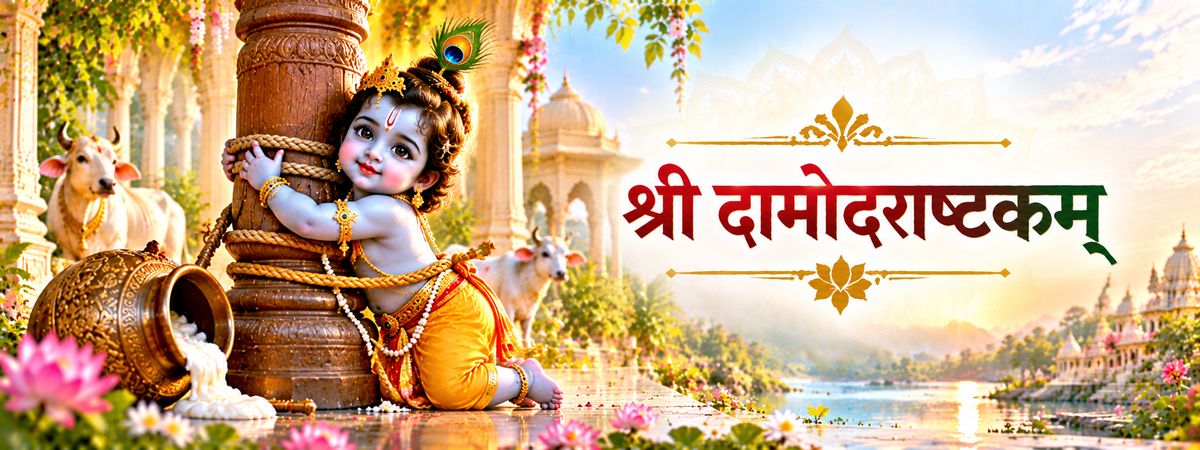
When the child Krishna broke a pot of yoghurt and ran from his mother, Yashoda caught him and tried to tie him to a wooden mortar. Every rope she tried was two fingers too short, until, seeing her effort and love, Krishna let himself be bound. The rope (dama) around his belly (udara) gave him the name Damodar. Kartik, the month of this lila, is also called Damodar maas, and in Vaishnava homes and temples, especially ISKCON, this ashtakam is sung every evening while devotees offer small ghee lamps to an image of Damodar.
What the eight verses say
- 1–2: the scene: earrings swinging, Krishna running from Yashoda, caught from behind; crying, rubbing his frightened eyes with lotus hands, his neck with three lines trembling with sobs, "bound by devotion".
- 3: by such lilas he drowns the people of Gokul in a lake of bliss and shows that he is conquered only by love; "I bow to him again, hundreds of times".
- 4: the heart of the hymn: "O Lord, I do not ask for liberation, nor the highest heaven, nor any other boon; may this form of yours, the cowherd child, always appear in my mind; what use are other things?"
- 5: may your lotus face, framed by dark curls and kissed again and again by the gopi (Yashoda), appear in my heart; a hundred thousand other gains are nothing.
- 6: a plea for mercy for one drowning in an ocean of sorrows.
- 7: as you freed the two sons of Kuber (Nalakuvara and Manigriva, who had been trees) while bound to the mortar, give me loving devotion; "I have no craving for liberation".
- 8: obeisance to the rope, to the belly that holds the universe, to Radhika his beloved, and to the Lord of endless lilas.
How it is sung in Kartik
- Every evening from Sharad Purnima (or Ashwin Purnima) to Kartik Purnima, with a small ghee lamp offered to Damodar in a circle during each verse.
- In 2026 Kartik begins after Sharad Purnima in late October.
- Offering lamps in Kartik is praised in the Puranas; the hymn and the lamp go together.
Frequently asked questions
Why is Krishna called Damodar?
Because Yashoda tied a rope (dama) around his belly (udara) to the mortar after he broke the yoghurt pot.
When is the Damodarashtakam sung?
Every evening of Kartik (Damodar maas), with a ghee lamp offering.
Who composed it?
It is found in the Padma Purana, spoken by Satyavrata Muni in a conversation with Narada and Shaunaka.
Who are the sons of Kuber in verse 7?
Nalakuvara and Manigriva, cursed to become twin arjuna trees; Krishna uprooted them while dragging the mortar and freed them.
Why does the hymn refuse liberation?
To show that pure devotion values the vision of Krishna himself above even moksha, a central idea in Vaishnava bhakti.
Spotted a mistake?
If you find any grammatical, Hindi, English, mantra-text or other mistake on this page, tell us — we will correct it within 24 hours.